Friday, April 03, 2015


Sunday, March 29, 2015
Shekhar Gupta on the Pakistani National Security State
This is a must-read for anyone even remotely interested in Pakistan: We respect all, we suspect all, until proven ok.
It is remarkable how much free speech and criticism even this security establishment allows the mostly western-educated intellectual class. But with one unwritten condition: it must remain confined to English, which is a marginalised discourse here. Follow some of Pakistan's finest, most courageous minds—many of them young women—in the new media. They have enormously more spunk than us in India. But all in English. Urdu is a different matter altogether. English publications' circulation is minuscule compared to Urdu and there isn't even one news channel in English, though they have in Mubashir Luqman someone who can by himself outshout all our English prime-time warriors, including the champion of champions. My friends tell me the story of Raza Rumi, a fine, brave liberal commentator and patriot. He was ignored as long as he confined himself to English. Then one day he succumbed to the temptation of TV, obviously in Urdu, and continued speaking the same honest truth. His car was attacked, his driver died and he escaped with a bullet and is now exiled in Washington. Do Google his writings.
PS: Raza Rumi's writings can be found here.
Monday, March 23, 2015
Friday, March 20, 2015
Rajiv Malhotra: Are Sanskrit Studies in the West becoming a New Orientalism?
An important talk by Rajiv Malhotra, in Hindi, with very few English subtitles.
Sunday, March 15, 2015
Two contrasting views of America - which one is true?
Ross Douthat in today's New York Times writes:
The median and average new house prices in the US from the Census Bureau:
So the average new home price rose from 4.6 times of the lowest quintile's average income to 14.8 times over 1979 to 2012.
The next set of numbers comes from Affording Health Care and Education on the Minimum Wage by John Schmitt and Marie-Eve Augier from the Center of Economic and Policy Research (PDF). It is expressed in terms of the minimum wage, but the point to take away is the dramatic increase in costs.
On health-care:
On higher education:
To be sure, the authors point out that government help has made the cost of higher education less onerous than the above simple arithmetic makes it out to be. And the article was written in 2012, before Obamacare helped or arrested the worsening situation with respect to health-care for many Americans.
The narrative competing with Douthat's is that it was much harder in 2012 for a family to earn enough to cover housing, health-care and higher education than in 1979. And even if monogamy, fidelity, thrift and sobriety were more in 1979 than today, people in 1979 were still in the mind-set of an era of increasing general prosperity. No culture can withstand the great deterioration of economic expectations that occurred over the past 30 years. At some point, fatigue sets in and the faith that things can be better evaporates.
....And yet, for all these disturbances and shifts, lower-income Americans have more money, experience less poverty, and receive far more safety-net support than their grandparents ever did. Over all, material conditions have improved, not worsened, across the period when their communities have come apart.and
Between 1979 and 2010, for instance, the average after-tax income for the poorest quintile of American households rose from $14,800 to $19,200; for the second-poorest quintile, it rose from $29,900 to $39,100.
Meanwhile, per-person antipoverty spending at the state and federal level increased sixfold between 1968 and 2008 — and that’s excluding Medicare, unemployment benefits and Social Security. Despite some conservative skepticism, this spending did reduce the poverty rate (though probably more so after welfare reform). One plausible estimate suggests the rate fell from 26 percent in 1967 to 15 percent in 2012, and child poverty fell as well.
But the basic point is this: In a substantially poorer American past with a much thinner safety net, lower-income Americans found a way to cultivate monogamy, fidelity, sobriety and thrift to an extent that they have not in our richer, higher-spending present.But let us look at what has happened to the basics - housing, health care and education.
The median and average new house prices in the US from the Census Bureau:
http://www.census.gov/const/uspricemon.pdf
Jan 1979 Median: $60,300 Average: $67,700
Jan 2010 Median: $218,200 Average: $283,400
So the average new home price rose from 4.6 times of the lowest quintile's average income to 14.8 times over 1979 to 2012.
The next set of numbers comes from Affording Health Care and Education on the Minimum Wage by John Schmitt and Marie-Eve Augier from the Center of Economic and Policy Research (PDF). It is expressed in terms of the minimum wage, but the point to take away is the dramatic increase in costs.
On health-care:
Health-insurance premiums have also increased enormously when expressed in terms of the minimum wage. In 1979, one year of individual health insurance coverage cost a minimum-wage worker 130 hours. By 2011, the same coverage cost 749 hours. (See Figure 2.)
The cost of family coverage increased from 329 hours in 1979 to 2,079 hours in 2011. These figures imply that after paying for family health insurance coverage, a minimum-wage worker would have just one hour’s worth of wages left over to spend on other goods and services after working 40 hours per week for 52 weeks in a year.
On higher education:
A minimum-wage worker in 1979, making $2.90 per hour, had to work 254 hours in a year to pay the $738 annual cost of tuition at a public four-year college. By 2010, minimum- wage workers at $7.25 per hour had to spend 923 hours to cover the $6,695 annual tuition at a public four-year college. (All our calculations ignore taxes and subsidies. More on that later.) (See Figure 1.)
In 1979, a four-year private college required 1,112 hours of work at the minimum wage. By 2010, the cost in minimum-wage hours had increased so much that it was no longer possible to pay for a full year of a private four- year college–3,201 hours–by working full-year, full- time (2080 hours) at the minimum wage.
Even the minimum-wage hours needed to pay tuition for one year at a two- year college almost tripled between 1979 and 2010, from 156 hours to 403 hours.
To be sure, the authors point out that government help has made the cost of higher education less onerous than the above simple arithmetic makes it out to be. And the article was written in 2012, before Obamacare helped or arrested the worsening situation with respect to health-care for many Americans.
The narrative competing with Douthat's is that it was much harder in 2012 for a family to earn enough to cover housing, health-care and higher education than in 1979. And even if monogamy, fidelity, thrift and sobriety were more in 1979 than today, people in 1979 were still in the mind-set of an era of increasing general prosperity. No culture can withstand the great deterioration of economic expectations that occurred over the past 30 years. At some point, fatigue sets in and the faith that things can be better evaporates.
On Social Mobility
Via an article on pakteahouse.net, this paper:
(only the abstract is available for free):
(only the abstract is available for free):
Abstract
Using educational status in England from 1170 to 2012, we show that the rate of social mobility in any society can be estimated from knowledge of just two facts: the distribution over time of surnames in the society and the distribution of surnames among an elite or underclass. Such surname measures reveal that the typical estimate of parent–child correlations in socioeconomic measures in the range of 0.2–0.6 are misleading about rates of overall social mobility. Measuring education status through Oxbridge attendance suggests a generalized intergenerational correlation in status in the range of 0.70–0.90. Social status is more strongly inherited even than height. This correlation is unchanged over centuries. Social mobility in England in 2012 was little greater than in preindustrial times. Thus there are indications of an underlying social physics surprisingly immune to government intervention.
Friday, March 13, 2015
Sweden, Germany say no arms for Saudi Arabia; will US ever be so principled?
Commentary here.
Excerpt:
Excerpt:
Swedish politicians have done a lot of nail-biting over the contract. The cancellation has been under discussion for months, with various interest groups, from feminists to environmentalists, putting pressure on the government.
Prime Minister Stefan Loefven has denied it, but the last straw apparently came on Monday, when Saudi Arabia blocked Swedish Foreign Minister Margot Wallstrom from speaking to the Arab League in Cairo.
Wallstrom had been invited because Sweden was the first EU country to recognize the Palestinian state, but because she had previously called Saudi Arabia a dictatorship, the kingdom’s representatives apparently feared she might further embarrass their county before other Arab leaders. It was only after Wollstrom’s invitation was rescinded that Loefven confirmed the Saudi deal was finally off.
Strictly speaking, military cooperation with the Saudi regime should have been a nonstarter for European Union countries since 2008, when they approved their Common Position on arms exports. The document makes “respect for human rights in the country of final destination” a precondition of defense cooperation. A country that uses Shariah law, as Saudi Arabia does, can hardly be a paragon of respect for human rights in the Western sense of this expression.
For a time, however, another paragraph in the Common Position has outweighed that consideration: “Behavior of the buyer country with regard to the international community, in particular its attitude to terrorism, the nature of its alliances and its respect for international law.”
The Saudis have managed to convince the West that they are a reliable ally against terrorist organizations. U.S. policy in the Middle East has been in large part based on its partnership with the Saudis. European voters, however, have long been irritated with what they perceive as the consequences of U.S. activity in the volatile region, including the increased flow of refugees from Syria and Iraq.
They find it hard to understand why their governments should support an oppressive and fundamentalist regime just because it is a U.S. ally. Politicians have to take the popular mood into account, so the tide began to turn against arms exports to Saudi Arabia.
Sooner or later, the United Kingdom, whose defense industry counts Saudi Arabia as its biggest foreign customer, will also need to confront the fact that it’s arming a blatantly undemocratic country in contradiction to EU commitments. It may decide in favor of holding on to its market share and its special relationship with the U.S., but that will inevitably weaken the U.K.’s diplomatic position in matters involving human rights. Germany, as Europe’s new leader, is at least trying to be more consistent in putting principles over cash.
Sunday, March 08, 2015
India's New Forest Conservation Plan
See here.
India just did something big for the climate: it announced that it will allocate $6 billion a year in tax revenue in a way that will encourage forest conservation. That’s more results-based finance for forest conservation than any other country in the world, including the current biggest spender Norway.We are also directed to this interaction with Dr Arvind Subramanian, Chief Economic Adviser, Ministry of Finance, Government of India" for more details:
Here’s how it will work: every year India’s central government collects about $200 billion in taxes. From that sum it then passes along about $60 billion to the 29 state governments. Following recommendations by India’s 14th Finance Commission, Parliament this past week accepted a watershed reform that not only increases the size of transfers to states from $60 billion to $80 billion, but also changes how this tax revenue is distributed between states.
The reform changes the “horizontal devolution” formula so that the pie will now – for the first time – be shared between states not just on the basis of population, area, and income, but also forest cover.
A pile of bunk
In his recent NYT column, Ross Douthat refers to this conversation on edge.org between Daniel Kahneman and Yuval Noah Harari. Kahneman is a Nobel Laureatte, and Harari is a historian who has won attention for successfully pushing his greatly oversimplified view of reality.
The best you can say about this conversation is that Harari is talking about many decades from now; and there's little original there - the masters of science fiction have long covered all these scenarios.
Let's take a few:
And the handful of people trickling in from Europe and America to join ISIS would not cause such consternation and alarm, if humans were so not-valuable for military purposes.
If any ultra-rich person thinks that the world is like the Star Trek universe, where the Captain asks how long will it take to solve this never-before encountered complex engineering or scientific problem, and the crew says "5 hours", and the Captain says, "make it 4, make it so", and it all happens, please send that ultra-rich person my way, so I may join the ranks of the ultra-rich in short order.
The best you can say about this conversation is that Harari is talking about many decades from now; and there's little original there - the masters of science fiction have long covered all these scenarios.
Let's take a few:
Nobody has a clue how the world will look like in, say, 40, 50 years.There is nothing new or profound about that. Consider the changes over the lifetime of a person who lived 1900-1980.
But in the 21st century, there is a good chance that most humans will lose, they are losing, their military and economic value. This is true for the military, it's done, it's over.This might be true in the future; but if it was true today, the USwould have ended the civil war in Syria, and failing that, it would certainly wipe out in zero time the excrescence that is ISIS/Daish. But military operations still require putting people in harm's way; remote air power is insufficient to defeat ISIS; it needs "boots on the ground".
And the handful of people trickling in from Europe and America to join ISIS would not cause such consternation and alarm, if humans were so not-valuable for military purposes.
People never die because the Angel of Death comes, they die because their heart stops pumping, or because an artery is clogged, or because cancerous cells are spreading in the liver or somewhere. These are all technical problems, and in essence, they should have some technical solution. And this way of thinking is now becoming very dominant in scientific circles, and also among the ultra-rich who have come to understand that, wait a minute, something is happening here. For the first time in history, if I'm rich enough, maybe I don't have to die.The attitude may be there (Steve Jobs might be an exception?) but this way of thinking is delusional. Not that there is an Angel of Death, but in thinking that "having some technical solution" means being able to achieve such a solution. The problem of reconciling quantum mechanics and the General Theory of Relativity is a technical problem, and in essence, it should have a technical solution. Good luck with that! And how far have we gotten with curing cancer? Or understanding the cause of autism? All these are "technical problems". Finding efficient computation for NP-complete problems is a "technical problem" with a "technical solution".
If any ultra-rich person thinks that the world is like the Star Trek universe, where the Captain asks how long will it take to solve this never-before encountered complex engineering or scientific problem, and the crew says "5 hours", and the Captain says, "make it 4, make it so", and it all happens, please send that ultra-rich person my way, so I may join the ranks of the ultra-rich in short order.
Saturday, March 07, 2015
The tax paradise that is Saudi Arabia
There are no income taxes, sales taxes, value-added taxes in Saudi Arabia. Corporate taxes and capital gains taxes seem to be a flat 20% except maybe for oil & gas business. This is possible because the Saudi state gets all its revenue from the oil business.
Libertarians should be asked to explain why Saudi Arabia is not the economic leader of the world.
Libertarians should be asked to explain why Saudi Arabia is not the economic leader of the world.
Monday, March 02, 2015
Drawing the boundaries of constituencies
In the US, it would seem that a Constitutional Amendment will be required to give the authority to draw the lines of constituencies to a body directly elected by the people, responsible to the legislature but not the legislature. Legislatures are famous for gerrymandering, i.e., drawing constituency boundaries to favor the majority party.
Thursday, February 12, 2015
Aam Aadmi Party's win in Delhi
The Bharatiya Janata Party (BJP - translates to Indian People's Party) led by Narendra Modi won convincingly in the national parliamentary elections because Modi had a credible message of good governance and economic development. This despite the "Hindu nationalism" charge constantly thrown against the BJP. As M.J. Akbar narrated, Modi told people that they could have Hindu-Muslim fights and remain poor, or they could work together and prosper.
Now Arvind Kejriwal and his Aam Aadmi Party (Ordinary People's Party) have swept the state elections in New Delhi. This despite Kejriwal's various previous missteps. The promise again was of corruption-free governance, and of government attention to the needs of ordinary people.
While the punditosphere is full of analysis of what all this means for the BJP, the Aam Aadmi Party, for the Congress Party (which is now virtually wiped out), to me it seems that the Indian electorate has moved away from identity politics - voting for one's religious group or caste. Perhaps not yet decisively, they may relapse a bit, in the two-steps forward, one-step backwards dance that is the nature of progress in real life. Performance and ideas matter a little bit more than identity now.
It is very fortunate that Communism is a spent force now, just when the Indian electorate, more open to ideas, might have become enamored with it. Per the Marxist commentaries that I read, the Communists found that caste-solidarity overcame all their attempts to initiate a class struggle in India, and they were rethinking how to use caste struggles to bring about the glorious Communist Revolution.
I wish well both the parties, ruling Delhi and ruling India from Delhi. Each has in its grasp a not-easy-to-repeat historic opportunity to transform India in a very good way. All the indicators are positive; if they squander their opportunities, it will be a tragedy of global proportions.
Now Arvind Kejriwal and his Aam Aadmi Party (Ordinary People's Party) have swept the state elections in New Delhi. This despite Kejriwal's various previous missteps. The promise again was of corruption-free governance, and of government attention to the needs of ordinary people.
While the punditosphere is full of analysis of what all this means for the BJP, the Aam Aadmi Party, for the Congress Party (which is now virtually wiped out), to me it seems that the Indian electorate has moved away from identity politics - voting for one's religious group or caste. Perhaps not yet decisively, they may relapse a bit, in the two-steps forward, one-step backwards dance that is the nature of progress in real life. Performance and ideas matter a little bit more than identity now.
It is very fortunate that Communism is a spent force now, just when the Indian electorate, more open to ideas, might have become enamored with it. Per the Marxist commentaries that I read, the Communists found that caste-solidarity overcame all their attempts to initiate a class struggle in India, and they were rethinking how to use caste struggles to bring about the glorious Communist Revolution.
I wish well both the parties, ruling Delhi and ruling India from Delhi. Each has in its grasp a not-easy-to-repeat historic opportunity to transform India in a very good way. All the indicators are positive; if they squander their opportunities, it will be a tragedy of global proportions.
Saturday, February 07, 2015
The Cure to Racism?
Over on the Partition of India blog, is posted an excerpt from a paper by Venkat Dhulipala, which describes Maulana Shabbir Ahmad Usmani's Quranic/historic justification for Pakistan, that was influential in the founding of Pakistan.
One thing bothered me:
It is as though, since we all have different faces, any "narrow identity" based on the face can be dissolved by requiring everyone to keep their face covered with a strip of black cloth. (Even so, some will try to decorate the black cloth.)
This equal brotherhood idea is not a way of living with being different. It is closer to "if you are different, you don't live". It as though religious edict can negate reality.
This project has resulted in the colossal failure that is Pakistan.
One thing bothered me:
Usmani outlined Pakistan's significance to Islam in the modern world by declaring that Pakistan was the first step in the process of self purification of Muslims, purging them of all their earlier narrow identities based on race, class, sect, language and region and creating an equal brotherhood of Islam as had been the case in Medina.The problem with this equal brotherhood is that it deals with differences by trying to eradicate them. Eliminate differences in language by forcing everyone to one language. Eliminate differences in tradition by eliminating all pre-Islamic literature and art. Eliminate differences in dress by getting everyone into one costume.
It is as though, since we all have different faces, any "narrow identity" based on the face can be dissolved by requiring everyone to keep their face covered with a strip of black cloth. (Even so, some will try to decorate the black cloth.)
This equal brotherhood idea is not a way of living with being different. It is closer to "if you are different, you don't live". It as though religious edict can negate reality.
This project has resulted in the colossal failure that is Pakistan.
Tuesday, January 20, 2015
Do Not Multi-Task!
http://www.theguardian.com/science/2015/jan/18/modern-world-bad-for-brain-daniel-j-levitin-organized-mind-information-overload
Russ Poldrack, a neuroscientist at Stanford, found that learning information while multitasking causes the new information to go to the wrong part of the brain. If students study and watch TV at the same time, for example, the information from their schoolwork goes into the striatum, a region specialised for storing new procedures and skills, not facts and ideas. Without the distraction of TV, the information goes into the hippocampus, where it is organised and categorised in a variety of ways, making it easier to retrieve.
Friday, January 16, 2015
Prime Minister Modi's answer to the question - Why do we need the state?
At the star-studded (Krugman, Bhagwati, Taleb included) Economics Time Business Summit, Prime Minister Narendra Modi provided an answer to American Libertarians and Republicans.
Read more at:
http://economictimes.indiatimes.com/articleshow/45914598.cms
PS: more excerpts from Modi's speech here.
Why do we need the state? There are five main components:
.. The first is public goods such as defence, police and judiciary.
.. The second is externalities which hurt others, such as pollution. For this, we need a regulatory system.
.. The third is market power, where monopolies need controls.
.. The fourth is information gaps, where you need someone to ensure that medicines are genuine and so on.
.. Last, we need a well-designed welfare and subsidy mechanism to ensure that the bottom of society is protected from deprivation. This especially includes education and health care.
These are five places where we need government.
Read more at:
http://economictimes.indiatimes.com/articleshow/45914598.cms
PS: more excerpts from Modi's speech here.
Sunday, January 11, 2015
Thursday, January 08, 2015

Sunday, January 04, 2015
On the failure to engage with one's own traditions
Pakistan has a law punishing blasphemy that is quite horrible in practice. Pakistan's tiny "liberal" elite, which is rather disdainful of their traditional systems (as is the Indian "liberal" elite) finds it impossible to change the operation of the law (e.g., do a full investigation instead of arrest first, investigate later), let alone amend it. The Governor of Punjab, Salman Taseer, was gunned down four years ago by his own bodyguard, Mumtaz Qadri, for committing the blasphemy of criticizing the blasphemy law. Sherry Rehman got into trouble for proposing legislation about the blasphemy law.
It seems that the political configuration in Pakistan doesn't want to hear about freedom of speech, secularism, etc., etc., it prefers its blasphemy law.
But it seems that the blasphemy law, as it stands, is not in accord with Islamic tradition. This article by Arafat Mazhar goes into it in some detail, but briefly, Pakistan follows the Hanafi school of Islamic law; and while the Hanafi law makes blasphemy an offense, it makes it a pardonable offense; it certainly does not carry the mandatory death sentence that the Pakistani law has. Why does the Pakistani law carry a death sentence? I think it is because few of the people in charge have seriously engaged with their own tradition.
If the Pakistani liberals want a state that has laws that look like a modern secular European state, they are going to fail; if they want a state that has justice, regardless of what the laws look like, and that has the support of the generally Islamized population, they are going to have to engage seriously with their traditions.
PS: Part 2 of Arafat Mazhar's article.
There is a similar problem in India; a lot of the intellectuals at the top do not engage seriously with the Indian traditions. Most of the Indic traditions are a embarrassment to them; and they basically engage in exercises of trying to wean people off of them. Michel Danino points out this failure in an article in the Hindu.
It seems that the political configuration in Pakistan doesn't want to hear about freedom of speech, secularism, etc., etc., it prefers its blasphemy law.
But it seems that the blasphemy law, as it stands, is not in accord with Islamic tradition. This article by Arafat Mazhar goes into it in some detail, but briefly, Pakistan follows the Hanafi school of Islamic law; and while the Hanafi law makes blasphemy an offense, it makes it a pardonable offense; it certainly does not carry the mandatory death sentence that the Pakistani law has. Why does the Pakistani law carry a death sentence? I think it is because few of the people in charge have seriously engaged with their own tradition.
If the Pakistani liberals want a state that has laws that look like a modern secular European state, they are going to fail; if they want a state that has justice, regardless of what the laws look like, and that has the support of the generally Islamized population, they are going to have to engage seriously with their traditions.
PS: Part 2 of Arafat Mazhar's article.
There is a similar problem in India; a lot of the intellectuals at the top do not engage seriously with the Indian traditions. Most of the Indic traditions are a embarrassment to them; and they basically engage in exercises of trying to wean people off of them. Michel Danino points out this failure in an article in the Hindu.
Friday, January 02, 2015
Language and Genetics in the British Isles
The British Isles might be a good case to examine for the relationship between population genetics and languages. In that context, I found this article in the popular press: Myths of British Ancestry, by Stephen Oppenheimer, Prospect Magazine, October 21, 2006. No doubt science has advanced some more in the past eight years, but this might be a good starting point.
Notice that the Celtic languages are Indo-European and per this author they spread with agriculture, not with the horse. (Supposedly horses were being domesticated in the Eurasian steppes 6000-5500 years ago.)
Notice that the Celtic languages are Indo-European and per this author they spread with agriculture, not with the horse. (Supposedly horses were being domesticated in the Eurasian steppes 6000-5500 years ago.)
Given the distribution of Celtic languages in southwest Europe, it is most likely that they were spread by a wave of agriculturalists who dispersed 7,000 years ago from Anatolia....Moreover, the conventional invasion & genocide theories are deprecated.
The other myth I was taught at school, one which persists to this day, is that the English are almost all descended from 5th-century invaders, the Angles, Saxons and Jutes, from the Danish peninsula, who wiped out the indigenous Celtic population of England......
The genocidal view was generated, like the Celtic myth, by historians and archaeologists over the last 200 years. With the swing in academic fashion against “migrationism” (seeing the spread of cultural influence as dependent on significant migrations) over the past couple of decades, archaeologists are now downplaying this story, although it remains a strong underlying perspective in history books.
Tuesday, December 30, 2014
Whither Pakistan? Tarek Fateh with Dr Baland Iqbal
Sorry, Urdu/Hindi speakers only. Tarek Fateh dissects and examines under the microscope the Pakistani mindset. He sees as the only solution the dissolution of Pakistan into its four provinces.
Update: for the Hindi/Urdu challenged, my rough notes below the fold.
Update: for the Hindi/Urdu challenged, my rough notes below the fold.
Monday, December 29, 2014
Indo-European Invasions into Europe
http://www.theguardian.com/science/2014/sep/18/ancient-ancestors-europeans-dna-study
The findings suggest that the arrival of modern humans into Europe more than 40,000 years ago was followed by an influx of farmers some 8,000 years ago, with a third wave of migrants coming from north Eurasia perhaps 5,000 years ago. Others from the same population of north Eurasians took off towards the Americas and gave rise to Native Americans.Genetically speaking, there seems to be no trace of any genetically significant movement of Indo-European people into Europe either (unless it is the farmers, but linguists think that 8000 years ago is too far back. The last population-genetically significant influx of people into India was 12,000 years ago or earlier.) On the other hand, the vocabulary of a language like Greek is estimated to be more than 30% non-Indo-European (e.g., compared to less than 4% of the 10,000 word vocabulary of the Rg Veda), so a elite dominance language replacement theory might work for Greece, where it can't work for the language of the Rg Veda. The only way it might work is if an Indo-European language was superposed on a previous Indo-European language.
Saturday, December 27, 2014
Wednesday, December 17, 2014
Bee on the Scientific Method
Bee (Sabine Hossenfelder) has an essay worth your time: Does the Scientific Method need Revision?
IBM's predictions from December 2009
IBM's predictions for today from five years ago:
ARMONK, N.Y. - 17 Dec 2009: Today, IBM (NYSE: IBM) unveiled a list of innovations that have the potential to change how people live, work and play in cities around the globe over the next five to ten years:
· Cities will have healthier immune systems
· City buildings will sense and respond like living organisms
· Cars and city buses will run on empty
· Smarter systems will quench cities’ thirst for water and save energy
· Cities will respond to a crisis -- even before receiving an emergency phone call
Lessons from a school shooting
Both houses of the Indian Parliament observed a moment of silence and passed resolutions condemning the killing of school children in Peshawar, Pakistan.
Beyond the natural empathy one feels at the cruel loss of young lives, there are some sharp lessons to be learned.
Beyond the natural empathy one feels at the cruel loss of young lives, there are some sharp lessons to be learned.
Monday, December 15, 2014
The Invasion That Never Was
Anand Rangarajan, here:
But it was the publication in 2011 of a path-breaking study that ultimately sealed the fate of the Aryan Invasion or Migration theory. Analysing 600,000 SNPs from as many as 30 ethnic groups – thereby extending the 2009 Nature ANI study through the inclusion of more European samples – Toomas Kivisild and co-workers discovered that both components of Indian ancestry, ANI and ASI, predate the Aryan Migration event by at least 9000 years. This was because the so-called k5 component, that bestows ancestry to South Asians, was found to contain no regional diversity differences; its spread across the Indian subcontinent must have happened well before 12,500 years ago (the detection limit) and not through a recent gene-flow event.
In 2013 Singh and co-workers extended the Kivisild study with some acute observations, namely that the ANI and ASI populations mixed robustly between 1900 to 4200 years ago and that these two groups didn’t mix either before or after this window. The authors, by analysing genomes of 571 individuals representing 73 ethno-linguistic groups, also ruled out Eurasian gene flow during this time period, concurring with the finding of another study that such an event could not have happened before 12,500 years. Moreover, argued the scientists, 3500 years ago India was a already a densely populated region with well-established agricultural practices and therefore the Eurasian migration would have had to be immense in order to explain the fact that half the Indian population is derived from ANI.
The Aryan Migration event of 1500 BCE has also been questioned based on an authoritative haplogroup U linkage study wherein scientists found an extensive and deep late-Pleistocene link between Indians and Europeans, suggesting a coalescence near the time when Asia was initially being peopled. The migration that led to the Indo-Eurasian stock, according to these scientists, happened not 3,500 years ago but rather 12,500 years or earlier.
Another study, this time involving Y-DNA haplotyping, rules out substantial gene-flow from Europe to Asia at least since the mid-Holocene period, i.e. the last 6,500 years. It has also been shown that the gateway to the subcontinent, the Hindu Kush – where the earliest archaeological evidence of human remains dates back to 26,500 years before the Rig Veda – was a confluence of gene-flows in the early Neolithic period as opposed to an indigenous population.
There is one other way to corroborate that Eurasian migration happened much before the time-point vouched for by AMT proponents – skin colour. It has long been known that a single mutation, rs1426654, in the human pigmentation gene SLC24A5 accounts for the lighter skin tone of Europeans. A year ago, scientists discovered that an allele of the rs1426654 mutation was shared among many South Asian and Western Eurasian populations. The coalescence was calculated to be 22000-28000 years ago, with the frequency of occurrence of this mutation – called the allele frequency – found to be significantly higher in the ANI compared to the ASI.
The verdict of population genetics is clear, and profound, as pointed out subsequently by the lead author of the Nature study Dr Lalji Singh himself: “There is no genetic evidence that Indo-Aryans invaded or migrated to India. It is high time we re-write India’s prehistory based on scientific evidence.”
Tuesday, December 09, 2014
Sunday, December 07, 2014
Fear
The transcript of the proceedings of the grand jury that examined the death of Michael Brown at the hands of police officer Darren Wilson, on August 9, on the streets of Ferguson, MO, is interesting on many counts.
Here is one excerpt that caught my eye.
Here is one excerpt that caught my eye.
Friday, December 05, 2014
Another Aatish Taseer Essay
Must-read: A Historical Sense: What Sanskrit has meant to me
http://www.openthemagazine.com/article/art-culture/a-historical-sense
Excerpt beneath the fold.
http://www.openthemagazine.com/article/art-culture/a-historical-sense
Excerpt beneath the fold.
A telling Twitter exchange
FYI:
On twitter, I followed Sonia Faleiro, who is an author, and writes commentary on India for the New York Times and such.
I was blocked after this exchange:
Sonia Faleiro:
"Lakhs of years ago Sage Kanad conducted a nuclear test" says BJP MP determined to take India back lakhs of years: http://www.hindustantimes.com/india-news/ancient-india-conducted-nuke-tests-claims-former-uttarakhand-chief-minister-ramesh-pokhriyal-nishank/article1-1293029.aspx
Me:
@soniafaleiro LOL, back to the Sat-Yuga, I suppose!
@soniafaleiro Tho ancients having technology lost till modern times is a bit more rational than parting of Red Sea or man rising from dead
I wouldn't have mentioned it except that I noticed this morning that this "liberal" has blocked me.
That is, if the BJP MP said that "lakhs of years ago Sage Kanad conducted a nuclear test" is how he reads and interprets his "religious scriptures", and so is a part of his "religious belief", it is still irrational and inadmissible and wrong; but God's parting of the Red Sea for Moses or the resurrection of Jesus, that is a legitimate matter of Christian belief and my saying it is less rational than the (non-supernatural) idea that the ancients had technology that was lost and that we again have only in modern times is bad manners.
On twitter, I followed Sonia Faleiro, who is an author, and writes commentary on India for the New York Times and such.
I was blocked after this exchange:
Sonia Faleiro:
"Lakhs of years ago Sage Kanad conducted a nuclear test" says BJP MP determined to take India back lakhs of years: http://www.hindustantimes.com/india-news/ancient-india-conducted-nuke-tests-claims-former-uttarakhand-chief-minister-ramesh-pokhriyal-nishank/article1-1293029.aspx
Me:
@soniafaleiro LOL, back to the Sat-Yuga, I suppose!
@soniafaleiro Tho ancients having technology lost till modern times is a bit more rational than parting of Red Sea or man rising from dead
I wouldn't have mentioned it except that I noticed this morning that this "liberal" has blocked me.
That is, if the BJP MP said that "lakhs of years ago Sage Kanad conducted a nuclear test" is how he reads and interprets his "religious scriptures", and so is a part of his "religious belief", it is still irrational and inadmissible and wrong; but God's parting of the Red Sea for Moses or the resurrection of Jesus, that is a legitimate matter of Christian belief and my saying it is less rational than the (non-supernatural) idea that the ancients had technology that was lost and that we again have only in modern times is bad manners.
Wednesday, November 19, 2014
Sunday, November 09, 2014

Saturday, November 08, 2014
Old Article on Old India
Quote:
Thursday November 16 2006 09:31 IST
S Gurumurthy
"What is it that keeps the country down", asked the speaker. A young man in the audience replied unhesitatingly: "Undoubtedly the institution of caste that kept the majority low castes and the society backward" and added "it continues".
The speaker replied, "May be". But, pausing for a moment, he added, "May not be". Shocked, the young man angrily asked him to explain his "may-not-be" theory.
The speaker calmly mentioned just one fact that clinched the debate. He said, "Before the British rule in India, over two-thirds - yes, two-thirds - of the Indian kings belonged to what is today known as the Other Backward Castes (OBCs).
"It is the British," he said, "who robbed the OBCs - the ruling class running all socio-economic institutions - of their power, wealth and status." So it was not the upper caste which usurped the OBCs of their due position in the society?
The speaker’s assertion that it was not so was founded on his study - unbelievably painstaking study for years and decades in the archives in India, England and Germany. He could not be maligned as a ‘saffron’ ideologue and what he said could not be dismissed thus. He was Dharampal, a Gandhian in ceaseless search of truth like his preceptor Gandhi himself was, but a Gandhian with a difference. He ran no ashram on state aid to do ‘Gandhigiri’.
Admitting that "he and those like him do not know much about our own society", the young man who questioned Dharampal - Banwari is his name - became his student. By meticulous research of the British sources over decades, Dharampal demolished the myth that India was backward educationally or economically when the British entered. Citing the Christian missionary William Adam’s report on indigenous education in Bengal and Bihar in 1835 and 1838, Dharampal established that at that time there were 100,000 schools in Bengal, one school for about 500 boys; that the indigenous medical system that included inoculation against small-pox.
He also proved by reference to other materials that Adam’s record was ‘no legend’. He relied on Sir Thomas Munroe’s report to the Governor at about the same time to prove similar statistics about schools in Madras. He also found that the education system in the Punjab during the Maharaja Ranjit Singh’s rule was equally extensive. He estimated that the literacy rate in India before the British was higher than that in England.
Citing British public records he established, on the contrary, that ‘British had no tradition of education or scholarship or philosophy from 16th to early 18th century, despite Shakespeare, Bacon, Milton, Newton, etc’. Till then education and scholarship in the UK was limited to select elite. He cited Alexander Walker’s Note on Indian education to assert that it was the monitorial system of education borrowed from India that helped Britain to improve, in later years, school attendance which was just 40, 000, yes just that, in 1792. He then compared the educated people’s levels in India and England around 1800. The population of Madras Presidency then was 125 lakhs and that of England in 1811 was 95 lakhs. Dharampal found that during 1822-25 the number of those in ordinary schools in Madras Presidency was around 1.5 lakhs and this was after great decay under a century of British intervention.
As against this, the number attending schools in England was half - yes just half - of Madras Presidency’s, namely a mere 75,000. And here to with more than half of it attending only Sunday schools for 2-3 hours! Dharampal also established that in Britain ‘elementary system of education at people’s level remained unknown commodity’ till about 1800! Again he exploded the popularly held belief that most of those attending schools must have belonged to the upper castes particularly Brahmins and, again with reference to the British records, proved that the truth was the other way round.
During 1822-25 the share of the Brahmin students in the indigenous schools in Tamil-speaking areas accounted for 13 per cent in South Arcot to some 23 per cent in Madras while the backward castes accounted for 70 per cent in Salem and Tirunelveli and 84 per cent in South Arcot.
The situation was almost similar in Malayalam, Oriya and Kannada-speaking areas, with the backward castes dominating the schools in absolute numbers. Only in the Telugu-speaking areas the share of the Brahmins was higher and varied from 24 to 46 per cent. Dharampal’s work proved Mahatma Gandhi’s statement at Chatham House in London on October 20, 1931 that "India today is more illiterate than it was fifty or hundred years ago" completely right.
Not many know of Dharampal or of his work because they have still not heard of the Indian past he had discovered. After, long after, Dharampal had established that pre-British India was not backward a Harvard University Research in the year 2005 (India’s Deindustrialisation in the 18th and 19th Centuries by David Clingingsmith and Jeffrey G Williamson) among others affirmed that "while India produced about 25 percent of world industrial output in 1750, this figure had fallen to only 2 percent by 1900." The Harvard University Economic Research also established that the Industrial employment in India also declined from about 30 to 8.5 per cent between 1809-13 and 1900, thus turning the Indian society backward.
PS: This great warrior who established the truth - the truth that was least known - that India was not backward when the British came, but became backward only after they came, is no more. He passed away two weeks ago on October 26, 2006, at Sevagram at Warda.
Thursday November 16 2006 09:31 IST
S Gurumurthy
"What is it that keeps the country down", asked the speaker. A young man in the audience replied unhesitatingly: "Undoubtedly the institution of caste that kept the majority low castes and the society backward" and added "it continues".
The speaker replied, "May be". But, pausing for a moment, he added, "May not be". Shocked, the young man angrily asked him to explain his "may-not-be" theory.
The speaker calmly mentioned just one fact that clinched the debate. He said, "Before the British rule in India, over two-thirds - yes, two-thirds - of the Indian kings belonged to what is today known as the Other Backward Castes (OBCs).
"It is the British," he said, "who robbed the OBCs - the ruling class running all socio-economic institutions - of their power, wealth and status." So it was not the upper caste which usurped the OBCs of their due position in the society?
The speaker’s assertion that it was not so was founded on his study - unbelievably painstaking study for years and decades in the archives in India, England and Germany. He could not be maligned as a ‘saffron’ ideologue and what he said could not be dismissed thus. He was Dharampal, a Gandhian in ceaseless search of truth like his preceptor Gandhi himself was, but a Gandhian with a difference. He ran no ashram on state aid to do ‘Gandhigiri’.
Admitting that "he and those like him do not know much about our own society", the young man who questioned Dharampal - Banwari is his name - became his student. By meticulous research of the British sources over decades, Dharampal demolished the myth that India was backward educationally or economically when the British entered. Citing the Christian missionary William Adam’s report on indigenous education in Bengal and Bihar in 1835 and 1838, Dharampal established that at that time there were 100,000 schools in Bengal, one school for about 500 boys; that the indigenous medical system that included inoculation against small-pox.
He also proved by reference to other materials that Adam’s record was ‘no legend’. He relied on Sir Thomas Munroe’s report to the Governor at about the same time to prove similar statistics about schools in Madras. He also found that the education system in the Punjab during the Maharaja Ranjit Singh’s rule was equally extensive. He estimated that the literacy rate in India before the British was higher than that in England.
Citing British public records he established, on the contrary, that ‘British had no tradition of education or scholarship or philosophy from 16th to early 18th century, despite Shakespeare, Bacon, Milton, Newton, etc’. Till then education and scholarship in the UK was limited to select elite. He cited Alexander Walker’s Note on Indian education to assert that it was the monitorial system of education borrowed from India that helped Britain to improve, in later years, school attendance which was just 40, 000, yes just that, in 1792. He then compared the educated people’s levels in India and England around 1800. The population of Madras Presidency then was 125 lakhs and that of England in 1811 was 95 lakhs. Dharampal found that during 1822-25 the number of those in ordinary schools in Madras Presidency was around 1.5 lakhs and this was after great decay under a century of British intervention.
As against this, the number attending schools in England was half - yes just half - of Madras Presidency’s, namely a mere 75,000. And here to with more than half of it attending only Sunday schools for 2-3 hours! Dharampal also established that in Britain ‘elementary system of education at people’s level remained unknown commodity’ till about 1800! Again he exploded the popularly held belief that most of those attending schools must have belonged to the upper castes particularly Brahmins and, again with reference to the British records, proved that the truth was the other way round.
During 1822-25 the share of the Brahmin students in the indigenous schools in Tamil-speaking areas accounted for 13 per cent in South Arcot to some 23 per cent in Madras while the backward castes accounted for 70 per cent in Salem and Tirunelveli and 84 per cent in South Arcot.
The situation was almost similar in Malayalam, Oriya and Kannada-speaking areas, with the backward castes dominating the schools in absolute numbers. Only in the Telugu-speaking areas the share of the Brahmins was higher and varied from 24 to 46 per cent. Dharampal’s work proved Mahatma Gandhi’s statement at Chatham House in London on October 20, 1931 that "India today is more illiterate than it was fifty or hundred years ago" completely right.
Not many know of Dharampal or of his work because they have still not heard of the Indian past he had discovered. After, long after, Dharampal had established that pre-British India was not backward a Harvard University Research in the year 2005 (India’s Deindustrialisation in the 18th and 19th Centuries by David Clingingsmith and Jeffrey G Williamson) among others affirmed that "while India produced about 25 percent of world industrial output in 1750, this figure had fallen to only 2 percent by 1900." The Harvard University Economic Research also established that the Industrial employment in India also declined from about 30 to 8.5 per cent between 1809-13 and 1900, thus turning the Indian society backward.
PS: This great warrior who established the truth - the truth that was least known - that India was not backward when the British came, but became backward only after they came, is no more. He passed away two weeks ago on October 26, 2006, at Sevagram at Warda.
Sunday, November 02, 2014
QOTD
Ajit Doval : Strategy without tactics is the noise before the defeat. Tactics without strategy is the shortest way of committing suicide.
The Post-Alcoholic Culture?
An excerpt from a transcript of Krista Tippett's radio show, "On Being":
Ms. Tippett: ......... Isn't it strange how, in Western culture in a field like psychotherapy or even I see this a lot in religion, in Western culture we turn these things into these chin-up experiences. We separated ourselves, we divided ourselves. I see this — I mean, yoga is everywhere now, right? And people are discovering all kinds of ways, as you say. There are all kinds of other ways to reunite ourselves, but …
Dr. van der Kolk: But it's true. Western culture is astoundingly disembodied and uniquely so. Because of my work, I've been to South Africa quite a few times and China and Japan and India. You see that we are much more disembodied. And the way I like to say is that we basically come from a post-alcoholic culture. People whose origins are in Northern Europe had only one way of treating distress: that's namely with a bottle of alcohol.
North American culture continues to continue that notion. If you feel bad, just take a swig or take a pill. And the notion that you can do things to change the harmony inside of yourself is just not something that we teach in schools and in our culture, in our churches, in our religious practices. And, of course, if you look at religions around the world, they always start with dancing, moving, singing …
Ms. Tippett: Yeah. Crying, laughing, yeah.
Dr. van der Kolk: Physical experiences. And then the more respectable people become, the more stiff they become somehow.
February 7, 2021 - the link above no longer works. the program was likely was likely this.
https://www.wnyc.org/story/unedited-bessel-van-der-kolk-with-krista-tippett/
Tuesday, October 28, 2014
C.C. Fair gives a Track II Indian a lesson
Track II is this diplomacy some idiots from India are carrying out with Pakistan, not understanding the fundamental nature of Pakistan. Prof. C. Christine Fair gives one such idiot a 101 lesson.
This link will start the Youtube video at the right point:
http://youtu.be/VrxDtncXZZg?t=45m22s
(Can't embed the video and start at a given point, it would seem.)
Saturday, October 25, 2014
A curious inversion
In the Bill Maher - Ben Affleck kerfuffle the other day, Affleck voiced a conventional opinion. e.g.,
In this view, there are a small percentage of crazies, who give the rest of the community a bad name. I found a contrary view in a somewhat unusual place, below the fold.
Affleck said that a minority of radical Islamists shouldn’t give a bad name to the overwhelming majority of Muslims who do not share the same extreme views.
In this view, there are a small percentage of crazies, who give the rest of the community a bad name. I found a contrary view in a somewhat unusual place, below the fold.
Friday, October 24, 2014
Wednesday, October 22, 2014
Life as a dhimmi - 14
(via Agnimitra on BRF).
Sheikh Ahmad Sirhindi, per Wiki, 1564-1624, "has been described as the Mujaddid Alf Thānī, meaning the "reviver of the second millennium", for his work in rejuvenating Islam and opposing the heterodoxies prevalent in the time of Mughal Emperor Akbar." He stands prominently in the lineage of the Naqshbandi Sufi order. The writing below explodes the idea that Sufis are "moderate".

Sheikh Ahmad Sirhindi, per Wiki, 1564-1624, "has been described as the Mujaddid Alf Thānī, meaning the "reviver of the second millennium", for his work in rejuvenating Islam and opposing the heterodoxies prevalent in the time of Mughal Emperor Akbar." He stands prominently in the lineage of the Naqshbandi Sufi order. The writing below explodes the idea that Sufis are "moderate".
PS: if you're puzzled how Sirhindi jumps from Hindus to Jews, it is an artifact of the compiler of this, Andrew Bostom; Sirhindi has a letter on the killing of Jews. It is strange only because Sirhindi likely never met a Jew.
PPS: The "accursed kafir of Gobindwal" I think is Guru Arjan the fifth Sikh Guru.
Thursday, October 02, 2014
A Climate Change Non-Event
Indian Prime Minister Modi in his visit to the US, at the event at Madison Square
Garden, at the Council for Foreign Relations, at the United Nations General Assembly spoke repeatedly of the
crisis that climate change is bringing upon the planet, and of his plans
for clean energy for India. He has the slogan "zero defect, zero
effect" for manufacturing in India - i.e., Indian manufacturing will try
to be world class and try to have zero net effect on the environment.
Strange that this has received next to zero coverage in the US media and blogs.
Strange that this has received next to zero coverage in the US media and blogs.
If you estimate the sustainable rate
of carbon dioxide emission (so that CO2 concentration remains constant)
for the planet, and divide it by the world population, you get a per
capita carbon budget (tons of CO2 per person per year).
Two important observations:
When the Indian Prime Minister Modi comes to the US and talks about climate change, and his aspiration to industrialize in a carbon-neutral way, and the US media collectively gives a yawn, it is infinitely and amply clear, that climate change is not taken seriously here, even in the liberal section of the media. When a key player in the world's carbon dioxide economy lands on their shores, and talks planet-friendly, it is a non-event.
Conclusion: Climate change doesn't exist for the Republicans; and for the Democrats, it is merely a way to bash Republicans as anti-science.
Two important observations:
- Indians as of 2007 were well below this per capita limit.
- 1250 million Indians want to industrialize and fast (that is why they voted for Modi).
When the Indian Prime Minister Modi comes to the US and talks about climate change, and his aspiration to industrialize in a carbon-neutral way, and the US media collectively gives a yawn, it is infinitely and amply clear, that climate change is not taken seriously here, even in the liberal section of the media. When a key player in the world's carbon dioxide economy lands on their shores, and talks planet-friendly, it is a non-event.
Conclusion: Climate change doesn't exist for the Republicans; and for the Democrats, it is merely a way to bash Republicans as anti-science.
Sunday, September 28, 2014

Thursday, September 25, 2014
Wednesday, September 24, 2014
Martian duet
Howdy @MarsCuriosity ? Keep in touch. I'll be around.
— ISRO's Mars Orbiter (@MarsOrbiter) September 24, 2014Friday, September 19, 2014
Mars Orbiter Mission: Key events approaching
Pictures from ISRO's Mars Orbiter Mission Facebook page. After 10 months in interplanetary space, the following events are scheduled to take place. Nail-biting times.

Exactly when:

Exactly when:
Sunday, September 07, 2014
The Forgotten(?) Battle Over the Infinitesimal
At the library, I picked up Amir Alexander's "Infinitesimal - How a dangerous mathematical theory shaped the modern world". This was because the dust jacket began thusly:
"ON AUGUST 10, 1632, five men in flowing black robes convened in a somber Roman palazzo to pass judgment on a deceptively simple proposition: that a continuous line is composed of distinct and infinitely tiny parts. With the stroke of a pen the Jesuit fathers banned the doctrine of infinitesimals, announcing that it could never be taught or even mentioned. The concept was deemed dangerous and subversive, a threat to the belief that the world was an orderly place, governed by a strict and unchanging set of rules. If infinitesimals were ever accepted, the Jesuits feared, the entire world would be plunged into chaos".
I knew that it took a long time for mathematics to be able to deal with the infinitesimal and the infinite with any kind of rigor, but that it invited religious opposition was something new to me.
Inside the book, I quickly come across that the Jesuits felt it necessary to "denounce indivisibles again in 1643 and 1649. By 1651 they had had enough: determined to put an end to unauthorized opinions in their ranks, the leaders of the Society produced a permanent list of banned doctrines, that could never be taught or advocated by members of the order. Among the forbidden teachings, featured repeatedly in various guises, was the doctrine of indivisibles."
A bit earlier in the book, the author tells us:
"Yet, useful as it was, and successful as it was, the concept of the infinitely small was challenged at every turn. The Jesuits opposed it; Hobbes and his admirers opposed it; Anglican churchmen opposed it, as did many others. What was it, then, about the infinitely small that inspired such fierce opposition from so many different quarters? The answer is that the infinitely small was a simple idea that punctured a great and beautiful dream: that the world is a perfectly rational place, governed by strict mathematical rules. In such a world, all things, natural and human, have their given and unchanging place in the grand universal order. Everything from a grain of sand to the stars in the sky, from the humblest beggar to kings and emperors, is a part of a fixed, eternal hierarchy. Any attempt to revise or topple it is a rebellion against the one unalterable order, a senseless disruption that in any case is doomed to failure."
"But if the paradoxes of Zeno and the problem of incommensurability prove anything, it is that the dream of a perfect fit between mathematics and the physical world is intenable. On the scale of the infinitely small, numbers do not correspond to physical objects and any attempt to force the fit leads to paradoxes and contradictions. Mathematical reasoning, however rigorous and true on its own terms, cannot tell us how the world actually must be. At the heart of creation, it seems, lies a mystery that eludes the grasp of the most rigorous reasoning, and allows the world to diverge from our best mathematical deductions and go its own way -- we know not where."
---- The problem of the incommensurable is "no matter how many times you divide each of the lines {of the side of the square and its diagonal which are in the ratio of 1:sqrt(2)}, or how thinly you slice them, you will never arrive at a magnitude that is their common measure". "Why are incommensurables a problem for indivisibles? Because if lines were composed of indivisibles, then the magnitudes of these mathematical atoms would be a common measure for any two lines. But if two lines are incommensurable, then there is not common component that they both share, and hence there are no mathematical atoms; no indivisibles."
---- Zeno's paradoxes all also have to do with the infinite and the infinitesimal.
"ON AUGUST 10, 1632, five men in flowing black robes convened in a somber Roman palazzo to pass judgment on a deceptively simple proposition: that a continuous line is composed of distinct and infinitely tiny parts. With the stroke of a pen the Jesuit fathers banned the doctrine of infinitesimals, announcing that it could never be taught or even mentioned. The concept was deemed dangerous and subversive, a threat to the belief that the world was an orderly place, governed by a strict and unchanging set of rules. If infinitesimals were ever accepted, the Jesuits feared, the entire world would be plunged into chaos".
I knew that it took a long time for mathematics to be able to deal with the infinitesimal and the infinite with any kind of rigor, but that it invited religious opposition was something new to me.
Inside the book, I quickly come across that the Jesuits felt it necessary to "denounce indivisibles again in 1643 and 1649. By 1651 they had had enough: determined to put an end to unauthorized opinions in their ranks, the leaders of the Society produced a permanent list of banned doctrines, that could never be taught or advocated by members of the order. Among the forbidden teachings, featured repeatedly in various guises, was the doctrine of indivisibles."
A bit earlier in the book, the author tells us:
"Yet, useful as it was, and successful as it was, the concept of the infinitely small was challenged at every turn. The Jesuits opposed it; Hobbes and his admirers opposed it; Anglican churchmen opposed it, as did many others. What was it, then, about the infinitely small that inspired such fierce opposition from so many different quarters? The answer is that the infinitely small was a simple idea that punctured a great and beautiful dream: that the world is a perfectly rational place, governed by strict mathematical rules. In such a world, all things, natural and human, have their given and unchanging place in the grand universal order. Everything from a grain of sand to the stars in the sky, from the humblest beggar to kings and emperors, is a part of a fixed, eternal hierarchy. Any attempt to revise or topple it is a rebellion against the one unalterable order, a senseless disruption that in any case is doomed to failure."
"But if the paradoxes of Zeno and the problem of incommensurability prove anything, it is that the dream of a perfect fit between mathematics and the physical world is intenable. On the scale of the infinitely small, numbers do not correspond to physical objects and any attempt to force the fit leads to paradoxes and contradictions. Mathematical reasoning, however rigorous and true on its own terms, cannot tell us how the world actually must be. At the heart of creation, it seems, lies a mystery that eludes the grasp of the most rigorous reasoning, and allows the world to diverge from our best mathematical deductions and go its own way -- we know not where."
---- The problem of the incommensurable is "no matter how many times you divide each of the lines {of the side of the square and its diagonal which are in the ratio of 1:sqrt(2)}, or how thinly you slice them, you will never arrive at a magnitude that is their common measure". "Why are incommensurables a problem for indivisibles? Because if lines were composed of indivisibles, then the magnitudes of these mathematical atoms would be a common measure for any two lines. But if two lines are incommensurable, then there is not common component that they both share, and hence there are no mathematical atoms; no indivisibles."
---- Zeno's paradoxes all also have to do with the infinite and the infinitesimal.
Saturday, August 30, 2014
The Sordid History of Humankind
Human unkind, really. ISIS is nothing new - in the name of Allah, or in the name of God, it is all the same, just there was no youtube or twitter in those days. From here:

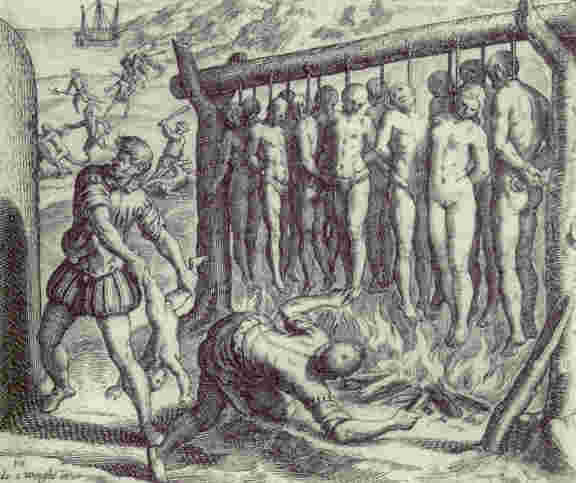
Wednesday, August 27, 2014
Twitch TV
Until the news broke that Amazon had acquired Twitch for $970 million, I had had no idea that watching other people play video games was such a big business.
Twitch is a company that lets you watch video gaming as a spectator sport — it live-streams gamers gaming and allows viewers to interact during the games, to enormous success.The natural question :
Twitch now boasts 55 million monthly active users, a count that's only growing. A recent graph of the peak Internet traffic in the U.S. puts Twitch ahead of Hulu, Valve and Amazon, behind just Netflix, Google and Apple.
Why would Amazon pay almost a billion dollars for a start-up that allows people to watch others play "Pokémon"? Johnson says the numbers explain it all.
"Twitch had 43 percent of the live video streaming traffic by volume in a given week," says Johnson. "That’s above ESPN’s website, MLB.com, CNN."
Last year during a championship for the game "League of Legends", 32 million people were reportedly watching live.
"That’s more than the audience for the finales of Breaking Bad, 24 and The Sopranos combined," adds Johnson.
Sunday, August 24, 2014
Juice vendor cart using solar power
This picture is making the rounds, said to be one Mr. Ramados, who came up with this solar power vendor cart. I'm wondering how much power he averages.

Tuesday, August 12, 2014
Obama answers a question
(via dailykos.com)
Context:
Context:
This weekend a lazy, seemingly gullible reporter asked President Obama if he regretted not leaving troops in Iraq. That is a question based on Republican talking points and not journalistic inquiry. The reporter should have known that the U.S.–Iraq Status of Forces Agreement was signed by President Bush which specifically said all combat troops would leave Iraq in December of 2011. President Obama attempted to negotiate keeping more soldiers in Iraq but could not come to an agreement with the Iraqi government who wanted the soldiers out.Question:
Mr. President, do you have any second thoughts about pulling all ground troops out of Iraq? And does it give you pause as the U.S. -- is it doing the same thing in Afghanistan?Obama:
What I just find interesting is the degree to which this issue keeps on coming up, as if this was my decision. Under the previous administration, we had turned over the country to a sovereign, democratically elected Iraqi government. In order for us to maintain troops in Iraq, we needed the invitation of the Iraqi government and we needed assurances that our personnel would be immune from prosecution if, for example, they were protecting themselves and ended up getting in a firefight with Iraqis, that they wouldn’t be hauled before an Iraqi judicial system.
Retrospective: MJ Akbar
MJ Akbar (from before the Indian elections) on why he joined the BJP and endorses Modi.
Can somebody give the young a job, the child an education, the elderly peace? Vote for them.
Can somebody give the young a job, the child an education, the elderly peace? Vote for them.
The text is here.
Sunday, August 10, 2014
Arif Jamal: Call for Transnational Jihad - LeT 1985-2014
The book: (amazon.com)
The book discussion at the Hudson Institute, June 30, 2014, in Washington, DC.
The parent organization of the LeT has penetrated all sections of Pakistani government; and has cells all over the world. The author, Arif Jamal, believes that it is next to impossible to prevent these jihadis from taking over Pakistan and declaring another Caliphate.
The book discussion at the Hudson Institute, June 30, 2014, in Washington, DC.
The parent organization of the LeT has penetrated all sections of Pakistani government; and has cells all over the world. The author, Arif Jamal, believes that it is next to impossible to prevent these jihadis from taking over Pakistan and declaring another Caliphate.
Thursday, August 07, 2014

Wednesday, August 06, 2014
The Last Rose of Summer
Wiki: The Last Rose of Summer is a poem by Irish poet Thomas Moore, who was a friend of Byron and Shelley. Moore wrote it in 1805 while at Jenkinstown Park in County Kilkenny, Ireland. It is set to a traditional tune called "Aislean an Oigfear" or "The Young Man's Dream",[1] which had been transcribed by Edward Bunting in 1792 based on a performance by harper Donnchadh Ó hÁmsaigh (Denis Hempson) at the Belfast Harp Festival.[2] The Poem and the tune together were published in December 1813 in volume 5 of a collection of Moore's work called A Section of Irish Melodies.
Wednesday, July 30, 2014

Only in Florida
The Court of Appeals reinstated Florida's law that makes it illegal for doctors to talk to their patients about guns (previously struck down by a lower court).
From an OpEd in today's NYT:
From an OpEd in today's NYT:
In Florida, in 2011, a law was signed that made it illegal for doctors to ask patients if they owned a gun. If doctors violate this law, they can be disciplined, leading to fines, citations and even a loss of their license.
A lower court struck down the law in 2012. But last week, a panel of judges on the United States Court of Appeals for the 11th Circuit upheld it. In their ruling, the judges declared that the law regulates physician conduct “to protect patient privacy and curtail abuses of the physician-patient relationship.” The clear assertion of the judges is that there is no legitimate health reason to be asking about gun ownership.Almost 20,000 people committed suicide in the United States with firearms in 2011. More than 11,000 were killed by firearms that year, and more than 200 were killed in accidents with guns. In 2009, almost 7,400 children were hospitalized because of injuries related to guns.Doctors who ask about guns aren’t doing so because they’re nosy. They’re doing so because the vast majority of those deaths and injuries are preventable.
Thursday, July 24, 2014
Race or Class?
The NY Times has an article about Americans' poor math skills: "Why Do Americans Stink at Math?"
In the comments, Steve Sailer, a "conservative race demagogue" quotes essentially the upper half of the table here. (The table is for Massachusetts, while Sailer quotes figures for the whole of the US.)
The figures are for the mathematics scores on the Program for International Student Assessment (PISA) tests. PISA tests are conducted all around the world. In 2012, students in Shanghai, China, topped the world with an average score of 613. Singapore came in second at 573. The United States scored an average of 481, way down on the list.
In the comments, Steve Sailer, a "conservative race demagogue" quotes essentially the upper half of the table here. (The table is for Massachusetts, while Sailer quotes figures for the whole of the US.)
The figures are for the mathematics scores on the Program for International Student Assessment (PISA) tests. PISA tests are conducted all around the world. In 2012, students in Shanghai, China, topped the world with an average score of 613. Singapore came in second at 573. The United States scored an average of 481, way down on the list.
| Massachusetts average | 514 | ||
|---|---|---|---|
| U.S. average | 481 | ||
| OECD average | 494 | ||
| Sex | |||
| Female | 509 | ||
| Male | 518 | ||
| Race/ethnicity | |||
| White | 530 | ||
| Black | 458 | ||
| Hispanic | 446 | ||
| Asian | 569 | ||
| Multiracial | ‡ | ||
| Percentage of students in enrolled schools eligible for free or reduced-price lunch |
|||
| Less than 10 percent | 583 | ||
| 10 to 24.9 percent | 514 | ||
| 25 to 49.9 percent | 493 | ||
| 50 to 74.9 percent | 465 | ||
| 75 percent or more | 457 | ||
Thursday, July 17, 2014
Tuesday, July 08, 2014
QOTD
Had circumstances been just a little bit different, Sarah Palin could have become an accidental president of these United States. We need to remember that. We can forget the Alamo, but that Sarah Palin was widely (?) considered presidential material by a sizable (?) chunk of the nation, and remains so to this day, needs to be tattooed on our national psyche from now until the distant day when the Yellowstone caldera ends all further need for writing stuff down. We need to remember it because, Christ Almighty, she is still around, and is still getting fawning attention, and there is still a large segment of one of the two dominant political parties in the United States that say golly gee, we wish we could be governed by someone the likes of that. She is the downright moron the prophet H.L. Mencken famously foretold, which given past White House residencies is saying something....... She represents the id that has overtaken the party and swallowed it up whole, the id that has given us the Scott Walkers and the Chris McDaniels and the All of Texas. She is the painted clown at the entrance to the great conservative roller coaster, the one that grins and points out a finger and says you must be no smarter than this to enter. -- Hunter on dailykos.com
(H.L. Mencken : “As democracy is perfected, the office of
president represents, more and more closely, the inner soul of the
people. On some great and glorious day the plain folks of the land will
reach their heart's desire at last and the White House will be adorned
by a downright moron.”)
Sunday, July 06, 2014
With Supremes like this, who needs law school?
The Religious Freedom Restoration Act 1993, (RFRA) says the following (highlighting added)
The dissent notes:
(a) Findings
The Congress finds that—(1) the framers of the Constitution, recognizing free exercise of religion as an unalienable right, secured its protection in the First Amendment to the Constitution;(2) laws “neutral” toward religion may burden religious exercise as surely as laws intended to interfere with religious exercise;(3) governments should not substantially burden religious exercise without compelling justification;
(b) PurposesJustice Alito, et. al., in Burwell v Hobby Lobby:
The purposes of this chapter are—
First, nothing in the text of RFRA as originally enacted suggested that the statutory phrase “exercise of religion under the First Amendment” was meant to be tied to this Court’s pre-Smith interpretation of that Amendment.....
On this understanding of our pre-Smith cases, RFRA did more than merely restore the balancing test used in the Sherbert line of cases; it provided even broader protection for religious liberty than was available under those decisions.
The dissent notes:
Despite these authoritative indications, the Court sees RFRA as a bold initiative departing from, rather than restoring, pre-Smith jurisprudence.The general worthlessness of Ivy League law degrees may be taken to have been demonstrated. (John Yoo, of the torture memos fame, is Harvard/Yale. David J. Barron of the execution without trial memos fame, is Harvard/Harvard.)
The Indian Rupee Sign
For future reference:
₹ is the HTML code for the symbol for the Indian Rupee ₹.
₹ is the HTML code for the symbol for the Indian Rupee ₹.
From Vietnam, an artifact
Vishnu stone head from Oc Eo culture, dated back 4,000-3,500 years.
The news-item is from the newspaper of the Vietnam Communist Party.
With those dates, this artifact would totally revolutionize history. I have to assume it is mislabeled, and should be more like 2500-2000 years old.

The news-item is from the newspaper of the Vietnam Communist Party.
With those dates, this artifact would totally revolutionize history. I have to assume it is mislabeled, and should be more like 2500-2000 years old.
Secularism in these United States is a joke
I was unaware of these numbers, from 2012:
The United States Conference of Catholic Bishops (USCCB) received $69,377,785 (a little over 31% of total revenues) from government contracts and grants in 2010, up from $58,327,207 (40% of revenues) in 2009, per their latest financial statement.As the author of the dailykos.com diary points out:
Also controlled by the bishops, Catholic Charities USA, the umbrella organization for all the diocesan Catholic Charities, received $2.90 billion (62% of revenues) from the government in 2010 and $2.64 billion (69%) in 2009; Catholic Relief Services received $517 million (56%) in 2010 from the government and $361 million (61%) in 2009, according to Forbes list of the 200 largest U.S. charities.
The USCCB are busting their collective butts to elect plutocrats and their proxies this election year under the pretense of “religious liberty” while they use our money to proselytize and bring harm to women and the LGBT community. They wield their standard anti-abortion, anti-gay campaigns to energize the state-wide contests as well.
Friday, July 04, 2014
Religionists run amuck
Two things say it all, and what an auspicious day to note it.
Supreme Court splits on gender lines in first post-Hobby Lobby case on contraception
From Justice Sonia Sotomayor's dissent:
Supreme Court splits on gender lines in first post-Hobby Lobby case on contraception
From Justice Sonia Sotomayor's dissent:
Those who are bound by our decisions usually believe they can take us at our word. Not so today. After expressly relying on the availability of the religious-nonprofit accommodation to hold that the contraceptive coverage requirement violates RFRA as applied to closely held for-profit corporations, the Court now, as the dissent in Hobby Lobby feared it might, see ante, at 29–30 (GINSBURG, J., dissenting), retreats from that position. That action evinces disregard for even the newest of this Court’s precedents and undermines confidence in this institution.A comment on dailykos.com:
There's more, though.This SCOTUS will rule any arbitrary way they
want. They are voting as right wing Catholic moralists, not as the institution to protect the tradition and values of American law.
Thursday, July 03, 2014
The Corporate Veil has been pierced.
As "Man from Wasichustan" points out on dailykos.com:
If Hobby Lobby's owners can give their Corporation religion, their religion gives Hobby Lobby's owners--and any other owner, shareholder, officer, whatever--liability for the actions of the corporation. Mr. Papantonio, who happens to be one of America's preeminent trial lawyers, sees it as an opportunity to sue owners for the company's negligence.Quoting Alex Park at MotherJones.com (emphasis added):
Some other people, it turns out, agree with his assessment and expand on what it means....
Basically, what you need to know is that if you and some friends start a company that makes a lot of money, you'll be rich, but if it incurs a lot of debt and fails, you won't be left to pay its bills. The Supreme Court affirmed this arrangement in a 2001 case, Cedric Kushner Promotions vs. Don King:
linguistically speaking, the employee and the corporation are different “persons,” even where the employee is the corporation’s sole owner. After all, incorporation’s basic purpose is to create a distinct legal entity, with legal rights, obligations, powers, and privileges different from those of the natural individuals who created it, who own it, or whom it employs.
Incidentally, this also holds for that falsehood taught in the MBA finance classes at the U. Maryland and other fine business schools - that dividends are "double-taxed". They aren't - the corporation is a distinct legal entity from the owners.That separation is what legal and business scholars call the "corporate veil," and it's fundamental to the entire operation. Now, thanks to the Hobby Lobby case, it's in question. By letting Hobby Lobby's owners assert their personal religious rights over an entire corporation, the Supreme Court has poked a major hole in the veil. In other words, if a company is not truly separate from its owners, the owners could be made responsible for its debts and other burdens.
"If religious shareholders can do it, why can’t creditors and government regulators pierce the corporate veil in the other direction?" Burt Neuborne, a law professor at New York University, asked in an email.
That's a question raised by 44 other law professors, who filed a friends-of-the-court brief that implored the Court to reject Hobby Lobby's argument and hold the veil in place. Here's what they argued:
Allowing a corporation, through either shareholder vote or board resolution, to take on and assert the religious beliefs of its shareholders in order to avoid having to comply with a generally-applicable law with a secular purpose is fundamentally at odds with the entire concept of incorporation. Creating such an unprecedented and idiosyncratic tear in the corporate veil would also carry with it unintended consequences, many of which are not easily foreseen.
Tuesday, July 01, 2014
Hobby-Lobby, past public distrust of Catholics
If I remember history correctly, there was considerable distrust of Catholicism amongst the American public back in the 1950s and John F. Kennedy had to make a strong speech that he would not be bound by the Catholic Church's doctrines in his presidential decisions, before people would trust him.
Well, if the Detroit Free Press is to be believed, the Catholic Church is indeed worthy of distrust, they have smuggled their religious doctrine into public policy -- via the Supreme Court justices.
Quote:
I'm curious as to what happens to a corporation's exemptions based on religious belief, when:
1. The corporation changes ownership, or
2. The owners convert to a different religious belief.
Also, suppose some of the owners of the corporation that have claimed an exemption from providing contraception coverage, are discovered to be using birth control. Are they merely sinning against their religious beliefs, and are accountable only to their God for their hypocrisy, or have they committed a public fraud?
I don't see, following the Supreme Court decision, how we can avoid having a periodic audit of corporate owners' religious beliefs by the government. And what is more offensive to the First Amendment - such audits, or everyone uniformly having to follow public policy?
Well, if the Detroit Free Press is to be believed, the Catholic Church is indeed worthy of distrust, they have smuggled their religious doctrine into public policy -- via the Supreme Court justices.
Quote:
There is nothing particularly conservative about Monday’s Supreme Court ruling excusing closely held corporations from a federal mandate to provide female employees with insurance coverage for certain forms of contraception.I'll pose my thoughts as questions:
Flying under the false colors of religious liberty, the five Catholics in the majority insisted they were acting to protect the constitutional rights of two closely held corporations owned and operated by Christian families.
I'm curious as to what happens to a corporation's exemptions based on religious belief, when:
1. The corporation changes ownership, or
2. The owners convert to a different religious belief.
Also, suppose some of the owners of the corporation that have claimed an exemption from providing contraception coverage, are discovered to be using birth control. Are they merely sinning against their religious beliefs, and are accountable only to their God for their hypocrisy, or have they committed a public fraud?
I don't see, following the Supreme Court decision, how we can avoid having a periodic audit of corporate owners' religious beliefs by the government. And what is more offensive to the First Amendment - such audits, or everyone uniformly having to follow public policy?
Subscribe to:
Comments (Atom)


