Sunday, September 28, 2014


Thursday, September 25, 2014
Wednesday, September 24, 2014
Martian duet
Howdy @MarsCuriosity ? Keep in touch. I'll be around.
— ISRO's Mars Orbiter (@MarsOrbiter) September 24, 2014Friday, September 19, 2014
Mars Orbiter Mission: Key events approaching
Pictures from ISRO's Mars Orbiter Mission Facebook page. After 10 months in interplanetary space, the following events are scheduled to take place. Nail-biting times.

Exactly when:

Exactly when:
Sunday, September 07, 2014
The Forgotten(?) Battle Over the Infinitesimal
At the library, I picked up Amir Alexander's "Infinitesimal - How a dangerous mathematical theory shaped the modern world". This was because the dust jacket began thusly:
"ON AUGUST 10, 1632, five men in flowing black robes convened in a somber Roman palazzo to pass judgment on a deceptively simple proposition: that a continuous line is composed of distinct and infinitely tiny parts. With the stroke of a pen the Jesuit fathers banned the doctrine of infinitesimals, announcing that it could never be taught or even mentioned. The concept was deemed dangerous and subversive, a threat to the belief that the world was an orderly place, governed by a strict and unchanging set of rules. If infinitesimals were ever accepted, the Jesuits feared, the entire world would be plunged into chaos".
I knew that it took a long time for mathematics to be able to deal with the infinitesimal and the infinite with any kind of rigor, but that it invited religious opposition was something new to me.
Inside the book, I quickly come across that the Jesuits felt it necessary to "denounce indivisibles again in 1643 and 1649. By 1651 they had had enough: determined to put an end to unauthorized opinions in their ranks, the leaders of the Society produced a permanent list of banned doctrines, that could never be taught or advocated by members of the order. Among the forbidden teachings, featured repeatedly in various guises, was the doctrine of indivisibles."
A bit earlier in the book, the author tells us:
"Yet, useful as it was, and successful as it was, the concept of the infinitely small was challenged at every turn. The Jesuits opposed it; Hobbes and his admirers opposed it; Anglican churchmen opposed it, as did many others. What was it, then, about the infinitely small that inspired such fierce opposition from so many different quarters? The answer is that the infinitely small was a simple idea that punctured a great and beautiful dream: that the world is a perfectly rational place, governed by strict mathematical rules. In such a world, all things, natural and human, have their given and unchanging place in the grand universal order. Everything from a grain of sand to the stars in the sky, from the humblest beggar to kings and emperors, is a part of a fixed, eternal hierarchy. Any attempt to revise or topple it is a rebellion against the one unalterable order, a senseless disruption that in any case is doomed to failure."
"But if the paradoxes of Zeno and the problem of incommensurability prove anything, it is that the dream of a perfect fit between mathematics and the physical world is intenable. On the scale of the infinitely small, numbers do not correspond to physical objects and any attempt to force the fit leads to paradoxes and contradictions. Mathematical reasoning, however rigorous and true on its own terms, cannot tell us how the world actually must be. At the heart of creation, it seems, lies a mystery that eludes the grasp of the most rigorous reasoning, and allows the world to diverge from our best mathematical deductions and go its own way -- we know not where."
---- The problem of the incommensurable is "no matter how many times you divide each of the lines {of the side of the square and its diagonal which are in the ratio of 1:sqrt(2)}, or how thinly you slice them, you will never arrive at a magnitude that is their common measure". "Why are incommensurables a problem for indivisibles? Because if lines were composed of indivisibles, then the magnitudes of these mathematical atoms would be a common measure for any two lines. But if two lines are incommensurable, then there is not common component that they both share, and hence there are no mathematical atoms; no indivisibles."
---- Zeno's paradoxes all also have to do with the infinite and the infinitesimal.
"ON AUGUST 10, 1632, five men in flowing black robes convened in a somber Roman palazzo to pass judgment on a deceptively simple proposition: that a continuous line is composed of distinct and infinitely tiny parts. With the stroke of a pen the Jesuit fathers banned the doctrine of infinitesimals, announcing that it could never be taught or even mentioned. The concept was deemed dangerous and subversive, a threat to the belief that the world was an orderly place, governed by a strict and unchanging set of rules. If infinitesimals were ever accepted, the Jesuits feared, the entire world would be plunged into chaos".
I knew that it took a long time for mathematics to be able to deal with the infinitesimal and the infinite with any kind of rigor, but that it invited religious opposition was something new to me.
Inside the book, I quickly come across that the Jesuits felt it necessary to "denounce indivisibles again in 1643 and 1649. By 1651 they had had enough: determined to put an end to unauthorized opinions in their ranks, the leaders of the Society produced a permanent list of banned doctrines, that could never be taught or advocated by members of the order. Among the forbidden teachings, featured repeatedly in various guises, was the doctrine of indivisibles."
A bit earlier in the book, the author tells us:
"Yet, useful as it was, and successful as it was, the concept of the infinitely small was challenged at every turn. The Jesuits opposed it; Hobbes and his admirers opposed it; Anglican churchmen opposed it, as did many others. What was it, then, about the infinitely small that inspired such fierce opposition from so many different quarters? The answer is that the infinitely small was a simple idea that punctured a great and beautiful dream: that the world is a perfectly rational place, governed by strict mathematical rules. In such a world, all things, natural and human, have their given and unchanging place in the grand universal order. Everything from a grain of sand to the stars in the sky, from the humblest beggar to kings and emperors, is a part of a fixed, eternal hierarchy. Any attempt to revise or topple it is a rebellion against the one unalterable order, a senseless disruption that in any case is doomed to failure."
"But if the paradoxes of Zeno and the problem of incommensurability prove anything, it is that the dream of a perfect fit between mathematics and the physical world is intenable. On the scale of the infinitely small, numbers do not correspond to physical objects and any attempt to force the fit leads to paradoxes and contradictions. Mathematical reasoning, however rigorous and true on its own terms, cannot tell us how the world actually must be. At the heart of creation, it seems, lies a mystery that eludes the grasp of the most rigorous reasoning, and allows the world to diverge from our best mathematical deductions and go its own way -- we know not where."
---- The problem of the incommensurable is "no matter how many times you divide each of the lines {of the side of the square and its diagonal which are in the ratio of 1:sqrt(2)}, or how thinly you slice them, you will never arrive at a magnitude that is their common measure". "Why are incommensurables a problem for indivisibles? Because if lines were composed of indivisibles, then the magnitudes of these mathematical atoms would be a common measure for any two lines. But if two lines are incommensurable, then there is not common component that they both share, and hence there are no mathematical atoms; no indivisibles."
---- Zeno's paradoxes all also have to do with the infinite and the infinitesimal.
Saturday, August 30, 2014
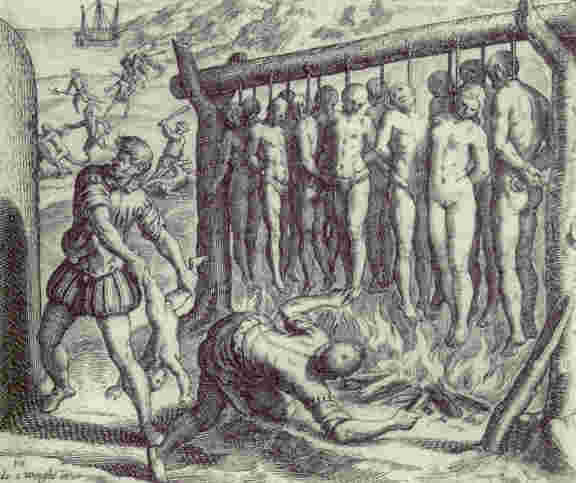
The Sordid History of Humankind
Human unkind, really. ISIS is nothing new - in the name of Allah, or in the name of God, it is all the same, just there was no youtube or twitter in those days. From here:

Wednesday, August 27, 2014
Twitch TV
Until the news broke that Amazon had acquired Twitch for $970 million, I had had no idea that watching other people play video games was such a big business.
Twitch is a company that lets you watch video gaming as a spectator sport — it live-streams gamers gaming and allows viewers to interact during the games, to enormous success.The natural question :
Twitch now boasts 55 million monthly active users, a count that's only growing. A recent graph of the peak Internet traffic in the U.S. puts Twitch ahead of Hulu, Valve and Amazon, behind just Netflix, Google and Apple.
Why would Amazon pay almost a billion dollars for a start-up that allows people to watch others play "Pokémon"? Johnson says the numbers explain it all.
"Twitch had 43 percent of the live video streaming traffic by volume in a given week," says Johnson. "That’s above ESPN’s website, MLB.com, CNN."
Last year during a championship for the game "League of Legends", 32 million people were reportedly watching live.
"That’s more than the audience for the finales of Breaking Bad, 24 and The Sopranos combined," adds Johnson.
Sunday, August 24, 2014
Juice vendor cart using solar power
This picture is making the rounds, said to be one Mr. Ramados, who came up with this solar power vendor cart. I'm wondering how much power he averages.

Tuesday, August 12, 2014
Obama answers a question
(via dailykos.com)
Context:
Context:
This weekend a lazy, seemingly gullible reporter asked President Obama if he regretted not leaving troops in Iraq. That is a question based on Republican talking points and not journalistic inquiry. The reporter should have known that the U.S.–Iraq Status of Forces Agreement was signed by President Bush which specifically said all combat troops would leave Iraq in December of 2011. President Obama attempted to negotiate keeping more soldiers in Iraq but could not come to an agreement with the Iraqi government who wanted the soldiers out.Question:
Mr. President, do you have any second thoughts about pulling all ground troops out of Iraq? And does it give you pause as the U.S. -- is it doing the same thing in Afghanistan?Obama:
What I just find interesting is the degree to which this issue keeps on coming up, as if this was my decision. Under the previous administration, we had turned over the country to a sovereign, democratically elected Iraqi government. In order for us to maintain troops in Iraq, we needed the invitation of the Iraqi government and we needed assurances that our personnel would be immune from prosecution if, for example, they were protecting themselves and ended up getting in a firefight with Iraqis, that they wouldn’t be hauled before an Iraqi judicial system.
Retrospective: MJ Akbar
MJ Akbar (from before the Indian elections) on why he joined the BJP and endorses Modi.
Can somebody give the young a job, the child an education, the elderly peace? Vote for them.
Can somebody give the young a job, the child an education, the elderly peace? Vote for them.
The text is here.
Sunday, August 10, 2014
Arif Jamal: Call for Transnational Jihad - LeT 1985-2014
The book: (amazon.com)
The book discussion at the Hudson Institute, June 30, 2014, in Washington, DC.
The parent organization of the LeT has penetrated all sections of Pakistani government; and has cells all over the world. The author, Arif Jamal, believes that it is next to impossible to prevent these jihadis from taking over Pakistan and declaring another Caliphate.
The book discussion at the Hudson Institute, June 30, 2014, in Washington, DC.
The parent organization of the LeT has penetrated all sections of Pakistani government; and has cells all over the world. The author, Arif Jamal, believes that it is next to impossible to prevent these jihadis from taking over Pakistan and declaring another Caliphate.
Thursday, August 07, 2014

Wednesday, August 06, 2014
The Last Rose of Summer
Wiki: The Last Rose of Summer is a poem by Irish poet Thomas Moore, who was a friend of Byron and Shelley. Moore wrote it in 1805 while at Jenkinstown Park in County Kilkenny, Ireland. It is set to a traditional tune called "Aislean an Oigfear" or "The Young Man's Dream",[1] which had been transcribed by Edward Bunting in 1792 based on a performance by harper Donnchadh Ó hÁmsaigh (Denis Hempson) at the Belfast Harp Festival.[2] The Poem and the tune together were published in December 1813 in volume 5 of a collection of Moore's work called A Section of Irish Melodies.
Wednesday, July 30, 2014

Only in Florida
The Court of Appeals reinstated Florida's law that makes it illegal for doctors to talk to their patients about guns (previously struck down by a lower court).
From an OpEd in today's NYT:
From an OpEd in today's NYT:
In Florida, in 2011, a law was signed that made it illegal for doctors to ask patients if they owned a gun. If doctors violate this law, they can be disciplined, leading to fines, citations and even a loss of their license.
A lower court struck down the law in 2012. But last week, a panel of judges on the United States Court of Appeals for the 11th Circuit upheld it. In their ruling, the judges declared that the law regulates physician conduct “to protect patient privacy and curtail abuses of the physician-patient relationship.” The clear assertion of the judges is that there is no legitimate health reason to be asking about gun ownership.Almost 20,000 people committed suicide in the United States with firearms in 2011. More than 11,000 were killed by firearms that year, and more than 200 were killed in accidents with guns. In 2009, almost 7,400 children were hospitalized because of injuries related to guns.Doctors who ask about guns aren’t doing so because they’re nosy. They’re doing so because the vast majority of those deaths and injuries are preventable.
Thursday, July 24, 2014
Race or Class?
The NY Times has an article about Americans' poor math skills: "Why Do Americans Stink at Math?"
In the comments, Steve Sailer, a "conservative race demagogue" quotes essentially the upper half of the table here. (The table is for Massachusetts, while Sailer quotes figures for the whole of the US.)
The figures are for the mathematics scores on the Program for International Student Assessment (PISA) tests. PISA tests are conducted all around the world. In 2012, students in Shanghai, China, topped the world with an average score of 613. Singapore came in second at 573. The United States scored an average of 481, way down on the list.
In the comments, Steve Sailer, a "conservative race demagogue" quotes essentially the upper half of the table here. (The table is for Massachusetts, while Sailer quotes figures for the whole of the US.)
The figures are for the mathematics scores on the Program for International Student Assessment (PISA) tests. PISA tests are conducted all around the world. In 2012, students in Shanghai, China, topped the world with an average score of 613. Singapore came in second at 573. The United States scored an average of 481, way down on the list.
| Massachusetts average | 514 | ||
|---|---|---|---|
| U.S. average | 481 | ||
| OECD average | 494 | ||
| Sex | |||
| Female | 509 | ||
| Male | 518 | ||
| Race/ethnicity | |||
| White | 530 | ||
| Black | 458 | ||
| Hispanic | 446 | ||
| Asian | 569 | ||
| Multiracial | ‡ | ||
| Percentage of students in enrolled schools eligible for free or reduced-price lunch |
|||
| Less than 10 percent | 583 | ||
| 10 to 24.9 percent | 514 | ||
| 25 to 49.9 percent | 493 | ||
| 50 to 74.9 percent | 465 | ||
| 75 percent or more | 457 | ||
Thursday, July 17, 2014
Tuesday, July 08, 2014
QOTD
Had circumstances been just a little bit different, Sarah Palin could have become an accidental president of these United States. We need to remember that. We can forget the Alamo, but that Sarah Palin was widely (?) considered presidential material by a sizable (?) chunk of the nation, and remains so to this day, needs to be tattooed on our national psyche from now until the distant day when the Yellowstone caldera ends all further need for writing stuff down. We need to remember it because, Christ Almighty, she is still around, and is still getting fawning attention, and there is still a large segment of one of the two dominant political parties in the United States that say golly gee, we wish we could be governed by someone the likes of that. She is the downright moron the prophet H.L. Mencken famously foretold, which given past White House residencies is saying something....... She represents the id that has overtaken the party and swallowed it up whole, the id that has given us the Scott Walkers and the Chris McDaniels and the All of Texas. She is the painted clown at the entrance to the great conservative roller coaster, the one that grins and points out a finger and says you must be no smarter than this to enter. -- Hunter on dailykos.com
(H.L. Mencken : “As democracy is perfected, the office of
president represents, more and more closely, the inner soul of the
people. On some great and glorious day the plain folks of the land will
reach their heart's desire at last and the White House will be adorned
by a downright moron.”)
Sunday, July 06, 2014
With Supremes like this, who needs law school?
The Religious Freedom Restoration Act 1993, (RFRA) says the following (highlighting added)
The dissent notes:
(a) Findings
The Congress finds that—(1) the framers of the Constitution, recognizing free exercise of religion as an unalienable right, secured its protection in the First Amendment to the Constitution;(2) laws “neutral” toward religion may burden religious exercise as surely as laws intended to interfere with religious exercise;(3) governments should not substantially burden religious exercise without compelling justification;
(b) PurposesJustice Alito, et. al., in Burwell v Hobby Lobby:
The purposes of this chapter are—
First, nothing in the text of RFRA as originally enacted suggested that the statutory phrase “exercise of religion under the First Amendment” was meant to be tied to this Court’s pre-Smith interpretation of that Amendment.....
On this understanding of our pre-Smith cases, RFRA did more than merely restore the balancing test used in the Sherbert line of cases; it provided even broader protection for religious liberty than was available under those decisions.
The dissent notes:
Despite these authoritative indications, the Court sees RFRA as a bold initiative departing from, rather than restoring, pre-Smith jurisprudence.The general worthlessness of Ivy League law degrees may be taken to have been demonstrated. (John Yoo, of the torture memos fame, is Harvard/Yale. David J. Barron of the execution without trial memos fame, is Harvard/Harvard.)
The Indian Rupee Sign
For future reference:
₹ is the HTML code for the symbol for the Indian Rupee ₹.
₹ is the HTML code for the symbol for the Indian Rupee ₹.
From Vietnam, an artifact
Vishnu stone head from Oc Eo culture, dated back 4,000-3,500 years.
The news-item is from the newspaper of the Vietnam Communist Party.
With those dates, this artifact would totally revolutionize history. I have to assume it is mislabeled, and should be more like 2500-2000 years old.

The news-item is from the newspaper of the Vietnam Communist Party.
With those dates, this artifact would totally revolutionize history. I have to assume it is mislabeled, and should be more like 2500-2000 years old.
Secularism in these United States is a joke
I was unaware of these numbers, from 2012:
The United States Conference of Catholic Bishops (USCCB) received $69,377,785 (a little over 31% of total revenues) from government contracts and grants in 2010, up from $58,327,207 (40% of revenues) in 2009, per their latest financial statement.As the author of the dailykos.com diary points out:
Also controlled by the bishops, Catholic Charities USA, the umbrella organization for all the diocesan Catholic Charities, received $2.90 billion (62% of revenues) from the government in 2010 and $2.64 billion (69%) in 2009; Catholic Relief Services received $517 million (56%) in 2010 from the government and $361 million (61%) in 2009, according to Forbes list of the 200 largest U.S. charities.
The USCCB are busting their collective butts to elect plutocrats and their proxies this election year under the pretense of “religious liberty” while they use our money to proselytize and bring harm to women and the LGBT community. They wield their standard anti-abortion, anti-gay campaigns to energize the state-wide contests as well.
Friday, July 04, 2014
Religionists run amuck
Two things say it all, and what an auspicious day to note it.
Supreme Court splits on gender lines in first post-Hobby Lobby case on contraception
From Justice Sonia Sotomayor's dissent:
Supreme Court splits on gender lines in first post-Hobby Lobby case on contraception
From Justice Sonia Sotomayor's dissent:
Those who are bound by our decisions usually believe they can take us at our word. Not so today. After expressly relying on the availability of the religious-nonprofit accommodation to hold that the contraceptive coverage requirement violates RFRA as applied to closely held for-profit corporations, the Court now, as the dissent in Hobby Lobby feared it might, see ante, at 29–30 (GINSBURG, J., dissenting), retreats from that position. That action evinces disregard for even the newest of this Court’s precedents and undermines confidence in this institution.A comment on dailykos.com:
There's more, though.This SCOTUS will rule any arbitrary way they
want. They are voting as right wing Catholic moralists, not as the institution to protect the tradition and values of American law.
Thursday, July 03, 2014
The Corporate Veil has been pierced.
As "Man from Wasichustan" points out on dailykos.com:
If Hobby Lobby's owners can give their Corporation religion, their religion gives Hobby Lobby's owners--and any other owner, shareholder, officer, whatever--liability for the actions of the corporation. Mr. Papantonio, who happens to be one of America's preeminent trial lawyers, sees it as an opportunity to sue owners for the company's negligence.Quoting Alex Park at MotherJones.com (emphasis added):
Some other people, it turns out, agree with his assessment and expand on what it means....
Basically, what you need to know is that if you and some friends start a company that makes a lot of money, you'll be rich, but if it incurs a lot of debt and fails, you won't be left to pay its bills. The Supreme Court affirmed this arrangement in a 2001 case, Cedric Kushner Promotions vs. Don King:
linguistically speaking, the employee and the corporation are different “persons,” even where the employee is the corporation’s sole owner. After all, incorporation’s basic purpose is to create a distinct legal entity, with legal rights, obligations, powers, and privileges different from those of the natural individuals who created it, who own it, or whom it employs.
Incidentally, this also holds for that falsehood taught in the MBA finance classes at the U. Maryland and other fine business schools - that dividends are "double-taxed". They aren't - the corporation is a distinct legal entity from the owners.That separation is what legal and business scholars call the "corporate veil," and it's fundamental to the entire operation. Now, thanks to the Hobby Lobby case, it's in question. By letting Hobby Lobby's owners assert their personal religious rights over an entire corporation, the Supreme Court has poked a major hole in the veil. In other words, if a company is not truly separate from its owners, the owners could be made responsible for its debts and other burdens.
"If religious shareholders can do it, why can’t creditors and government regulators pierce the corporate veil in the other direction?" Burt Neuborne, a law professor at New York University, asked in an email.
That's a question raised by 44 other law professors, who filed a friends-of-the-court brief that implored the Court to reject Hobby Lobby's argument and hold the veil in place. Here's what they argued:
Allowing a corporation, through either shareholder vote or board resolution, to take on and assert the religious beliefs of its shareholders in order to avoid having to comply with a generally-applicable law with a secular purpose is fundamentally at odds with the entire concept of incorporation. Creating such an unprecedented and idiosyncratic tear in the corporate veil would also carry with it unintended consequences, many of which are not easily foreseen.
Tuesday, July 01, 2014
Hobby-Lobby, past public distrust of Catholics
If I remember history correctly, there was considerable distrust of Catholicism amongst the American public back in the 1950s and John F. Kennedy had to make a strong speech that he would not be bound by the Catholic Church's doctrines in his presidential decisions, before people would trust him.
Well, if the Detroit Free Press is to be believed, the Catholic Church is indeed worthy of distrust, they have smuggled their religious doctrine into public policy -- via the Supreme Court justices.
Quote:
I'm curious as to what happens to a corporation's exemptions based on religious belief, when:
1. The corporation changes ownership, or
2. The owners convert to a different religious belief.
Also, suppose some of the owners of the corporation that have claimed an exemption from providing contraception coverage, are discovered to be using birth control. Are they merely sinning against their religious beliefs, and are accountable only to their God for their hypocrisy, or have they committed a public fraud?
I don't see, following the Supreme Court decision, how we can avoid having a periodic audit of corporate owners' religious beliefs by the government. And what is more offensive to the First Amendment - such audits, or everyone uniformly having to follow public policy?
Well, if the Detroit Free Press is to be believed, the Catholic Church is indeed worthy of distrust, they have smuggled their religious doctrine into public policy -- via the Supreme Court justices.
Quote:
There is nothing particularly conservative about Monday’s Supreme Court ruling excusing closely held corporations from a federal mandate to provide female employees with insurance coverage for certain forms of contraception.I'll pose my thoughts as questions:
Flying under the false colors of religious liberty, the five Catholics in the majority insisted they were acting to protect the constitutional rights of two closely held corporations owned and operated by Christian families.
I'm curious as to what happens to a corporation's exemptions based on religious belief, when:
1. The corporation changes ownership, or
2. The owners convert to a different religious belief.
Also, suppose some of the owners of the corporation that have claimed an exemption from providing contraception coverage, are discovered to be using birth control. Are they merely sinning against their religious beliefs, and are accountable only to their God for their hypocrisy, or have they committed a public fraud?
I don't see, following the Supreme Court decision, how we can avoid having a periodic audit of corporate owners' religious beliefs by the government. And what is more offensive to the First Amendment - such audits, or everyone uniformly having to follow public policy?
Monday, June 30, 2014
De-Macaulayization - 7
Sankrant Sanu writes:
A few years ago I set off to villages in Rajasthan, Haryana and Uttarakhand to do a study. I carried with me non-verbal IQ tests normed on the US population. I administered these to children in the US, children in English-medium urban schools and children in village schools. In my sample, Indian village children outscored both Indian and US urban children in IQ. In a small village Khandodra in Haryana, 30 per cent of the children scored above the 90th percentile. I was stunned. When I spoke to the principal of the village, he spoke about how the English class system in India affected the children’s self esteem and their chances of future progress.
हमारा ग्रामीन क्षेत्र है। अगर हाईर ऐडूकेशन से टच में है तभी बच्चा सफल हो पाएगा। जब वो आठवीं क्लास पास करता है, दसवीं तक जाता है, उसमें इंगलिश की ऐसी हीन भावना आ जाती है, की ऊपर जाता है—काॅम्पिटिशन में भी इंगलिश-मीडियम है।(Ours is a rural area. To succeed these children need to be in touch with higher education. However when the child passes 8th class, goes into 10th, he experiences a feeling of inferiority in dealing with English; to go higher the competition is in English).
This encounter created my passion to reverse this injustice. A child in Turkey, in Malaysia, in Korea or Japan, does not face the same discriminative glass ceiling as the child in a village in Khandodra. Some years ago, Malaysia made an explicit decision to change its highest court system to allow Bhasha, its native language (a word ironically derived from Sanskrit). Yet in this ancient land of scholarship of ours, which influenced other civilisations for centuries, we cannot plead our case in the Supreme Court in any Indian language.
Sunday, June 29, 2014
A debate worth watching
Excerpts of a debate - via MEMRI - among Mussalmans, that is very important; which side prevails in practice will determine the fate of a large portion of humanity. And sorry, not watching, but reading the sub-titles for most of us.
The Paradox of The Veda
Sri Aurobindo wrote (PDF):
1. The difficulty of the language:
1. The difficulty of the language:
We have in the Rig Veda, — the true and only Veda in the estimation of European scholars, — a body of sacrificial hymns couched in a very ancient language which presents a number of almost insoluble difficulties. It is full of ancient forms and words which do not appear in later speech and have often to be fixed in some doubtful sense by intelligent conjecture; a mass even of the words that it has in common with classical Sanskrit seem to bear or at least to admit another significance than in the later literary tongue; and a multitude of its vocables, especially the most common, those which are most vital to the sense, are capable of a surprising number of unconnected significances which may give, according to our preference in selection, quite different complexions to whole passages, whole hymns and even to the whole thought of the Veda.2. The existing commentaries and difficulty of interpretation:
In the course of several thousands of years there have been at least three considerable attempts, entirely differing from each other in their methods and results, to fix the sense of these ancient litanies. One of these is prehistoric in time and exists only by fragments in the Brahmanas and Upanishads; but we possess in its entirety the traditional interpretation of the Indian scholar Sayana and we have in our own day the interpretation constructed after an immense labour of comparison and conjecture by modern European scholarship.3. The paradox
Both of them present one characteristic in common, the extraordinary incoherence and poverty of sense which their results stamp upon the ancient hymns. The separate lines can be given, whether naturally or by force of conjecture, a good sense or a sense that hangs together; the diction that results, if garish in style, if loaded with otiose and decorative epithets, if developing extraordinarily little of meaning in an amazing mass of gaudy figure and verbiage, can be made to run into intelligible sentences; but when we come to read the hymns as a whole we seem to be in the presence of men who, unlike the early writers of other races, were incapable of coherent and natural expression or of connected thought. Except in the briefer and simpler hymns, the language tends to be either obscure or artificial; the thoughts are either unconnected or have to be forced and beaten by the interpreter into a whole. The scholar in dealing with his text is obliged to substitute for interpretation a process almost of fabrication. We feel that he is not so much revealing the sense as hammering and forging rebellious material into some sort of shape and consistency.
Yet these obscure and barbarous compositions have had the most splendid good fortune in all literary history. They have been the reputed source not only of some of the world’s richest and profoundest religions, but of some of its subtlest metaphysical philosophies. In the fixed tradition of thousands of years they have been revered as the origin and standard of all that can be held as authoritative and true in Brahmana and Upanishad, in Tantra and Purana, in the doctrines of great philosophical schools and in the teachings of famous saints and sages. The name borne by them was Veda, the knowledge, — the received name for the highest spiritual truth of which the human mind is capable. But if we accept the current interpretations, whether Sayana’s or the modern theory, the whole of this sublime and sacred reputation is a colossal fiction. The hymns are, on the contrary, nothing more than the naive superstitious fancies of untaught and materialistic barbarians concerned only with the most external gains and enjoyments and ignorant of all but the most elementary moral notions or religious aspirations.Part of the "most splendid good fortune" is the civilizational effort to preserve these in the original sound. In fact, an entire school of philosophy says that it is the sound that matters, not the meaning.
How far are we from the robots taking over?
The shipping time for container shipping from China to New York is between 20-30 days. For a fashion-driven industry like textiles and garments, the advantage of cheaper labor in China would be offset by the extra month it takes to respond to the changing market. If robots could reduce the human labor component of garment production to insignificance, it would be advantageous to serve the US market with robotic factories located in the US. It would seem then that robotic manufacturing is not yet ready to take over, at least from an economic feasibility perspective.
There are alternatives, of course, which could explain this. For example, the garment industry could be still in a relatively slow supply chain model, so that the extra 3-4 weeks for shipping from China don't matter. What I mean is that what you see in the store displays today might have been planned up to an year ago, rather than weeks ago. If the business model is that slow-moving, where manufacturing is located may not matter.
Anyway, here is an article from 2012, from the Indian Textile Journal.
There are alternatives, of course, which could explain this. For example, the garment industry could be still in a relatively slow supply chain model, so that the extra 3-4 weeks for shipping from China don't matter. What I mean is that what you see in the store displays today might have been planned up to an year ago, rather than weeks ago. If the business model is that slow-moving, where manufacturing is located may not matter.
Anyway, here is an article from 2012, from the Indian Textile Journal.
Sri Aurobindo on the meaning of the Vedas
A passage from Sir Aurobindo's "Secrets of the Veda":
From this past history of language certain consequences derive which are of considerable importance in Vedic interpretation. In the first place by a knowledge of the laws under which the relations of sound and sense formed themselves in the Sanskrit tongue and by a careful and minute study of its word-families it is possible to a great extent to restore the past history of individual words. It is possible to account for the meanings actually possessed by them, to show how they were worked out
through the various stages of language-development, to establish the mutual relations of different significances and to explain how they came to be attached to the same word in spite of the wide
difference and sometimes even the direct contrariety of their sense-values. It is possible also to restore lost senses of words on a sure and scientific basis and to justify them by an appeal to the observed laws of association which governed the development of the old Aryan tongues, to the secret evidence of the word itself and to the corroborative evidence of its immediate kindred.
Thus instead of having a purely floating and conjectural basis for our dealings with the vocables of the Vedic language, we can work with confidence upon a solid and reliable foundation. Naturally, it does not follow that because a Vedic word may or must have had at one time a particular significance,
that significance can be safely applied to the actual text of the Veda. But we do establish a sound sense and a clear possibility of its being the right sense for the Veda. The rest is a matter of comparative study of the passages in which the word occurs and of constant fitness in the context. I have continually found that a sense thus restored illumines always the context wherever it is applied and on the other hand that a sense demanded always by the context is precisely that to which we are led by the history of the word. This is a sufficient basis for a moral, if not for an absolute certainty.
Secondly, one remarkable feature of language in its inception is the enormous number of different meanings of which a single word was capable and also the enormous number of words which could be used to represent a single idea. Afterwards this tropical luxuriance came to be cut down. The intellect intervened with its growing need of precision, its growing sense of economy. The bearing capacity of words progressively diminished; and it became less and less tolerable to be burdened with a superfluous number of words for the same idea, a redundant variety of ideas for the same word. A considerable, though not too rigid economy in these respects, modified by a demand for a temperate
richness of variation, became the final law of language.
But the Sanskrit tongue never quite reached the final stages of this development; it dissolved too early into the Prakrit dialects. Even in its latest and most literary form it is lavish of varieties of meanings for the same word; it overflows with a redundant wealth of synonyms. Hence its extraordinary capacity for rhetorical devices which in any other language would be difficult, forced and hopelessly artificial, and especially for the figure of double sense, of slesa.
The Vedic Sanskrit represents a still earlier stratum in the development of language. Even in its outward features it is less fixed than any classical tongue; it abounds in a variety of forms and inflexions; it is fluid and vague, yet richly subtle in its use of cases and tenses. And on its psychological side it has not yet crystallised, is not entirely hardened into the rigid forms
of intellectual precision. The word for the Vedic Rishi is still a living thing, a thing of power, creative, formative. It is not yet a conventional symbol for an idea, but itself the parent and former of ideas. It carries within it the memory of its roots, is still conscient of its own history.
The Rishis’ use of language was governed by this ancient psychology of the Word. When in English we use the word “wolf” or “cow”, we mean by it simply the animal designated; we are not conscious of any reason why we should use that particular sound for the idea except the immemorial custom of
the language; and we cannot use it for any other sense or purpose except by an artificial device of style. But for the Vedic Rishi “vrika” meant the tearer and therefore, among other applications of the sense, a wolf; “dhenu” meant the fosterer, nourisher, and therefore a cow. But the original and general sense predominates, the derived and particular is secondary. Therefore, it was possible for the fashioner of the hymn to use these common words with a great pliability, sometimes putting forward the image of the wolf or the cow, sometimes using it to colour the more general sense, sometimes keeping it merely as a conventional figure for the psychological conception on which his mind
was dwelling, sometimes losing sight of the image altogether. It is in the light of this psychology of the old language that we have to understand the peculiar figures of Vedic symbolism as handled by the Rishis, even to the most apparently common and concrete. It is so that words like “ghritam”, the clarified butter, “soma”, the sacred wine, and a host of others are used.
From this past history of language certain consequences derive which are of considerable importance in Vedic interpretation. In the first place by a knowledge of the laws under which the relations of sound and sense formed themselves in the Sanskrit tongue and by a careful and minute study of its word-families it is possible to a great extent to restore the past history of individual words. It is possible to account for the meanings actually possessed by them, to show how they were worked out
through the various stages of language-development, to establish the mutual relations of different significances and to explain how they came to be attached to the same word in spite of the wide
difference and sometimes even the direct contrariety of their sense-values. It is possible also to restore lost senses of words on a sure and scientific basis and to justify them by an appeal to the observed laws of association which governed the development of the old Aryan tongues, to the secret evidence of the word itself and to the corroborative evidence of its immediate kindred.
Thus instead of having a purely floating and conjectural basis for our dealings with the vocables of the Vedic language, we can work with confidence upon a solid and reliable foundation. Naturally, it does not follow that because a Vedic word may or must have had at one time a particular significance,
that significance can be safely applied to the actual text of the Veda. But we do establish a sound sense and a clear possibility of its being the right sense for the Veda. The rest is a matter of comparative study of the passages in which the word occurs and of constant fitness in the context. I have continually found that a sense thus restored illumines always the context wherever it is applied and on the other hand that a sense demanded always by the context is precisely that to which we are led by the history of the word. This is a sufficient basis for a moral, if not for an absolute certainty.
Secondly, one remarkable feature of language in its inception is the enormous number of different meanings of which a single word was capable and also the enormous number of words which could be used to represent a single idea. Afterwards this tropical luxuriance came to be cut down. The intellect intervened with its growing need of precision, its growing sense of economy. The bearing capacity of words progressively diminished; and it became less and less tolerable to be burdened with a superfluous number of words for the same idea, a redundant variety of ideas for the same word. A considerable, though not too rigid economy in these respects, modified by a demand for a temperate
richness of variation, became the final law of language.
But the Sanskrit tongue never quite reached the final stages of this development; it dissolved too early into the Prakrit dialects. Even in its latest and most literary form it is lavish of varieties of meanings for the same word; it overflows with a redundant wealth of synonyms. Hence its extraordinary capacity for rhetorical devices which in any other language would be difficult, forced and hopelessly artificial, and especially for the figure of double sense, of slesa.
The Vedic Sanskrit represents a still earlier stratum in the development of language. Even in its outward features it is less fixed than any classical tongue; it abounds in a variety of forms and inflexions; it is fluid and vague, yet richly subtle in its use of cases and tenses. And on its psychological side it has not yet crystallised, is not entirely hardened into the rigid forms
of intellectual precision. The word for the Vedic Rishi is still a living thing, a thing of power, creative, formative. It is not yet a conventional symbol for an idea, but itself the parent and former of ideas. It carries within it the memory of its roots, is still conscient of its own history.
The Rishis’ use of language was governed by this ancient psychology of the Word. When in English we use the word “wolf” or “cow”, we mean by it simply the animal designated; we are not conscious of any reason why we should use that particular sound for the idea except the immemorial custom of
the language; and we cannot use it for any other sense or purpose except by an artificial device of style. But for the Vedic Rishi “vrika” meant the tearer and therefore, among other applications of the sense, a wolf; “dhenu” meant the fosterer, nourisher, and therefore a cow. But the original and general sense predominates, the derived and particular is secondary. Therefore, it was possible for the fashioner of the hymn to use these common words with a great pliability, sometimes putting forward the image of the wolf or the cow, sometimes using it to colour the more general sense, sometimes keeping it merely as a conventional figure for the psychological conception on which his mind
was dwelling, sometimes losing sight of the image altogether. It is in the light of this psychology of the old language that we have to understand the peculiar figures of Vedic symbolism as handled by the Rishis, even to the most apparently common and concrete. It is so that words like “ghritam”, the clarified butter, “soma”, the sacred wine, and a host of others are used.
Friday, June 27, 2014
Tuesday, June 24, 2014
Bruce Reidel: An Impossible Partnership? Pakistan, America....
Bruce Reidel at the Dickey Center: May 13, 2014.
Transcript from around @17:56 "The third factor, after the state within a state, and the obsession with India is that Pakistan carries the very unique attribute of being both a patron state sponsor of terrorism -- I would argue probably the leading patron state sponsor of terrorism in the world -- and a victim of terror at the same time. Pakistan supports groups like Lashkar-e-Taiba, the group that attacked Mumbai in November 2008. It doesn't support groups like Lashkar-e-Taiba; as Dan knows better than almost anyone, it **runs** Lashkar-e-Taiba. Or to put it more accurate, the Army, the ISI, the Lashkar-e-Taiba are one entity, that is entwined, deeply. We know that from the Mumbai attack. We have the confession of the Pakistani-American David Headley, who was involved in all the planning of the attack, and he tells us in detail how the ISI, Lashkar-e-Taiba were working together. "
"But that's not the only group. Jaish-e-Muhammad, Hizbul Mujahiddin, the Afghan Taliban, the Haqqani network -- these are all instruments of the Inter-Services Intelligence directorate. They control their safe havens, they control their media outlets, they provide them with assistance and funding, and assistance in getting weapons. For example, the head of Lashkar-e-Taiba, a man who has a $10 million bounty on his head, isn't hiding in Pakistan; he is on Pakistani television once a week. He routinely comes on Pakistani television and says, "Hey CIA, you looking for me? Channel 45, here I am! And tomorrow I'll be live on channel -- whatever."
"And yet, at the same time, somewhere around 50,000 Pakistanis have died in militant-related violence in Pakistan since 2001. That is the Pakistani code word for terrorism."
-----
Bruce Reidel noted earlier in his talk that the last two US Presidents - Bush and Obama - have given Pakistan $25 billion, mostly in arms, and continue to fund Pakistan. So inconsequential are Indian (and Pakistani civilian) lives! When Georgetown Prof. C. Christine Fair, speaking at the Heritage Foundation, suggested levying sanctions against specific Pakistani Army and ISI officials - for their involvement in the killing of American soldiers in Afghanistan - just like has been done for some of Putin's associates during the recent kerfuffle in Ukraine -- the two ex-State Department men on the panel were dismissive of that idea. So inconsequential are the lives of American servicemen!
PS: around 32:00, Reidel points out that the US Congress, which is on a budget-cutting spree, routinely passes aid for Pakistan without a debate. As he put it, even the Tea Party votes for aid for Pakistan.
Riedel joined Brookings following a 30-year career at the Central Intelligence Agency, a tenure which included multiple overseas postings. He served as a senior advisor to the last four U.S. presidents on South Asia and the Middle East, working as a senior member of the National Security Council. In the 1990s, Riedel also served as deputy assistant secretary of defense for the Near East and South Asia at the Pentagon and a senior advisor at the North Atlantic Treaty Organization in Brussels. A member of President Bill Clinton’s Middle East negotiating team, Riedel took part in the Camp David peace negotiations, as well as other Arab-Israeli summits. An adviser to President Clinton on South Asia, Riedel organized the president’s trip to India in 2000.In January 2009, at the request of President Barack Obama, Riedel chaired a review of American policy towards Afghanistan and Pakistan. President Obama announced the results of that review in a speech to the nation in March 2009. In 2011, Riedel served as an expert advisor to the prosecution of al Qaeda terrorist Omar Farooq Abdulmutallab in Detroit. Later that same year, Prime Minister David Cameron requested that Riedel deliver a briefing on Pakistan to Britain’s National Security Council.
Transcript from around @17:56 "The third factor, after the state within a state, and the obsession with India is that Pakistan carries the very unique attribute of being both a patron state sponsor of terrorism -- I would argue probably the leading patron state sponsor of terrorism in the world -- and a victim of terror at the same time. Pakistan supports groups like Lashkar-e-Taiba, the group that attacked Mumbai in November 2008. It doesn't support groups like Lashkar-e-Taiba; as Dan knows better than almost anyone, it **runs** Lashkar-e-Taiba. Or to put it more accurate, the Army, the ISI, the Lashkar-e-Taiba are one entity, that is entwined, deeply. We know that from the Mumbai attack. We have the confession of the Pakistani-American David Headley, who was involved in all the planning of the attack, and he tells us in detail how the ISI, Lashkar-e-Taiba were working together. "
"But that's not the only group. Jaish-e-Muhammad, Hizbul Mujahiddin, the Afghan Taliban, the Haqqani network -- these are all instruments of the Inter-Services Intelligence directorate. They control their safe havens, they control their media outlets, they provide them with assistance and funding, and assistance in getting weapons. For example, the head of Lashkar-e-Taiba, a man who has a $10 million bounty on his head, isn't hiding in Pakistan; he is on Pakistani television once a week. He routinely comes on Pakistani television and says, "Hey CIA, you looking for me? Channel 45, here I am! And tomorrow I'll be live on channel -- whatever."
"And yet, at the same time, somewhere around 50,000 Pakistanis have died in militant-related violence in Pakistan since 2001. That is the Pakistani code word for terrorism."
-----
Bruce Reidel noted earlier in his talk that the last two US Presidents - Bush and Obama - have given Pakistan $25 billion, mostly in arms, and continue to fund Pakistan. So inconsequential are Indian (and Pakistani civilian) lives! When Georgetown Prof. C. Christine Fair, speaking at the Heritage Foundation, suggested levying sanctions against specific Pakistani Army and ISI officials - for their involvement in the killing of American soldiers in Afghanistan - just like has been done for some of Putin's associates during the recent kerfuffle in Ukraine -- the two ex-State Department men on the panel were dismissive of that idea. So inconsequential are the lives of American servicemen!
PS: around 32:00, Reidel points out that the US Congress, which is on a budget-cutting spree, routinely passes aid for Pakistan without a debate. As he put it, even the Tea Party votes for aid for Pakistan.
Monday, June 23, 2014

Thursday, June 19, 2014
Krugman reviews Geithner
Krugman's review of Geithner's book about the 2008 financial crisis, Stress Test in the New York Review of Books.
There’s a curious change in tone about two thirds of the way through Stress Test. Up to that point—basically, up to the stress test itself and its immediate aftermath—Geithner tells a tale of heroic activism, of good men and women pulling out all the stops to save the world. Thereafter, however, Geithner turns apologetic and self-exculpatory. He acknowledges that more stimulus and debt relief would have been good things; he claims that he wanted to do much more, but that practical difficulties and political opposition made stronger action impossible. The can-do hero of the financial crisis, endlessly creative in finding ways to bypass institutional and political obstacles to do what needs to be done, suddenly becomes a passive observer of events.
Is that really how it was? I’m sorry to say this, but Geithner doesn’t appear to be a reliable narrator here.
Wednesday, June 18, 2014
Blatant Hypocrisy
When something like this happens in India, we get thundering editorials from the New York Times, and a whole raft of OpEds about the lack of freedom of expression in India.
Or if that infamous video been withdrawn, the one that provoked riots in Libya and Egypt and that may have been part of the motivation for the attack on the American consulate in Benghazi in which four Americans actually lost their lives --- the howls of "censorship" would have been deafening.
But the following, oh, it is business as usual:
http://www.nytimes.com/2014/06/18/arts/music/met-opera-cancels-telecast-of-klinghoffer.html
Or if that infamous video been withdrawn, the one that provoked riots in Libya and Egypt and that may have been part of the motivation for the attack on the American consulate in Benghazi in which four Americans actually lost their lives --- the howls of "censorship" would have been deafening.
But the following, oh, it is business as usual:
http://www.nytimes.com/2014/06/18/arts/music/met-opera-cancels-telecast-of-klinghoffer.html
The Metropolitan Opera announced on Tuesday that it was canceling plans to simulcast John Adams’s “The Death of Klinghoffer” this fall to cinemas around the world, drawing praise from some Jewish groups who object to the opera, but laments from the work’s fans and a warning from its composer that the decision promotes “intolerance.”
The opera, considered one of Mr. Adams’s masterpieces, depicts the 1985 hijacking of the cruise ship Achille Lauro by members of the Palestine Liberation Front, and the killing of a disabled Jewish American passenger, Leon Klinghoffer. The work, which sought to give voice to Palestinians and Israelis, and hijackers as well as victims, has attracted controversy since its 1991 premiere. Some Jewish groups have questioned the Met’s plans to present it.
The Met decided to cancel its planned Nov. 15 Live in HD transmission of “Klinghoffer” to movie theaters and a radio broadcast after discussions with the Anti-Defamation League. The league praised the Met’s decision, saying that “while the opera itself is not anti-Semitic, there is a concern the opera could be used in foreign countries to stir up anti-Israel sentiments or as a vehicle to promote anti-Semitism.”
Tuesday, June 17, 2014
Cheney: December 2007
In an interview with Politico, one of the architects of the Iraq mess, then Vice President Dick Cheney, December 2007:
Cheney, who has been widely criticized for overly optimistic — and sometime flat wrong — projections in the past, sounded as confident as ever that the Bush administration will achieve its objectives in Iraq.
“I am fairly confident we’ll have [Iraq] in a good place, where we’ll be able to look back on it and say, 'That was the right decision. It was a sound decision going into Iraq,'” Cheney told us in a 40-minute White House interview.
Sounding a note of caution, the vice president said: "We've got a lot of work to do. We're sort of halfway through the surge, in a sense. We'll be going back to pre-surge levels over the course of the next year."
But Cheney said that by the middle of January 2009, it will be clear that “we have in fact achieved our objective in terms of having a self-governing Iraq that’s capable for the most part of defending themselves, a democracy in the heart of the Middle East, a nation that will be a positive force in influencing the world around it in the future.”
All of that by 2009? “Yes, sir,” he replied.
Thursday, June 05, 2014
Atif Mian on the Leonard Lopate Show
Listen!
Economists Atif Mian explains his new book on the Leonard Lopate show. (House of Debt: How They (and You) Caused the Great Recession, and How We Can Prevent It from Happening Again by Atif Mian and Amir Sufi).
Economists Atif Mian explains his new book on the Leonard Lopate show. (House of Debt: How They (and You) Caused the Great Recession, and How We Can Prevent It from Happening Again by Atif Mian and Amir Sufi).
Wednesday, June 04, 2014
Bail out the banks, not the borrowers?
Ta-Nehisi Coates has a long essay "The Case for Reparations". Here I just want to point out one passage:
In 2010, Jacob S. Rugh, then a doctoral candidate at Princeton, and the sociologist Douglas S. Massey published a study of the recent foreclosure crisis. Among its drivers, they found an old foe: segregation. Black home buyers—even after controlling for factors like creditworthiness—were still more likely than white home buyers to be steered toward subprime loans. Decades of racist housing policies by the American government, along with decades of racist housing practices by American businesses, had conspired to concentrate African Americans in the same neighborhoods. As in North Lawndale half a century earlier, these neighborhoods were filled with people who had been cut off from mainstream financial institutions. When subprime lenders went looking for prey, they found black people waiting like ducks in a pen.
“High levels of segregation create a natural market for subprime lending,” Rugh and Massey write, “and cause riskier mortgages, and thus foreclosures, to accumulate disproportionately in racially segregated cities’ minority neighborhoods.”
Plunder in the past made plunder in the present efficient. The banks of America understood this. In 2005, Wells Fargo promoted a series of Wealth Building Strategies seminars. Dubbing itself “the nation’s leading originator of home loans to ethnic minority customers,” the bank enrolled black public figures in an ostensible effort to educate blacks on building “generational wealth.” But the “wealth building” seminars were a front for wealth theft. In 2010, the Justice Department filed a discrimination suit against Wells Fargo alleging that the bank had shunted blacks into predatory loans regardless of their creditworthiness. This was not magic or coincidence or misfortune. It was racism reifying itself. According to The New York Times, affidavits found loan officers referring to their black customers as “mud people” and to their subprime products as “ghetto loans.”
“We just went right after them,” Beth Jacobson, a former Wells Fargo loan officer, told The Times. “Wells Fargo mortgage had an emerging-markets unit that specifically targeted black churches because it figured church leaders had a lot of influence and could convince congregants to take out subprime loans.”
In 2011, Bank of America agreed to pay $355 million to settle charges of discrimination against its Countrywide unit. The following year, Wells Fargo settled its discrimination suit for more than $175 million. But the damage had been done. In 2009, half the properties in Baltimore whose owners had been granted loans by Wells Fargo between 2005 and 2008 were vacant; 71 percent of these properties were in predominantly black neighborhoods.
Monday, June 02, 2014
Madhusree Mukerjee on Churchill
Rajan pointed me to Madhusree Mukerjee's 2010 book "Churchill's Secret War: The British Empire and the Ravaging of India during World War II". I found an interview with Mukerjee here.
My indictment is based on what Churchill did, not on what he said.Of the six questions to Madhusree Mukerjee, I reproduce three here:
Sunday, June 01, 2014
Ian Jack's review of Madhusree Mukherjee's book on Churchill
Here.
Just occasionally, though, a book really does alter your view of the world, so much so that you insist others read it and sometimes foist it on them as a gift. This has just happened to me with Madhusree Mukerjee’s account of the Bengal Famine, titled Churchill’s Secret War. I’ve been absorbed and shaken by it. I don’t think anyone who reads Mukerjee can ever see Churchill in the same light again. This may scarcely matter in India, but Britain still sees him as its greatest-ever prime minister and the saviour in 1940 of the civilized world. That reputation, which is both grounded in fact and self-created, will probably survive; so much of Britain’s sense of itself still depends on ‘our finest hour’. But in Mukerjee’s book another kind of Churchill emerges to rival the war hero: obstructive, wilful, egocentric, foolish, and wickedly racist — ‘insane’, as more than one of his colleagues remarked, when it came to India.
On Churchill
Winston Churchill was about as imperialist and as racist as they come. His good reputation comes from the fact that history is written by the victors. Somewhere between 1.5 million and 4 million people died in Bengal just as surely as if they had been gassed by Hitler.

Churchill (1943) refused to release shipping to send food to India. “@IndiaHistorypic: 1943 :: Bengal Famine 3M pic.twitter.com/z0ggnp3yQO”
— SGK (@captaink99) June 1, 2014
Friday, May 30, 2014
What Americans need to understand about Pakistan
There are a recent trio of books about Pakistan that should be required reading for Americans who want to understand that country and the Indian subcontinent. These are:
1. "Magnificent Delusions: Pakistan, the United States, and an Epic History of Misunderstanding" by Husain Haqqani, former Pakistani Ambassador to the US.
2. "The Wrong Enemy: America in Afghanistan, 2001-2014" by Carlotta Gall of the New York Times.
3. "Fighting to the End: The Pakistan Army's Way of War" by C. Christine Fair, Assistant Professor at Georgetown University.
The last book, by C. Christine Fair, was discussed at the Hudson Institute, the hour-and-a-half session should be watched. Some C.C. Fair-isms:
1. "...I argue in the book that Pakistan's issues with India are ideological, they are philosophical, they are basically - its a civilizational conflict that Pakistan has set up, and therefore how can you resolve a civilizational conflict by resolving a contentious border?"
2. "I see the Pakistan Army more as international insurgents".
3. "To the Pakistan Army absolute acquiescence is real defeat".
4. "When the Indians think about taking on Pakistan, they think about defeating Pakistan. What Pakistan's military needs to survive an engagement is just the ability to mount another confrontation."
I think C.C. Fair has changed her views considerably in the last four years. A welcome change. As JE Menon on BRF commented:
1. "Magnificent Delusions: Pakistan, the United States, and an Epic History of Misunderstanding" by Husain Haqqani, former Pakistani Ambassador to the US.
2. "The Wrong Enemy: America in Afghanistan, 2001-2014" by Carlotta Gall of the New York Times.
3. "Fighting to the End: The Pakistan Army's Way of War" by C. Christine Fair, Assistant Professor at Georgetown University.
The last book, by C. Christine Fair, was discussed at the Hudson Institute, the hour-and-a-half session should be watched. Some C.C. Fair-isms:
1. "...I argue in the book that Pakistan's issues with India are ideological, they are philosophical, they are basically - its a civilizational conflict that Pakistan has set up, and therefore how can you resolve a civilizational conflict by resolving a contentious border?"
2. "I see the Pakistan Army more as international insurgents".
3. "To the Pakistan Army absolute acquiescence is real defeat".
4. "When the Indians think about taking on Pakistan, they think about defeating Pakistan. What Pakistan's military needs to survive an engagement is just the ability to mount another confrontation."
I think C.C. Fair has changed her views considerably in the last four years. A welcome change. As JE Menon on BRF commented:
C.Fair's interview is so refreshingly honest that given her background I suspect she is on some kind of medication. It is that blunt. Rare from an American.
Tuesday, May 27, 2014

Monday, May 26, 2014
The Second Amendment's origin in slavery
The constituent states of the United States of America were concerned backed in the 18th century, that if the state militias could be regulated, then if it so chose, only the Federal Government would be able to put down slave rebellions. Read this, it is fairly convincing.
The real reason the Second Amendment was ratified, and why it says "State" instead of "Country" (the Framers knew the difference - see the 10th Amendment), was to preserve the slave patrol militias in the southern states, which was necessary to get Virginia's vote. Founders Patrick Henry, George Mason, and James Madison were totally clear on that ... and we all should be too.
......
If the anti-slavery folks in the North had figured out a way to disband - or even move out of the state - those southern militias, the police state of the South would collapse. And, similarly, if the North were to invite into military service the slaves of the South, then they could be emancipated, which would collapse the institution of slavery, and the southern economic and social systems, altogether.So the Second Amendment came about. The Second Amendment is now read to mean an unqualified right of individuals to bear arms. And the result is periodic havoc. So Americans needlessly die today because of their legacy of slavery. Karma is a bitch.
These two possibilities worried southerners like James Monroe, George Mason (who owned over 300 slaves) and the southern Christian evangelical, Patrick Henry (who opposed slavery on principle, but also opposed freeing slaves).
Sunday, May 25, 2014
Sunny Singh on NaMo
Here.
Lots of interesting things there, I'm focusing below on just one. Do read the whole essay.
....
Lots of interesting things there, I'm focusing below on just one. Do read the whole essay.
Varanasi is also in many ways a microcosm of India. It is one of the most sacred sites for Hindus and attracts millions of religious tourists. Just beyond the city limits, Sarnath continues to be a crucial Buddhist sacred site. It also boasts of the world-famous silk industry, now in an advanced state of decay, and almost entirely composed of Muslim weavers. The city also has neighbourhoods that have been historically dominated by communities from various parts of India, drawn there for its religious significance and settled within the city boundaries for centuries. It is worth noting that despite the platitudes about Varanasi's pluralism - and secularism - in much of Indian press, the communities do not always co-exist without tensions. Economic scarcity and political manipulation have in recent decades added to these inter-community tensions.
....
In Varanasi, Modi has made specific promises for development of the city. He has also reached out - not in the vote-bank way of Congress, SP and BSP - to the Muslim community. While he has refused the facile symbolic political gestures such as visiting the Gyan Vaapi mosque, he has promised 24-hour power supply to the weavers, as well as twinning them with the industry in Surat. As a sound-bite generator, this makes little news. But for those of us who know how desperately the weaving community needs assistance, this holds out a ray of hope.
Saturday, May 24, 2014
Aatish Taseer on "A Hindu without vengeance, and without apology"
In case you didn't know, NaMo is Narendra Modi. TsuNaMo is what swept India.
Aatish Taseer has written another thought-provoking essay about the recent elections, "The Light of Benares". Maybe I'm biased or pre-disposed to think in a certain way - but Taseer's words resonate with me.
Some excerpts:
Aatish Taseer has written another thought-provoking essay about the recent elections, "The Light of Benares". Maybe I'm biased or pre-disposed to think in a certain way - but Taseer's words resonate with me.
Some excerpts:
And when Modi began to speak, after the interminable bugling of a conch and cries of ‘Bharat Mata ki…’, what he seemed really to catch was this feeling, at once full of sorrow and rage, of hopes betrayed, of a kind of wasted promise. It was as if he spoke directly to the crowd’s restlessness, and rather than making them feel ashamed of it, he endowed it with a kind of nobility. He made their restlessness and hunger and wish to make something of their lives seem like the noblest impulse a man could possess. He showed them their anger in the light of a government that held their talent and energy and potential in contempt. It was amazing: his belief in that vast crowd’s ability to empower itself was absolute.and
Monday, May 19, 2014
A Most Baffling Photography Patent
Here is the story.
Amazon.com was granted a patent by the US Patent Office on photographing people or things against a white backdrop. The patent was filed in 2011.
You don't believe it? Look up patent # 8676045.
Amazon.com was granted a patent by the US Patent Office on photographing people or things against a white backdrop. The patent was filed in 2011.
You don't believe it? Look up patent # 8676045.
Girmit
GirmitUnited.org:
History:The British and other European colonial powers started the Indian indenture system in 1838, as a cheap source of labour to their colonies after African slavery was abolished in 1833. Under this system some 1.2 million Indians were transported to the colonies between 1838 and 1916. Some 60,500 Indians were transported to Fiji between 1879 and 1916, when the transportation of indentured Indian laborers was stopped.
The indenture system itself was abolished in 1921. The contracts of the indentured labourers, which they called GIRMIT or agreements, required them to work in Fiji for a certain period of time as specified in their agreements.
Women were forced to work on farms just days after birth and they had to leave their crying babies at the fringes of farms, not allowed to feed them….Most suicides were by hanging, committed in early mornings. When the feet touched ground because the rope was too long, the victims folded their feet- so great was the desire to die and escape from a barbarous and inhumane system of girmit-the indenture.
That is the stolen history of girmit, the indenture system that was told by Rajendra Prasad, author of “Tears in Paradise -Suffering and Struggles of Indians in Fiji 1879-2004.”
Sunday, May 18, 2014
The Hidden Symbolism of Amar Akbar Anthony
That hit movie from 1977, Amar Akbar Anthony, supposedly has deep ideological significance. In Body & Society Vol. 15(2): 71–99 DOI: 10.1177/1357034X0910343, Jacob Copeman in his paper "Gathering Points: Blood Donation and the Scenography of 'National Integration' in India" cites Cohen (2001)
But the gibberish of the social "scientists" beats it hollow.
Cohen (2001) has described the 1977 film Amar Akbar Anthony in which three brothers, separated at birth, have been brought up as Hindu, Muslim and Christian, respectively.One of the famous lines from the movie is this gibberish: "You see the whole country of the system is juxtapositioned by the haemoglobin in the atmosphere, because you are a sophisticated rhetorician intoxicated with the exuberance of your own verbosity."
A woman, unbeknownst to them their mother, requires a transfusion.
In the transfusion scene, three intravenous lines connect the men to the woman, Bharati, whose name ("Indian") and body figure the nation. The camera pans showing the three young transfusers in turn with a temple, mosque or church respectively as backdrop. (2001: 15).India herself is the centre into which its constituent religious populations deliver themselves in an image of transfusion as national integration.
As Cohen (2001) points out, however, that the transfused woman is Hindu ensures that 'integration' takes place under a Hindu sign, thus suggesting a vertical interpretation of national integration, with Hinduism the overarching national schema into which 'minorities' must obligingly position themselves. This, of course, can be read as a departure from the Nehruvian insistence on the equal status of all religions, and serves as a reminder that 'national integration' is a contested category, the egalitarian content of which cannot be taken for granted. (McKean, 1996; Sheth, 1996) 38.
But the gibberish of the social "scientists" beats it hollow.
Friday, May 16, 2014
The election results in India
1. Narendra Modi will be the first Indian Prime Minister born after Independence. Modi was born in 1950. (Rajiv Gandhi was born in 1944, and the power behind Manmohan Singh (1932), Sonia Gandhi was born in 1946. The other Prime Ministers were born in 1889, 1898, 1904, 1917, 1896, 1902, 1931, 1927, 1924, 1933 ).
2. Modi makes 3 claims about the elections (the first two here):
The agenda for the elections after the Emergency was the restoration of civil liberties; and the agenda for this election is development. The poll results seem to show splits in the votes of Muslims, and various caste groups including Dalits. (Excuse me for the old terminology - the political set up in India since Independence has featured politicians exploiting these divides to create "vote banks". The terminology and the "vote bank" phenomena should hopefully fade away.)
It also appears that the youth vote went for Modi in a big way. We shall know more as the analyses roll in.
All in all, a truly historic election.
PS: Pankaj Misra is upset. As a BRF-er put it: "Delicious whine from Pankaj Mishra. Just count each word as a drop of tear and enjoy. Don't try to read it."
2. Modi makes 3 claims about the elections (the first two here):
1. This election has proved that polls can be won in the country on the issue of development alone. This verdict is a verdict for development, to take India forward and to work hard to fulfill people's dreams.
2. This is the second election after the Emergency where people voted for an agenda, rather than going by caste and religion. This result is the answer to those who attacked me fiercely. They did hard work and so much of research to attack me, but finally they lost.
3. (here) During the victory rally, Mr. Modi referred to people born after British rule ended in 1947, saying they never had the “opportunity” to die or to go to jail to fight colonialism. “We did not die for independence, but we will live for good governance.” “This is the first time people who were born in independent India have played a decisive role in the election,” Mr. Modi said.
The agenda for the elections after the Emergency was the restoration of civil liberties; and the agenda for this election is development. The poll results seem to show splits in the votes of Muslims, and various caste groups including Dalits. (Excuse me for the old terminology - the political set up in India since Independence has featured politicians exploiting these divides to create "vote banks". The terminology and the "vote bank" phenomena should hopefully fade away.)
It also appears that the youth vote went for Modi in a big way. We shall know more as the analyses roll in.
All in all, a truly historic election.
PS: Pankaj Misra is upset. As a BRF-er put it: "Delicious whine from Pankaj Mishra. Just count each word as a drop of tear and enjoy. Don't try to read it."
De-Macaulayization - 6
Agnimitra on BRF:
1. Survey results of English Proficiency Index (EPI) in among non-native English speakers worldwide shows India slipping down the rankings fast (from 14 to 21 between 2012 and 2014), even as the number of "English-literate" Indians rises.
Wednesday, May 14, 2014
Monday, May 12, 2014
Sunday, May 11, 2014
Friday, May 09, 2014
Malaysian airlines flight MH370 - Inmarsat calculations don't make sense
http://www.theatlantic.com/technology/archive/2014/05/why-the-official-explanation-of-mh370s-demise-doesnt-hold-up/361826/
(via S.)
That the Doppler shift curve didn't make sense was clear when it was first published. (e.g., me, here, see below.) But just exactly how has been worked out by Exner, Schulman, Steel and Farrar.
PS: http://www.duncansteel.com/ is a good place to follow all of this.
(via S.)
That the Doppler shift curve didn't make sense was clear when it was first published. (e.g., me, here, see below.) But just exactly how has been worked out by Exner, Schulman, Steel and Farrar.
PS: http://www.duncansteel.com/ is a good place to follow all of this.
Tuesday, May 06, 2014
Sunday, May 04, 2014
IDRF
IDRF is the Indian Development & Relief Fund, a charitable organization based in the US, run by Dr Vinod and Sarla Prakash, that raises funds for good works in India.
Back in 2002, the professional leftist brigade in the US, including such people as Dr. Angana Chatterji and Prof. Vinay Lal, and organizations like SAJA (South Asian Journalists Association) and FOIL (Forum of Indian Leftists) undertook a campaign against "the funding of hatred in India", and their main target was IDRF.
That was the first I heard of IDRF; and at that time, I had considerable sympathy for leftists.
The leftists managed to get the US Department of Justice to investigate IDRF, and to get US corporations, whose Indian employees make donations to IDRF through paycheck deductions, to withhold payments to IDRF.
I did my own finding-out, and IDRF was nothing at all like what the leftists had represented. That finding marked my break with the leftists. I was also determined that IDRF should not be hurt by the vile campaign against it; and I started making regular contributions, which I have been doing ever since.
IDRF continues, and is featured in a Sunday Magazine article in the Chennai-based "The Hindu" newspaper. Don't be fooled by the name "The Hindu", it is a leftist publication, and has an editorial policy that seems to emanate from Beijing. People on Bharat-Rakshak fondly call it "The Chindu". So while the title of the article in the Hindu is "Payback Time" where the payback is as in people contributing to society, it is a sweet payback to IDRF, too, that it now features positively in a leftist publication.
Back in 2002, the professional leftist brigade in the US, including such people as Dr. Angana Chatterji and Prof. Vinay Lal, and organizations like SAJA (South Asian Journalists Association) and FOIL (Forum of Indian Leftists) undertook a campaign against "the funding of hatred in India", and their main target was IDRF.
That was the first I heard of IDRF; and at that time, I had considerable sympathy for leftists.
The leftists managed to get the US Department of Justice to investigate IDRF, and to get US corporations, whose Indian employees make donations to IDRF through paycheck deductions, to withhold payments to IDRF.
I did my own finding-out, and IDRF was nothing at all like what the leftists had represented. That finding marked my break with the leftists. I was also determined that IDRF should not be hurt by the vile campaign against it; and I started making regular contributions, which I have been doing ever since.
IDRF continues, and is featured in a Sunday Magazine article in the Chennai-based "The Hindu" newspaper. Don't be fooled by the name "The Hindu", it is a leftist publication, and has an editorial policy that seems to emanate from Beijing. People on Bharat-Rakshak fondly call it "The Chindu". So while the title of the article in the Hindu is "Payback Time" where the payback is as in people contributing to society, it is a sweet payback to IDRF, too, that it now features positively in a leftist publication.
Saturday, May 03, 2014
Bird-watching

A Rose-breasted Grosbeak showed up this afternoon, too. So I dusted off the camera and lay in wait. Couldn't catch a Grosbeak, but there were other familiar friends and a surprise.
This fellow on the left is a white-throated sparrow, that yellow spot I think makes it Zonotrichia albicollis, per the Peterson Field Guide.
All the photos here are with the 400mm f/5.6 with a 12mm tube. The tube reduces the minimum focus distance. Even so, everything here is a major crop of the original frame.
New birds at the feeder
I don't have photographs, but a new species visited the bird feeders this morning - the Rose-breasted Grosbeak. There were a pair of them. This is what they look like:
 This is my first sighting of these birds. (Though I feed the birds, I'm not much of a bird-watcher.)
Friday, May 02, 2014
QOTD
Ahistorical liberals—like most Americans—still believe that race invented racism, when in fact the reverse is true.That is Ta-Nehisi Coates in the Atlantic, on Oafish and Graceful Racism.
If the above is incomprehensible, here is a longer quote, with the important part highlighted:
"The way to stop discrimination on the basis of race is to stop discriminating on the basis of race," {Supreme Court Chief Justice} John Roberts elegantly wrote. Liberals have yet to come up with a credible retort. That is because the theories of John Roberts are prettier than the theories of most liberals. But more, it is because liberals do not understand that America has never discriminated on the basis of race (which does not exist) but on the basis of racism (which most certainly does.)"Races don't exist?", someone expostulates. Without going into biology, let's just consider the fact that President Obama with one parent from the "white" race and one parent from the "black" race is black per American racial classification. This is just as arbitrary as saying the son of a German and a Swede is always Swede.
A person with one "black" grandparent, or one "black" great-grandparent is also black. "Passing" is the phenomenon where someone of mixed race who looks "white" enough, passes themselves off as "white".
And yes, I've encountered enough liberals who don't understand that race as used in America is a social construct. They go ballistic over this, and invoke biology and DNA and whatever; or else they seemingly concede the point, but at the first opportunity continue their talk about the genetics of black vs. white IQs and such. (I've decided to boycott such people.)
Anyway, please read the whole of Ta-Nehisi Coates' essay.
Thursday, May 01, 2014
CUNY: Capital in the 21st century
One and a half hours long:
Panel discussion led by Thomas Piketty, author, "Capital in the Twenty-First Century," who discusses economic growth, returns on capital, and inequality with four economists: Joseph Stiglitz, Columbia University; Paul Krugman, Princeton University; Steven Durlauf, University of Wisconsin-Madison; Branko Milanovic, CUNY Graduate Center. Introductions by Chase Robinson, CUNY Graduate Center, and Janet Gornick, Luxembourg Income Study Center. Taped April 16, 2014 at the CUNY Graduate Center.
Subscribe to:
Comments (Atom)


