Tuesday, June 09, 2009

Supreme Court OKs Buy-A-Judge - Almost

Four of the nine justices on the Supreme Court will come up with specious reasoning if it favors big money.

Read about Caperton v. A. T. Massey Coal Co. here. Though, as the diarist put it, first slather on some "Soul Protection Factor".

PS: Changed the title of the post.

Friday, June 05, 2009

Duck

duck3

(The same duck)
duck

(One of its brood)
duck4

Thursday, June 04, 2009

My Editorial for the Day

How Obama concludes the war in Iraq or pursues the war in Afghanistan, how he tries to rescue the financial sector, revive the economy, reform health care, handles the Israel-Palestine issue, and so on - these are all genuinely policy issues; nothing actually (except the wars) requires the President to even take any action; we can disagree with Obama but continue to support him.

On the issue of the rule of law and constitutional liberties however, the President is mandated to act in certain ways, and the choices he has are much more constrained because he is an officer of the Constitution. When he makes a choice outside those limits, he merits our opposition, and importantly, he loses our trust. These are not issues on which we can agree to disagree. As we note that accountability for illegal surveillance by the government has been lost in part because of Obama's votes in the Senate and his actions as President, we hope someone in the White House is paying attention. Political support on specific issues and policies is easy-come, easy-go. Trust is hard to come by and easy to go.

Wednesday, June 03, 2009

The Wake Of The Duck

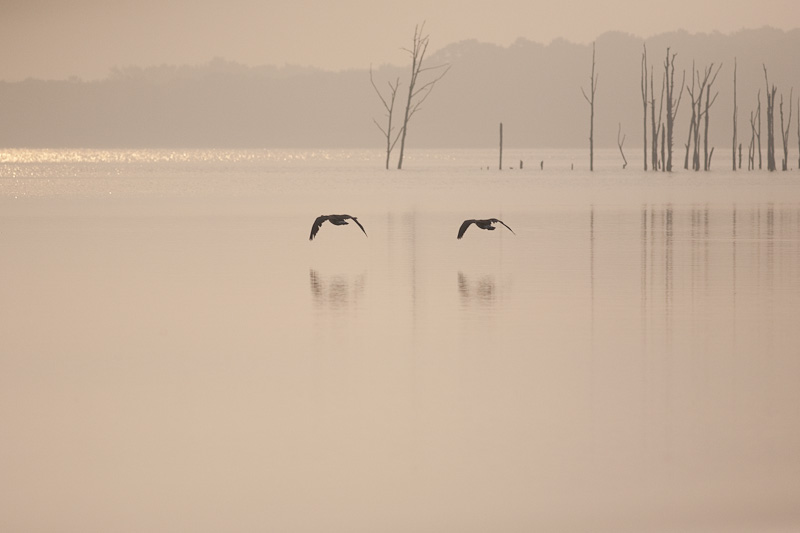
A different crop of the last of the Misty Moisty Morning below. I must say that it looks more golden and silver in Photoshop than in Firefox. Not sure why. Hmm, camera sensor also probably needs cleaning.
wake_of_the_duck

While I'm at it, Mr. Duck in the photo below is incidental, I'm posting the photograph because of the contour lines on the water. The lines occur only in one snapshot out of series, so perhaps it requires a very specific angle of light.

duck2

Desolation

More lemonade.
desolation

A Misty Moisty Morning

Manasquan Reservoir, in Howell, NJ.
An attempt to make lemonade from the lemons that life hands out.

1.
misty_morning
2.
misty_morning2
3.
misty_morning3
4.
misty_morning4

Monday, June 01, 2009

The Chicago School of Economics Goes Belly-Up

Read Brad DeLong. He pulls apart the attempt by Richard Posner, "leader of the Chicago School of Economics and Fourth Circuit Court of Appeals judge to rescue the Chicago School’s foundational assumption that the economy behaves as if all economic agents and actors are rational, far-sighted calculators."

Fun though that is, I'm making this entry to save this quote:

Start with the observation that financial markets have six useful purposes:

* to aggregate the money of people who ought to be savers into pools large enough to finance large-scale enterprises.

* to channel the money of people who ought to be savers to institutions and people who ought to be borrowers.

* to spread risks so that no one individual finds herself ruined by the failure of any one investment or the bankruptcy of any one company or the slow growth of any one region.

* to keep managements efficient by upsetting and replacing teams and organizations that have outlived their usefulness.

* to encourage savings by creating liquidity—the marvelous fact that one can own a piece of an extremely illiquid and durable piece of social capital (an oil refinery, say) and yet get your money out quickly and cheaply should you suddenly have an unexpected need for it.

* to take the money of rich people who like to gamble and, by providing some excitement for them as they watch their gains and losses, use it to buy capital equipment that raises the wages of the rest of us (at the price of paying a 20 percent cut to the Princes of Wall Street). This is a superior use for the rich—and for the rest of us—than, say, taking their wealth to the crap tables of Vegas.

Wall Street innovations and practices are useful only insofar as they promote these six useful purposes. Call them aggregation, accumulation, diversification, efficientization, liquiditization, and casinoization.

Thursday, May 28, 2009

Why US Health Care Costs So Much

(via Matthew Yglesias): Atul Gawande explains, in the New Yorker, why US healthcare costs so much.

It is hard to summarize, but it is the cultural practices of the health care professionals that results in high or low healthcare costs.

This is a must-read article.

Tuesday, May 26, 2009

The road to success

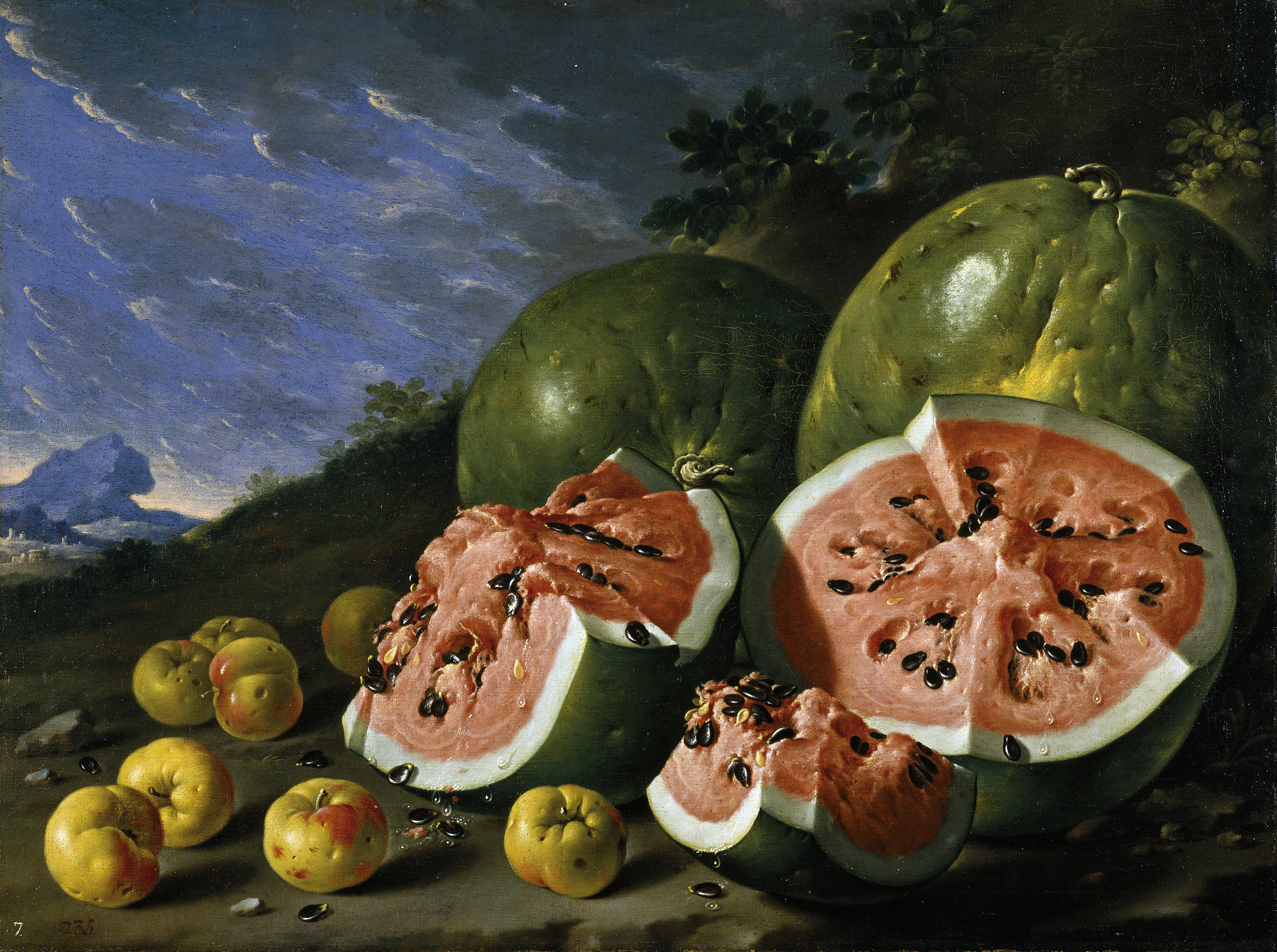
Ken Johnson begins his review in the NYT of a exhibition of Luis Meléndez paintings at the National Gallery of art thus:
Here is a time-tested recipe for success: fail at what you want to do, then do what you really can do.It worked for Luis Meléndez. He desperately sought appointment as a salaried court artist like his contemporary Francisco Goya, but his petitions to the king were rejected. So instead of producing unctuous portraits of nobles, grandiose history paintings and saccharine mythic scenes, he painted small, intensely realistic pictures of fruit, vegetables and kitchenware. Today he is considered the greatest still-life painter of 18th-century Spain.


Image from Wikipedia: "Still Life With Watermelons and Apples in a Landscape (1771)"

Sunday, May 24, 2009

Foerter Farm

If the pictures here are of interest, it is because of the effort to save Foerter Farm from development. Foerter Farm is one of the key open areas along Lawrence Brook. You can read about it here, http://lbwp.org/index.htm .

There are no pictures of the farm here. What the farm lends is open space and an ambience to the surroundings. Photographically, it is a lot of flat land. Currently the areas I saw are fallow.

The Ved Mandir is the next-lot neighbor to the farm. In this view, the farm is behind me. (Blast that street-light pole!)
random-3

Farrington dam is north of the farm. Pictures from the top of the dam I posted already. Here are pictures from the base of the dam.

random-4

random-5

Bicentennial Park abuts the lake formed by the dam. Here is one of the park residents.
Yes, I blew highlights in the background.)
random-1

Finally, something totally unrelated. My niece spotted the opportunity. This is the door of a restaurant at the beach in Long Branch. (Remember, east is the Atlantic. The setting sun hits a not-so-pretty skyline, so the way to capture a sunset is by reflection.)
random-2

My first panorama

I've never done one before! The results are modest.

This is from the top of Farrington dam, on Lawrence Brook, in East Brunswick, NJ.

Farrington Dam

PS: Not sure why this one has a peculiar outline, very much more pronounced than the one above (before a rectangular crop of the Photoshop output).

farrington_dam_2

More on The Case for Working With Your Hands

Matthew B. Crawford's essay, about which I posted yesterday, can be found here.

There are other thoughts there that may be a starting point for elaboration.

The common desi hazard is not Indian-only.
There is a pervasive anxiety among parents that there is only one track to success for their children. It runs through a series of gates controlled by prestigious institutions.


The philosophers of science do not understand why many times one hypothesis wins out. Simplicity and beauty are not quantifiable, nor are reliable guides to scientific truth. But all hypotheses are not created equal. The motorcycle mechanic encounters it, though in a different way.
Measured in likelihood of screw-ups, the cost is not identical for all avenues of inquiry when deciding which hypothesis to pursue. Imagine you’re trying to figure out why a bike won’t start. The fasteners holding the engine covers on 1970s-era Hondas are Phillips head, and they are almost always rounded out and corroded. Do you really want to check the condition of the starter clutch if each of eight screws will need to be drilled out and extracted, risking damage to the engine case? Such impediments have to be taken into account. The attractiveness of any hypothesis is determined in part by physical circumstances that have no logical connection to the diagnostic problem at hand. The mechanic’s proper response to the situation cannot be anticipated by a set of rules or algorithms.


There is an ethical dimension to the very process of thought:
...habits of mind have an ethical dimension that we don’t often think about....The slap of worn-out pistons hitting their cylinders can sound a lot like loose valve tappets, so to be a good mechanic you have to be constantly open to the possibility that you may be mistaken. This is a virtue that is at once cognitive and moral. It seems to develop because the mechanic, if he is the sort who goes on to become good at it, internalizes the healthy functioning of the motorcycle as an object of passionate concern. How else can you explain the elation he gets when he identifies the root cause of some problem?....
There is good reason to suppose that responsibility has to be installed in the foundation of your mental equipment — at the level of perception and habit.


The problem the mid-level manager faces is described:
A manager has to make many decisions for which he is accountable. Unlike an entrepreneur with his own business, however, his decisions can be reversed at any time by someone higher up the food chain (and there is always someone higher up the food chain). It’s important for your career that these reversals not look like defeats, and more generally you have to spend a lot of time managing what others think of you. Survival depends on a crucial insight: you can’t back down from an argument that you initially made in straightforward language, with moral conviction, without seeming to lose your integrity. So managers learn the art of provisional thinking and feeling, expressed in corporate doublespeak, and cultivate a lack of commitment to their own actions.


The remoteness of the decision-makers from the content of the work that they make decisions about is described, leading to this:
Rather, my supervisor and I both were held to a metric that was conjured by someone remote from the work process — an absentee decision maker armed with a (putatively) profit-maximizing calculus, one that took no account of the intrinsic nature of the job. I wonder whether the resulting perversity really made for maximum profits in the long term. Corporate managers are not, after all, the owners of the businesses they run.


The scarcity of good jobs:
A good job requires a field of action where you can put your best capacities to work and see an effect in the world. Academic credentials do not guarantee this.

Nor can big business or big government — those idols of the right and the left — reliably secure such work for us. Everyone is rightly concerned about economic growth on the one hand or unemployment and wages on the other, but the character of work doesn’t figure much in political debate.

Saturday, May 23, 2009

Telling it like it is

Matthew B. Crawford has a essay in tomorrow's NYT Magazine (no link available yet).
The blurb reads "After acquiring a Ph.D. and an information age resume, I opened a motor-cycle repair shop. And that's where I learned to think". The title of the essay is "The Case for Working With Your Hands".

As it happened, in the spring, I landed a job as executive director of a policy organization in Washington. This felt like a coup. But certain perversities became apparent as I settled into the job. It sometimes required me to reason backward, from desired conclusion to suitable premise. The organization had taken certain position, and there were some facts it was more fond of than others. As its figurehead, I was making arguments I didn't fully buy myself. Further, my boss seemed intent on retraining me according to a certain cognitive style — that of the corporate world, from which he had recently come. This style demanded that I project an image of rationality, but not indulge too much in actual reasoning. As I sat in my K Street office, Fred's life as an independent tradesman gave me an image that I kept coming back to: someone who really knows what he is doing, losing himself in work that is genuinely useful and has a certain integrity to it. He also seemed to be having a lot of fun.

Friday, May 22, 2009

Indian mythology

From "Stuffed & Starved : The Hidden Battle for the World Food System" by Raj Patel
Economist Utsa Patnaik has followed the statistical sleight of hand that have enabled India's poor to vanish since the 1970s, and she has calibrated her observations by going back to one of the central features we associate with poverty - hunger.

At the beginning of the 1970s, over half the population was classed as poor. Two decades later, in 1993-94, the number of poor people had fallen to just over one-third. This progress was achieved in no small part because the official threshold for poverty had been lowered. In the 1970s, being on the poverty line afforded you 2,400 calories per day — in the early 1990s, you were afforded only 1,970 calories per day. By 1999-2000, just over one quarter were poor — an impressive reduction. But the threshold for poverty meant consuming fewer than 1,890 calories per day. Says Patnaik, 'by the 60th Round, 2004-05 [the poverty line] is likely to be below 1,800 calories and correspond to less than one-fifth of the rural population.

Today, when the official figure for poverty in India is around 27 per cent, a more accurate calculation based on the implied calorie norm of 2,400 per day puts three-quarters of the population under the poverty line. To put it slightly differently, around half a billion people have been written out of poverty, by the simple expedient of shifting the goal-posts and the diligent advertising of present and future prosperity. This is how the story of 'Shining India' is told - with an official narrative about poverty that directly contradicts the facts. Jobs have been created for the educated middle class, but for those without access to education, the story has been rather different.

Tuesday, May 19, 2009

Is genius necessary to do math?

Terence Tao is a mathematics genius, but here are his thoughts on
Does one have to be a genius to do maths?

The brief answer is - No!

Personally, I feel that the huge quantities of energy that a lot of people spend in wondering where they and their colleagues stand in the genius and intelligence pecking order would be better spent elsewhere.

Monday, May 18, 2009

Pakistan Watch - 10


Sunday, May 17, 2009

Oldies

Courtesy youtube.


or try this.

Hume's problem of induction

The library had this very slim "Philosophy of Science - A Very Short Introduction" by Samir Okasha, and of course, I had to pick it up.

A quick scan of the book seems to indicate that the practice of science has rather loose philosophical foundations. A bigger mystery than any in the book then is why is it that science works? A second question is - are there ways of doing science that we have not yet imagined (this thought because perhaps the incompleteness of our knowledge is what leads to this philosophical mess).

Hume's problem of induction: Inductive reasoning is essentially the generalizing we do from a set of particular instances (e.g., having observed the sun to rise in the east every day, how do we justify that it will do so tomorrow? The process we use is induction). Hume argued that it is impossible to provide a rational (deductive) argument to justify induction. When we try to do so, we find we have to make additional assumptions, such as the uniformity of nature (which begs the question, because we cannot justify the uniformity of nature without induction).

From my point of view, errors of induction abound. A most common one is when someone justifies their prejudices against an entire people based on their experience with a handful of them. But it extends to science, too. Induction would lead us to believe that all matter is made of atoms (or various arrangements of atomic constituents). And yet when we look into deep space, we find that to explain what we see there is that there must be dark gravitating matter that is unlike any matter we are familiar with; consistency with known laws requires this matter to be non-baryonic (i.e., not the familiar atomic constituents).

The answer that, yes, science gives us provisional knowledge, and the laws (or models) that we have are of limited scope still does not answer the problem of induction; because even within the limited scope of the law we have to assume nature behaves uniformly.

Now, I'm not a philosopher, let alone a competent one. Still, here goes. From the point of view of the Indic traditions, before addressing the problem of induction, the focus would be on this rational creature that we are trying to convince from some self-evident premises and logical reasoning that induction is justifiable. My intuition is that the very existence of such a being is knowable to us only by induction. Why does language have any meaning? because we can connect it to the world - the real world, or the mathematical world - through induction. "Cat", "gas", "point", "Euclidean geometry" only make sense because there is some stability of memory and experience. "I", "I think" are concepts arrived at by induction. Perhaps only the God of the Bible or Quran can apprehend the world without induction; we humans cannot. Therefore we cannot properly pose Hume's question. "Convince this creature that knows of itself solely through induction that induction is a valid means of knowledge".

PS: Descartes' "I think, therefore I am" is inductive, not deductive.

Wednesday, May 13, 2009

Brock Farms Watch

Brock Farms is a garden nursery near where I live. Infinitely more fun than following the news from Pakistan.

If you think about it, in some ways gardening is the most basic of pleasures. In another, it is the ultimate luxury.

brock-11


brock-12


brock-13
brock-14


brock-15


brock-16


brock-17


brock-18


brock-19


brock-20


brock-21


brock-22


brock-23

Monday, May 11, 2009

Pakistan Watch - 9

Syed Mansoor Hussain in the Daily Times:

Many in the English language media within the country as well as in the foreign media maintain that the fight against the Taliban in Pakistan is somehow a fight between the forces of liberalism and democracy against the forces of religious extremism and a theocratic impulse. This is entirely wrong.

The forces of liberalism, democracy and secularism lost the fight sixty years ago when the Objectives Resolution was passed by the Constituent Assembly of Pakistan. Since then, at best these forces have a fought a losing battle against the Islamisation of Pakistan. Today, Pakistan is firmly and without argument an Islamic state with a constitution that clearly and unambiguously states that no laws can be repugnant to Islam.

What Pakistan has seen since the death of Mohammad Ali Jinnah in 1948 is essentially a fight between competing visions of piety. For the first twenty years of its existence, Pakistan was under the sway of a ‘kinder and gentler’ version of Islamic practice as envisioned by the Sufi influenced Hanafi-Barelvi majority of the country.

Once General Zia-ul Haq took over and the Afghan war started, the religious centre of the country rapidly shifted under official patronage towards the more austere and extreme Wahhabi-Deobandi interpretation of Islam. The Taliban are a product of that interpretation and find support within the country from those that adhere to that vision of Islam even outside the border areas.
....
....
Once the non-Taliban types are fully mobilised, what we will see is not necessarily a victory of secular democratic forces but rather of the Islamic ideation of a different mindset; but still very much Islamic and perhaps even equally extreme in its own way. I do not believe that Pakistan is headed towards an Iranian-style theocracy but we might not end up too far from it either.

Wednesday, May 06, 2009

The Rise of Islamic Terrorism

Searching in the New York Times archives for the term "Islamic terrorism", the following is found:

1851-1980 - 0 results
1981 - 0 results
1982 - 0 results
1983 - 0 results
1984 - 1 result
DIRE STRAIT; IRAN AND IRAQ TURN UP THE HEAT IN THE GULF

...But Riyadh also fears that a visible American embrace or presence could open the door to Soviet intervention or to Islamic terrorism. So, Washington's overtures toward sending military help are resisted. The Saudis spent the week in full diplomatic...View free preview

May 27, 1984 - By LESLIE H. GELB - Week in Review - 1120 words

1985 - 0 results
1986 - 1 result
BOOKS OF THE TIMES

...In a discussion entitled ''Islamic Terrorism?,'' the scholar Bernard {Lewis} ...character than other religions, Islamic terrorism as practiced today is essentially...about the Western roots of Islamic terrorism, while analyzing some of the...

April 25, 1986 - By John Gross - Arts - 1000 words

1987 - 2 results (One refers to Amir Taheri's book, Holy Terror - Inside the World of Islamic Terrorism)
1988 - 0 results
1989 - 1 result (a reference to Amir Taheri's book, thusly
MINDS THAT NEVER MET

...client ties or Western-Muslim relations. Mr. Taheri, the author of ''Holy Terror: Inside the World of Islamic Terrorism,'' prefers to view the story as more akin to a psychological study of the principals, using the relationship...

April 9, 1989 - By LISA ANDERSON; Lisa Anderson is an associate professor of Middle East politics at Columbia University. - Arts - 973 words

1990 - 0 results
1991 - 0 results
1992 - 1 result, appears as follows:
About the B.C.C.I. Agenda

...nothing "Islamic," about B.C.C.I. Radical Islam opposes banks in general as they are ipso facto "un-Islamic." Terrorism, money-laundering, influence peddling, etc., are political, not religious tactics. As for banking, most...

August 16, 1992 - Business - 202 words

1993 - 5 results (only! despite Feb 26, 1993 WTC bombing)
1994 - 1 result (story about Algeria)
1995 - 4 result (three stories related to Israel, one to Bosnia)
1996 - 4 results
1997 - 1 results
1998 - 4 results
1999 - 3 results
2000 - 8 results
2001 - 40 results
2002 - 26 results
2003 - 24 results
2004 - 56 results
2005 - 36 results
2006 - 42 results
2007 - 40 results
2008 - 21 results

I know I should search for other variations, such as "Islamic terrorist(s)", and so on, but my guess is that it would be borne out that it took two attacks on its hometown for the New York Times to report news through the lens of Islamic terrorism.

Tuesday, May 05, 2009

Pakistan Watch - 8

Asia Times reports (h/t BRF):
he high-profile arrest of a group of Pakistani militants in mid-April in the restive Afghan province of Helmand by the Afghan army and their subsequent handover to the North Atlantic Treaty Organization (NATO) for grilling exposed a jihadi network running to the heart of urban Pakistan.

In the course of interrogation, the militants confessed to being recruited, trained and then launched into Helmand after spending some time in places such as the southern port city of Karachi and Quetta, the capital of Balochistan province.

They also gave details of their Pakistani leaders and their activities, including how these leaders could move around freely and how they owned huge religious establishments.

The report of the interrogation of the militants, circulated to all tiers of NATO command, including the top military and diplomatic command, raises immediate questions on the competence and the commitment of the Pakistani government in controlling militants.

.....
.....

While US officials were shuttling back and forth to Pakistan, seven youths were seized by the Afghan National Army (ANA) in the Gramsir district of Helmand province.

Pakistani youths from the tribal areas and the cities have frequently been arrested or killed by NATO troops in Afghanistan. Most of these youngsters went to the country in the zeal of jihad, and they could usually be linked to particular stand-alone point-persons.

This time it was different.

Three of the men have been identified as Enyatur Rahman (North-West Frontier Province - NWFP), Saeed (NWFP) and Imran (Punjab). When they were apprehended along with the four others, a Pakistani Taliban commander named Mansoor, based in Helmand, aware of the possibility of them exposing a major jihadi network inside Pakistan, tried his level-best to negotiate with ANA to prevent them from falling into the hands of NATO.

But a little mishandling caused ANA to turn them over to NATO.

There is an arrangement between the Taliban and ANA all over the south of Afghanistan, especially in Khost, Paktia, Paktika, Helmand and Ghazni provinces.

Under this, when ANA troops are sent on patrol inside Taliban areas, they pay the Taliban to avoid being killed. The price is arms, ammunition or rockets, which is handed over and then reported as having been lost during an encounter with the Taliban.
In turn, when ANA arrests any Taliban fighters, they demand cash money for their release. If the fighters are Pakistani or non-Afghan, ANA takes a little longer to negotiate a price, but if the fighters are Afghans, ANA personnel will not take unnecessary risks. Either they strike a deal then and there and release the Taliban fighters, or within a few days they hand them over to NATO. The reason is to avoid direct confrontation with the Afghan Taliban and their tribal constituencies, which could cause problems in any prolonged negotiations.

Under this arrangement, as the seven men were Pakistani, Mansoor started negotiations with ANA for the release of his men. ANA demanded US$200,000, Mansoor countered with an offer of 2 million rupees (US$25,000), which was refused. Mansoor then arranged for 10 million rupees to be paid, but since almost 10 days had passed, ANA handed the Pakistanis over to NATO.

Mansoor mishandled the situation on two counts. First, he did not involve the Afghan Taliban command, and secondly he took too long in reaching an agreeable figure.

Apparently, the youths soon began talking under interrogation. In particular, they gave details of a jihadi network known for its past association with the defunct Jaish-e-Mohammad. They also gave details of their backgrounds and how they were recruited and how they had spent time in different Pakistani urban centers, where the leaders of their network openly ran religious establishments.

This information was shared with concerned Pakistani quarters, but by that time all senior Pakistani Taliban commanders had gone underground. In the bigger picture, though, the incident provided Washington the ammunition it needed to really go after the Pakistan national leadership and warn that the entire country needed to stand up as one to fight against all sections and groups of the Taliban in the country. They reminded that it is not any particular government or political party, but the state of Pakistan that is running out of time.

This is where a new joint government involving Sharif could come into play, and Pakistan will once again be dancing to American tunes.

The Pakistani Taliban and their al-Qaeda allies obviously will not stand back. Al-Qaeda's command has already drawn up plans to stir up a reaction all across the country - the masses will be urged to show their allegiance in black and white.

Pakistan Watch - 7

Retired Pakistani Lt. General K. Matinnudin writes in Jang about the pressing concerns of the Islamic Law zealots: (hattip BRF)
Our religious clerics talk about referring matters to the Council of Islamic Ideology established by General Ziaul Haq. There is an interesting case of what kind of work they were engaged in. Once on my way from Karachi to Islamabad. I was sitting next to the then chairman of the Islamic Ideology Council (CII) in the plane. When I asked him what was the issue presently being undertaken by the CII, he told me that they were working on the issue of whether transplanting a non-Muslim’s kidney into a Muslim person is permitted in Islam.


PS: with only some 3% of the population non-Muslim (and that too, in part because Ahmeddiyas are declared to be non-Muslims) one wonders where this non-Muslim supply of kidneys is coming from. In the Pakistani context, this has to be an entirely theoretical question. Maybe they were doing this for the edification of their co-religionists in India, who number about 15% of the population? I doubt it is for Saudis and other wealthy Middle Easterners, who presumably can find a way to purchase organs in India, because they would not look on Pakistanis as authorities on Islam.

Sunday, May 03, 2009

Installing Microwave Ovens

When a headachy installation finally completes, it is a matter for celebration.

I had to replace my dead twelve-year old under-the-counter microwave (model Whirlpool) that had been installed when I moved in. I naively thought that if I could find a model with the identical dimensions and identical mounting hardware, then replacement would be fairly easy, a job I could do myself.

A search on the web revealed my assumption to be dubious. While the 30 inch wide, 16 inch high space for the microwave is supposed to standard, all the Whirlpools showed a dimension of 17 something. When I went to Lowes, however, the salesman there said, no, no they are all 16 inch, don't trust the manual. Well, Lowes did itself out of a nice healthy installation fee! because based on the salesman's assurances, I decided to not pay for the hefty installation that Lowes' charges (almost worth a microwave in itself!), and to try to do it myself.

If you've read "Zen and Art of Motorcycle Maintenance", there is the notion of gumption. You should try handyman's work only when your gumption is high. The trick is to have a functioning kitchen during the periods gumption is low, and the work is temporarily abandoned half-done.

The first part was getting the right color and model of machine, and that took a week. Then while the package was not very heavy, it was packed with a lot of padding and was bulky and difficult to handle. Mentally rehearsed moves before actually moving the item made that a snap.

Then the next part was gathering the steam to do the install. Work schedule, garden stuff and so on made for a delay of almost two weeks.

The instructions say, two persons are necessary to remove or lift the microwave into position. That can't be true, because the store would send only one installer. And it isn't true. First, unpacked, the microwave is much more manageable. Second, a small stool, a telephone directory and a set of kitchen chopping boards turns out to be more than adequate to position the microwave for removal or installation. (The telephone directory is essential because you need some "give" in the support). You basically first position the stool (stool is standing on the countertop) then put the microwave on it. Lifting the microwave with one arm, you slide the necessary extra supports one by one.

The real problem was the hardware. The store guy was wrong, this was really 17+ inches. Moreover the plate that goes against the back wall has entirely changed in the last 12 years. That had to be deinstalled and replaced with the new much smaller plate. The old plate covered the entire back of the microwave. The new is simply a strip at the bottom. The old plate had 8 supports - four screws into studs and four drywall supports. The new one has four - two bolts into studs and two drywall supports. Anyway, the installation there is essentially on a flat surface, so with reasonable care, it is a finite job.

Then there are the two bolts that fasten the microwave at the top to the cabinet above it. My first calculation was that an existing hole and a new hole would do. The new hole I drilled after what I thought were reasonable measurements. Disaster! (not really, it just felt that way). The bolts were way off. The problem is that looking from the bottom, the cabinet surface is not flat, there are all kinds of wooden reapers going this way and that.

Ultimately, the solution was, hoist the microwave into final position. Mark on it the edge of the cabinet. Mark the cabinet with key positions on the microwave. Go to Home Depot and get a right-angle (very important, relying on the edge of your ruler for a right angle can be fatal), and a contour gauge. (Cute tool, a contour gauge. Think of a tightly packed comb of moveable parallel pins. You press it against a surface and pins slide to conform to the surface.) Measure in every which way the position of the bolt receptacles on the microwave - from the centerline, from the edges, from each other. Make measurements and markings every which way on the cabinet. Measure five times to verify. Make a prayer. Drill holes. Install.

Yay! it worked! Took half of Saturday and half of Sunday! (remember the gumption thing?) The exhilaration comes from having done it entirely solo!

Now to put all the tools away.....

PS: the completed installation -

mw-1

Sunday, April 26, 2009

Pakistan Watch - 6

Nadeem Paracha writes in Dawn that Pakistanis have been brainwashed into accepting a degenerated form of political Islam, which is not connected to their traditions.
Pakistanis eventually gobbled up a myopic and unthinking brand of Islamic logic. So much so, that today the overall intellectual faculties of critique in the society have been overpowered by loud discourses that are incapable of ever venturing outside from the top-of-the-mind clichés about religion that have been fed to us ever since the 1980s.

These clichés and notions were cleverly engineered into our system by years and years of misinformation on the subject. That’s why most Pakistanis today, both young and old, become like social time bombs, always going off the moment anyone dares question these notions.
(emphasis added)

The author continues:
To tackle and face it, we will have to liberate our minds from the concoctions we’ve been fed in the name of Political Islam and history. We need to become critical again, so we can escape the unfounded guilt many of us feel in responding rationally to anyone calling for the implantation of ‘divine laws’ and ‘holy writ’.
(emphasis added)

Indoctrination that produces guilt in the ones who challenge it is powerful stuff indeed.

Thursday, April 23, 2009

Terrorism is Lucrative!

Pakistan will never kill the goose that lays golden eggs.
Between 1952 and 2008, Islamabad received over $73bn as foreign aid, according to Pakistan’s Economic Survey. But in the period since the Mumbai strikes, the amount of aid pledged or delivered to Pakistan has totalled a staggering $23.3bn. This figure excludes China’s unpublicised contributions but includes the IMF’s $7.6bn bailout package, released after the Mumbai attacks.
(hat-tip banerjee)

Pakistan Watch - 5

This may help in understanding Pakistan Watch - 4 below. Emphasis added (thanks BRF!)

Two stuffed camels, as tall and as dour as the actual beasts, stand these days along the Lahore canal. Atop them ride two figures – dressed from head-to-toe in stark white robes and obviously meant to represent desert Arabs. The camels seem oddly out of place amidst the colourful floats and other, sometimes garish, displays of dancers and peacocks and boats and horses meant to mark the city's Spring Festival. One asks how they came to stand there or what role they have amongst the 'dhol' carrying figures from a Punjabi village or the colourfully dressed women who churn their pots of 'lassi'.

But the presence of the Arabs represents something of the confusion that has overtaken us. Since the 1980s, a forceful attempt has been made to turn heads to the west, to place Pakistan in the Muslim Middle East and to have it abandon its place amidst the more diverse whole of South Asia. It is this thinking of course that has led to the absurd -- but widely held notion that the history of Pakistan begins with the landing in Sindh of Muhammad Bin Qasim in 711 A.D. Today, the mindset that inspired this twist on history seems active again. There is talk of India, rather than the Taliban, being the 'real' enemy.

This view is echoed frequently in the media. This of course is no big surprise given that the media has, indeed, traditionally leaned largely to the right. But more alarming is the fact that within Pakistan's military there is a clear opinion that while the civilian government may see militants as the enemies, the real foe is India.

So far, even if reluctantly, the military has been following political orders to take on the militants. It has not had much success. This embarrassment seems to be one factor in its decision that it may be better to join an enemy one cannot beat. Faced with a military that it believes is not fully under its command, the political setup too has shown signs of wavering.

There are no easy answers. But a start has to be made somewhere. One place to do so is by encouraging people to gaze once more to the east and to re-establish Pakistan as a South Asian nation, an inheritor of its unique blend of cultures, rather than as a country that equates itself only with that portion of the past that belongs to Islam.

To do this, the fallacy that we can militarily take on India – perhaps because we have nuclear weapons – must be exposed as nothing more than a lie. An army that has been unable to tame a few thousand maverick militants can hardly be expected to take on a far larger and more organized army. There are also other hard realities that must be confronted. Much as we may wish to deny it, much as stories of Indian 'failure' are lapped up by our media, the real, unquestionable fact is that that country has succeeded.

Its 1.2 billion people, despite a slowdown that has crippled many segments of the Indian economy, look to the future with hope. Pakistan's 160 million see less and less light to brighten the darkness that swirls all around and threatens to overwhelm them. Think tanks hold India will, by 2020, rank as a world super power. They ask if Pakistan can till then even hold together as a cohesive state.


PS: a bit of the cart before the horse above - Pakistan's confrontational attitude to India derives from the idea that Pakistan is purely Islamic. What the author is saying is that because Pakistan cannot win in that confrontation, it should reexamine its premises. I would say, Pakistan should reexamine its premises, and from that understanding, abandon its confrontation.

Wednesday, April 22, 2009

Pakistan Watch - 4

Read this essay. A lot of things should become clearer.

...what I didn’t realize was that my attempts to become a better Muslim actually distanced me from my ethnic identity rather than compliment it. In actuality I was doing something that many young Pakistani Muslims do these days: I was trying to be Arab....

So many times, I’ve heard fellow Pakistani Muslims saying that we should abolish culture completely because there is no culture in Islam.


PS: the above is the logical outcome of this:
Pakistan, the Quaid-e-Azam remarked, was not the product of the conduct or misconduct of the Hindus. It had always been there; only they were not conscious of it. Hindus and Muslims, though living in the same towns and villages, had never been blended into one nation; they were always two separate entities.

Tracing the history of the beginning of Islam in India, he proved that Pakistan started the moment the first non-Muslim was converted to Islam in India long before the Muslims established their rule. As soon as a Hindu embraced Islam he was outcast not only religiously but also socially, culturally and economically.

As for the Muslim, it was a duty imposed on him by Islam not to merge his identity and individuality in any alien society. Throughout the ages Hindus had remained Hindus and Muslims had remained Muslims, and they had not merged their entities - that was the basis for Pakistan. In a gathering of European and American officials he was asked as to who was the author of Pakistan. Mr. Jinnah's reply was 'Every Mussalman.'

Now the question is how to get Pakistan? Raising his eye-brows and speaking in grim tones, Mr. Jinnah said, "not by asking, not by begging, not even by mere prayers but by working with trust in God. Inshallah! Pakistan is now in your hands."

The Dawn, March 10, 1944
From here.

Sunday, April 19, 2009

Spring


spring-7

spring-2

spring-1

spring-4

spring-9

spring-8

spring-6

spring-3


Pakistan Watch - 3

At times of stress in their, national life, some Pakistanis take refuge in the notion that if they simply rename themselves, their problems will go away. For instance, for a while, they talked about their problems as being "South Asian" problems.

With the Taliban breathing down their neck, and with no coherent response from the state, such types are further retreating into the notion that they are the real India.

Here are two such. The first claims the heritage of India for "proto-Pakistan". Let us simply forget that the creation of Pakistan in 1947 was accompanied with an explicit rejection of such heritage. Forget that in subsequent years, Pakistani history is written to have begun with the invasion of Sindh by Muhammad bin Qasim in the seventh century AD. Forget what V.S. Naipaul (I think) told us, of the graffiti on the remains of the 2000BC city Harappa - "this is the fate of unbelievers". Just read an excerpt:
The Vedas, particularly the Rig Veda, with its strong avowal of monotheism, was written in proto-Pakistan. Auyurveda, the so-called Indian ancient system of medicine, now in great vogue in India, was compiled by Carak, a man from Multan, in proto-Pakistan. Classical Sanskrit was developed in proto-Pakistan. It was codified in the great Eight Chapters of Panini, a man from Swabi, in NWFP, proto-Pakistan. Kautilya/Canakya/Cankya, who wrote Arth Shaastar, and who is regarded as a huge Indian scholar, taught at Takshasila University, in proto-Pakistan.
Yoga, the ‘Indian’ system of health and meditation (and Sankhya philosophy, the cornerstone of Hinduism - a name given by the British, in the eighteenth century, to the diverse cults in proto-India - was codified by Patanjali, a man from Multan, in proto- Pakistan as the Yog Sutr..
The idea being promoted in the essay is that it is Pakistan that deserves the support that derives from any interest in the West in ancient (pre-Islamic) Indian culture.

(Snark) Anyone who cannot pronounce "tra" (as in Arth Shaastra) can hardly claim to be a descendant of the Sanskritic civilization.


The second argues thusly
:
...Hindus do not have the name for their own country - they have swindled us of our name “India” - which had been ours exclusively.

Indian Muslims on either side of the border have never been ‘Pakistanis’ and Hindus on either side of the border have never been ‘Indians’ - We have been ‘Indian Muslims’ throughout and they have been ‘Bharati Hindus’ throughout. Similarly Indian Muslims have never ever named their homeland as Pakistan during their 1000-year rule - and ‘Bharati Hindus’ have never ever named their homeland as India, before the Muslims rule.
and
The word, Pakistan has no real historical meaning and had never ever been a word or entity that had been written or entered in any dictionary or encyclopedia in any part of the world.


Why does it matter whether the people are called Pakistani or some other name?
A goodwill name does not come by overnight - it takes centuries and years that a goodwill name is established and recognized.


Namely, rename Pakistan "The Islamic Republic of India" and suddenly it becomes the recepient of goodwill that was in the centuries in the making.

Pakistan Watch - 2

It is always the Jews!
From The Daily Times,
Federal Minister Senator Azam Khan Swati of the Jamiat Ulema-e-Islam (JUI-F) said on Saturday that the flogging of the 17-year-old girl in Swat was a Jewish conspiracy aimed at destroying peace in Swat and distort the image of those Islamists who sport beards and wear turbans.


A Dawn editorial says Pakistan is living in denial.
... it is alarming that Pakistan’s state and society continue to bury their heads in the sand and resort to denial of either specific acts of brutality or the threat in general posed by the Taliban. The most recent example of this approach is an investigation team’s conclusion that the video depicting the whipping of the young woman in Swat was ‘fake and false’, as indicated by Interior Secretary Kamal Shah.

He quoted the final report as saying that that no such incident took place since the girl in question denied it and the area’s residents also expressed their ignorance. Yet anyone who has suffered such an act of barbarity, and who continues to live under the shadow of his or her persecutors, is unlikely to risk inducing their ire further. More dangerous, however, is the reduction of the issue to a debate over whether or not the video was ‘real’ and when exactly the incident took place.

This constitutes yet another example of the manner in which the Pakistani state and its citizenry live in denial of the clear and present danger to their personal freedoms. It is precisely this attitude that has allowed the Taliban and others of their ilk to make such deep inroads. Even if this particular video was faked, there is ample evidence otherwise of the Taliban’s brutality. Reports of beheadings, shootings and the coercion of people — who are citizens of Pakistan and residents of Swat — are made public practically everyday.


Meanwhile the Taliban turn the screws.
Dawn, Ardeshir Cowasjee
Footnote: Karachi is already feeling the Taliban pinch. Co- educational schools in Defence, Clifton and Saddar areas are known to have received visits and been threatened if they do not change, others have been sent letters with the same message.

Jang
Maulana Sufi Muhammad said that only black turban was ‘Sunnat-e-Nabvi’ and using turban of any other colour was not ‘Sunnat-e-Nabvi’. He said that the existing system was in contravention of Nizam-e-Islam and the Holy Quran.

High Courts and Supreme Court were ‘Ghair Sharaiee’ institutions and going for appeal in ‘Ghair Sharaiee’ institutions was ‘Haram’. He said Darul Qaza could be approached in case of any reservations on our verdicts, but the final decisions of Darul Qaza not allowed to be challenged in the High Courts and Supreme Court.

Pakistan Watch

In some ways, we are holding a begging bowl in one hand, and a raised middle finger in the other. If we had a third hand, it would be holding a gun to our head. In fact, this is now our preferred negotiation mode.
Irfan Husain (Mazdak) in Dawn.


Noting that so far there has not been a popular revolt against feudalism in Pakistan, this opinion in The News continues:
The sophistication of the Taliban strategy is becoming clearer. They were unlikely ever to come to national power via the ballot box, but they may come to it via popular revolution.

Examining the way in which they took hold of Swat tells us that they targeted a group of key landowners and landlords, as well as several local politicians who were also landowners or landlords. Disaffected peasants were organised into armed groups, pressure was applied either through direct intimidation or indirectly by the publication of 'the list' of people disapproved of by the Taliban. 'The masses' were promised swift transparent justice for their grievances, a redistribution of wealth – the landlords and landowners having fled – and an end to corrupt and inefficient governance. To a landless peasant or daily-wager this was an attractive proposition; even if it did come loaded with a different version of tyranny. The result is what we see today with Swat existing as a state outside of Pakistan and ruled by the Taliban. Swat is the prototypical model, the 'proof of concept' that the Taliban needed in order to replicate their success outside of their Pashtun homelands. They are now self-sustaining, less reliant on foreign aid, and have the rudiments of governance at their fingertips. They also make plain that the conquest of the rest of the country is their end-goal.

As recently as two years ago we might have laughed this off such is its improbability. Not today. Today there is no shortage of Doomsday scenarios for Pakistan emerging from various think-tanks and commentators. Some of them are far-fetched – the suggestion that the state will collapse in six months for instance - but others less so and we have to consider them as a possibility. There is a ring of credibility about the New York Times analysis that should give us pause for thought, and it cannot be dismissed as the musings of a crackpot. The state is extremely vulnerable not only because of the ramshackle politics and corruption, but also at the hitherto untouchable feudal end of the spectrum. And where is the great stronghold of feudalism? Punjab. Punjab is populous, wealthy and provides most of the power-elites that have run the country since partition – periodically aided and abetted by Sindhi feudals. Punjab is clearly in the sights of the Taliban. They have power-bases in all the major cities and the conscientisation and mobilization of a disaffected peasantry, albeit on a far larger scale than in Swat valley, is possible. They are tilling fertile ground – the peasantry sees a dwindling income from the land and endless years of bonded labour ahead, and in the cities the pool of uneducated or ill-educated and unemployed urban youth is an unruly character in search of an author. Punjab will be the Swat model writ large; and it may be that the failure to implement land reform from the outset of the state, choosing instead to perpetuate feudalism, will be its downfall.


Dr. Farrukh Saleem laments the fate of Swat, in The News
:
Which one of the 192 member-states of the UN would Swat be like? Which one of the 57 OIC countries would Swat be like? Saudi Arabia or Afghanistan?

Would the 'Switzerland of Pakistan' now be like Saudi Arabia? Saudi Arabia's per capita book readership is one of the lowest on the face of the planet. Saudi Arabia is yet to produce a Nobel prize winner (Israel has produced eight). Saudi Arabia has no more than 5,000 scientists (200 per million) while the US has 1.5 million (4,000 per million). Saudi Arabia hasn't invented anything of consequence for the human civilisation in its 77 years of existence. Saudi Arabia officially practises a comprehensive gender-based apartheid system whereby 14 million Saudi women have different legal rights than Saudi men, an "unequal access to property and jobs, and restrictions on freedom of movement… (Saudi women were not allowed to vote in the municipal elections of 2005)." Would the 'Switzerland of Pakistan' now be like the 'Islamic Emirate of Afghanistan' (as Afghanistan was from 1996 to 2001)? No political parties, no politics, no elections -- and absolutely dictatorial. No TV, no chess, no kites. For women -- restricted employment, no education, no sports, no nail-polish. For everyone else -- no videos, no music, no dancing, no clapping during sports events -- and a beard "extending farther than a fist clamped at the base of the chin." No paintings, no photographs, no stuffed animals -- and no dolls.


Letter published in The News:
Doctor or death?
Sunday, April 19, 2009
I am a girl who lives in Swat -- and I have a question for the Taliban. Will I be allowed to become a doctor? If not tell me now -- so I can commit suicide.

Dari

Swat

Friday, April 17, 2009

Pakistan - the coming revolution

More on jaziya.

But perhaps the real significant news of the day is that the Taliban seem to be fomenting a religious marxist movement. If it is true, then in my judgment they are unstoppable.

NYT:

In Swat, accounts from those who have fled now make clear that the Taliban seized control by pushing out about four dozen landlords who held the most power.

To do so, the militants organized peasants into armed gangs that became their shock troops, the residents, government officials and analysts said.

The approach allowed the Taliban to offer economic spoils to people frustrated with lax and corrupt government even as the militants imposed a strict form of Islam through terror and intimidation.

“This was a bloody revolution in Swat,” said a senior Pakistani official who oversees Swat, speaking on the condition of anonymity for fear of retaliation by the Taliban. “I wouldn’t be surprised if it sweeps the established order of Pakistan.”

The Taliban’s ability to exploit class divisions adds a new dimension to the insurgency and is raising alarm about the risks to Pakistan, which remains largely feudal.

Unlike India after independence in 1947, Pakistan maintained a narrow landed upper class that kept its vast holdings while its workers remained subservient, the officials and analysts said. Successive Pakistani governments have since failed to provide land reform and even the most basic forms of education and health care. Avenues to advancement for the vast majority of rural poor do not exist.

Analysts and other government officials warn that the strategy executed in Swat is easily transferable to Punjab, saying that the province, where militant groups are already showing strength, is ripe for the same social upheavals that have convulsed Swat and the tribal areas.

Mahboob Mahmood, a Pakistani-American lawyer and former classmate of President Obama’s, said, “The people of Pakistan are psychologically ready for a revolution.”

Sunni militancy is taking advantage of deep class divisions that have long festered in Pakistan, he said. “The militants, for their part, are promising more than just proscriptions on music and schooling,” he said. “They are also promising Islamic justice, effective government and economic redistribution.”


"Avenues to advancement for the vast majority of rural poor do not exist" - this is something that Pakistan watchers have noted for a long time. This remains true in India as well, though not with the finality that obtains in Pakistan. The BJP, even with its "India Shining" and good overall economic record, got voted out I think precisely because little of that growth was seen in the rural areas.

Another thought is that the powerful can yield justice voluntarily, or else, eventually pressure will build up to the level where there is a revolution. Perhaps the degree of resistance from the powerful has been different in Pakistan and India.

Anyway, gather the popcorn and soda and watch. Nothing the US can do to prop up the Pakistani Anglosphere is going to work. The Taliban have both religious sentiments and economic justice working in their favor (not that they are going to be able to deliver anything; simply that the wind blows favorably for them).

Wednesday, April 15, 2009

Open Letter to General Kayani

From here.
An open letter to Gen Kayani
Tuesday, April 14, 2009
By Dear Gen Kayani,
Sir, let me begin by recounting that old army quip that did the rounds in the immediate aftermath of World war II: To guarantee victory, an army should ideally have German generals, British officers, Indian soldiers, American equipment and Italian enemies.

A Pakistani soldier that I met in Iraq in 2004 lamented the fact that the Pakistani soldier in Kargil had been badly let down firstly by Nawaz Sharif and then by the Pakistani officers' cadre. Pakistani soldiers led by Indian officers, , he believed, would be the most fearsome combination possible. Pakistani officers, he went on to say, were more into real estate, defence housing colonies and the like.

As I look at two photographs of surrender that lie before me, I can't help recalling his words. The first is the celebrated event at Dhaka on Dec 16, 1971, which now adorns most Army messes in Delhi and Calcutta. The second, sir, is the video of a teenage girl being flogged by the Taliban in Swat -- not far, I am sure, from one of your Army check posts.

The surrender by any Army is always a sad and humiliating event. Gen Niazi surrendered in Dhaka to a professional army that had outnumbered and outfought him. No Pakistani has been able to get over that humiliation, and 16th December is remembered as a black day by the Pakistani Army and the Pakistani state. But battles are won and lost – armies know this, and having learnt their lessons, they move on.

But much more sadly, the video of the teenager being flogged represents an even more abject surrender by the Pakistani Army. The surrender in 1971, though humiliating, was not disgraceful. This time around, sir, what happened on your watch was something no Army commander should have to live through. The girl could have been your own daughter, or mine.

I have always maintained that the Pakistani Army, like its Indian counterpart, is a thoroughly professional outfit. It has fought valiantly in the three wars against India, and also accredited itself well in its UN missions abroad. It is, therefore, by no means a pushover. The instance of an Infantry unit, led by a lieutenant colonel, meekly laying down arms before 20-odd militants should have been an aberration. But this capitulation in Swat, that too so soon after your own visit to the area, is an assault on the sensibilities of any soldier. What did you tell your soldiers? What great inspirational speech did you make that made your troops back off without a murmur? Sir, I have fought insurgency in Kashmir as well as the North-East, but despite the occasional losses suffered (as is bound to be the case in counter-insurgency operations), such total surrender is unthinkable.

I have been a signaller, and it beats me how my counterparts in your Signal Corps could not locate or even jam a normal FM radio station broadcasting on a fixed frequency at fixed timings. Is there more than meets the eye?

I am told that it is difficult for your troops to "fight their own people." But you never had that problem in East Pakistan in 1971, where the atrocities committed by your own troops are well documented in the Hamoodur Rahman Commission Report. Or is it that the Bengalis were never considered "your own" people, influenced as they were by the Hindus across the border? Or is that your troops are terrified by the ruthless barbarians of the Taliban?

Sir, it is imperative that we recognise our enemy without any delay. I use the word "our" advisedly – for the Taliban threat is not far from India's borders. And the only force that can stop them from dragging Pakistan back into the Stone Age is the force that you command. In this historic moment, providence has placed a tremendous responsibility in your hands. Indeed, the fate of your nation, the future of humankind in the subcontinent rests with you. It doesn't matter if it is "my war" or "your war" – it is a war that has to be won. A desperate Swati citizen's desperate lament says it all – "Please drop an atom bomb on us and put us out of our misery!" Do not fail him, sir.

But in the gloom and the ignominy, the average Pakistani citizen has shown us that there is hope yet. The lawyers, the media, have all refused to buckle even under direct threats. It took the Taliban no less than 32 bullets to still the voice of a brave journalist. Yes, there is hope – but why don't we hear the same language from you? Look to these brave hearts, sir – and maybe we shall see the tide turn. Our prayers are with you, and the hapless people of Swat.

The New York Times predicts that Pakistan will collapse in six months. Do you want to go down in history as the man who allowed that to happen?


The writer is a retired colonel of the Indian army who lives in Pune. Email: hbpuri@hotmail.com

Tuesday, April 14, 2009

Jazia

Jazia is a tax imposed by the Islamic state on infidels.

Pakistan Daily Times:

Sikh families leave Orakzai after Taliban demand jizia

By Abdul Saboor Khan

HANGU: Sikh families living in Orakzai Agency have left the agency after the Taliban demanded Rs 50 million as jizia (tax) from them, official sources and locals said on Tuesday.

Residents of Ferozekhel area in Lower Orakzai Agency told Daily Times on Tuesday that around 10 Sikh families left the agency after the demand by the Taliban, who said they were a minority and liable to pay the tax for living in the area in accordance with sharia.

Locals said the Taliban had notified the Sikh families about the ‘tax’ around a week ago. They said of the 15 Sikh families in Ferozekhel, 10 had shifted while the remaining were preparing to do so.

The locals said the families were impoverished and had left the area to avoid any Taliban action.

Monday, April 13, 2009

Obama reneges on civil liberties

The President (Bush) asserted the right to capture anyone anywhere in the world and to detain them indefinitely without judicial review. Obama, despite speaking out against this as a senator and as presidential candidate, is also asserting this right as president.

The President (Bush) asserted the right to listen in on anyone's phone conversations without warrant, without judicial review and without legal recourse for anyone who was so wiretapped, claiming that even having to make an argument in camera to a federal judge that state secrets would be revealed to the detriment of national security in a particular case would jeopardize national security. Obama makes a similar even more sweeping claim.

Opprobrium is coming in from many quarters.

As Glenn Greenwald says (all the above links are to various of his writings)
Even for the hardest-core Obama loyalists, it's rather difficult to attribute these increasingly harsh condemnations of Obama's civil liberties, secrecy and executive power abuses to bad motives or ignorance when they're coming from the likes of Russ Feingold, TalkingPointsMemo, the Center for American Progress, Nancy Pelosi, EFF, the ACLU, The New York Times Editorial Board, Keith Olbermann, Jonathan Turley, The American Prospect, Bruce Fein, Digby, along with some of the most enthusiastic Obama supporters and a bevvy of liberal law professors and international law experts -- those who were most venerated by progressives during the Bush era on questions of the Constitution and executive power. ......

.....Whatever else one might say, the rule of law, the Constitution, and core civil liberties are the centerpiece of a healthy and well-functioning government, and nothing justifies an assault on those safeguards. That was the argument most progressives made throughout the Bush presidency, and the more Obama continues on the Bush/Cheney path in this area, the more solid the progressive consensus against his actions becomes.

Sunday, April 12, 2009

Our periodic crises of debt repudiation

NYT op-ed

Frederick Soddy was a Nobel Laureate chemist turned political economist. He conceived of the economy as a thermodynamic engine. His ideas lead to a view of the root cause of the financial problems.

....Debt, for its part, is a claim on the economy’s ability to generate wealth in the future. “The ruling passion of the age,” Soddy said, “is to convert wealth into debt” — to exchange a thing with present-day real value (a thing that could be stolen, or broken, or rust or rot before you can manage to use it) for something immutable and unchanging, a claim on wealth that has yet to be made.....

Problems arise when wealth and debt are not kept in proper relation. The amount of wealth that an economy can create is limited by the amount of low-entropy energy that it can sustainably suck from its environment — and by the amount of high-entropy effluent from an economy that the environment can sustainably absorb. Debt, being imaginary, has no such natural limit. It can grow infinitely, compounding at any rate we decide.

Whenever an economy allows debt to grow faster than wealth can be created, that economy has a need for debt repudiation. Inflation can do the job, decreasing debt gradually by eroding the purchasing power, the claim on future wealth, that each of your saved dollars represents. But when there is no inflation, an economy with overgrown claims on future wealth will experience regular crises of debt repudiation — stock market crashes, bankruptcies and foreclosures, defaults on bonds or loans or pension promises, the disappearance of paper assets.

It’s like musical chairs — in the wake of some shock (say, the run-up of the price of gas to $4 a gallon), holders of abstract debt suddenly want to hold money or real wealth instead. But not all of them can. One person’s loss causes another’s, and the whole system cascades into crisis. Each and every one of the crises that has beset the American economy in recent years has been, at heart, a crisis of debt repudiation. And we are unlikely to avoid more of them until we stop allowing claims on income to grow faster than income.

Soddy would not have been surprised at our current state of affairs. The problem isn’t simply greed, isn’t simply ignorance, isn’t a failure of regulatory diligence, but a systemic flaw in how our economy finances itself. As long as growth in claims on wealth outstrips the economy’s capacity to increase its wealth, market capitalism creates a niche for entrepreneurs who are all too willing to invent instruments of debt that will someday be repudiated. There will always be a Bernard Madoff or a subprime mortgage repackager willing to set us up for catastrophe. To stop them, we must balance claims on future wealth with the economy’s power to produce that wealth. (emphasis added)


And that leads to a prescription on how to avoid this.

Tuesday, April 07, 2009

Andher Nagari Chaupat Raja

"Dark is the nation and insane the king" - the full story is here. The old saying describes a situation where irrationality reigns and injustice is rampant.

Glenn Greenwald:

In his quest to obtain key documents proving that his client was tortured at the hands of the Bush administration, Smith is now involved in a truly bizarre though revealing controversy, first reported last Thursday by The Guardian. In February, Smith wrote a letter to President Obama urging Obama to authorize the release of evidence relevant to Mohamed's torture so that Obama does not become complicit in covering-up crimes of torture (which is itself a crime). Smith attached to his letter to Obama a 2-page memo detailing the facts proving his client's torture. But under the rigid rules of Guantanamo, all lawyers for detainees are barred (under threat of criminal penalties) from disclosing any information they learn from their clients -- even if the subject of the communication is the torture to which their clients were subjected -- without first obtaining the approval from something called the "Privilege Review Team," a secret tribunal of Pentagon officials who monitor and censor all communications from Guantanamo lawyers.

As a formality, Smith submitted his letter to President Obama to this Privilege Review Team, naturally assuming (since Obama obviously has full security clearances) that it would be passed on to Obama without any problems. Instead, the letter was sent back to Smith with the entire body of the memo -- every word -- redacted with black blocks, with only the "from" line left (see the unbelievable redacted memo here -- .pdf). In other words, the Privilege Review Team blocked Smith from communicating to President Obama the facts surrounding his client's torture at Guantanamo. Smith then sent that redacted memo directly to Obama along with a new cover letter informing Obama of the "bizarre reality" that "you, as commander in chief, are being denied access to material that would help prove that crimes have been committed by US personnel. This decision is being made by the very people who you command."

As a response to that new letter, Smith and a colleague of his have now been summoned to appear before a Washington court on May 11, to answer a criminal complaint filed by the Privilege Review Team, alleging that Smith -- merely by sending Obama the redacted memo -- has violated the secrecy terms to which he is bound. He faces up to six months in prison if found guilty.

Just think about that: these Pentagon officials -- who have long been accused of using their censoring powers to hide evidence of torture at Guantanamo -- first blocked Smith from sending Obama any information about his client's torture, and now seek to criminally punish him merely for notifying Obama of how extensively his letter to Obama had been redacted by that Pentagon agency. If that isn't the behavior of a lawless and tyrannical government completely out of control, it is hard to know what is.

Lesson from History

"If the Taliban are not defeated, history is a witness that whenever Khyber has been breached, the battle has been fought in Panipat." - Pakistan's Ambassador to the UN, Abdullah Hussain Haroon, quoted by Khalid Hassan in the Daily Times.

Saturday, April 04, 2009

Yet more financial stuff

Wall Street owns our government.

Harvard Derivatives Whiz Fired For Emailing Larry Summers About "Frightening" Trades?

Tuesday, March 31, 2009

More Financial Stuff

1. It is not just the toxic assets, it is the CDSes.

2. The Formula that killed Wall Street.

3. An explanation of just what was so pernicious about the Formula that killed Wall Street.

4. How the CDS revived the bucket shop, banned in 1907.

5. The author of the CDO creation software tells his story.

A lot of reading, but good reading.

Sunday, March 29, 2009

The Daily Dish: View from your recession

Andrew Sullivan has an occasional "The view from your recession". For some reason this one "got" to me.

Here are some others:
#55

#61

Even #63 did not move me as much.

Saturday, March 28, 2009

Simon Johnson: The Quiet Coup

Here.

Quoting the official blurb:
The crash has laid bare many unpleasant truths about the United States. One of the most alarming, says a former chief economist of the International Monetary Fund, is that the finance industry has effectively captured our government—a state of affairs that more typically describes emerging markets, and is at the center of many emerging-market crises. If the IMF’s staff could speak freely about the U.S., it would tell us what it tells all countries in this situation: recovery will fail unless we break the financial oligarchy that is blocking essential reform. And if we are to prevent a true depression, we’re running out of time.

Friday, March 27, 2009

Goose

IMG_9997

Saturday, March 21, 2009

Matt Taibbi in Rolling Stone

Read it here.

People are pissed off about this financial crisis, and about this bailout, but they're not pissed off enough. The reality is that the worldwide economic meltdown and the bailout that followed were together a kind of revolution, a coup d'état. They cemented and formalized a political trend that has been snowballing for decades: the gradual takeover of the government by a small class of connected insiders, who used money to control elections, buy influence and systematically weaken financial regulations.

The crisis was the coup de grâce: Given virtually free rein over the economy, these same insiders first wrecked the financial world, then cunningly granted themselves nearly unlimited emergency powers to clean up their own mess. And so the gambling-addict leaders of companies like AIG end up not penniless and in jail, but with an Alien-style death grip on the Treasury and the Federal Reserve — "our partners in the government," as Liddy put it with a shockingly casual matter-of-factness after the most recent bailout.

The mistake most people make in looking at the financial crisis is thinking of it in terms of money, a habit that might lead you to look at the unfolding mess as a huge bonus-killing downer for the Wall Street class. But if you look at it in purely Machiavellian terms, what you see is a colossal power grab that threatens to turn the federal government into a kind of giant Enron — a huge, impenetrable black box filled with self-dealing insiders whose scheme is the securing of individual profits at the expense of an ocean of unwitting involuntary shareholders, previously known as taxpayers.

Wednesday, March 18, 2009

Untitled

goose

PS: the mellow light Rajan mentioned in the comment was on the trees as follows (facing east; the pic above is facing south):
mellowlight

PPS: trial crop - perhaps a telephoto would have been good here, because the structure of the trees is mildly interesting :)
mellowlight2

The Real AIG Scandal

While the firestorm rages about the bonuses for the very individuals in that one unit of AIG that brought down the whole company writing toxic CDSes, the real scandal is that AIG was used as a conduit to give Goldman Sachs, JP Morgan Chase, Bank of America, etc., 100 cents on the dollar on their worthless assets. Elliot Spitzer reminds us of this (via dkos)

The AIG bailout has been a way to hide an enormous second round of cash to the same group that had received TARP money already.

Who are the parties really benefitting? The usual suspects: Goldman, Bank of America, Merrill Lynch, UBS, JPMorgan Chase, Morgan Stanley, Deutsche Bank, Barclays, etc. etc.

The same parties who had ALREADY milked us for billions.

They are now getting MORE billions through AIG.

Why did Goldman have to get back 100 cents on the dollar? Didn't we already give Goldman a $25 billion capital infusion, and aren't they sitting on more than $100 billion in cash? Haven't we been told recently that they are beginning to come back to fiscal stability? If that is so, couldn't they have accepted a discount, and couldn't they have agreed to certain conditions before the AIG dollars—that is, our dollars—flowed?

Saturday, March 14, 2009

Satyameva Jayate!

Truth alone triumphs — this is proclaimed by the Upanishads, and is India's national motto. However, here is a contemporary view of the truth (from a letter on salon.com)
...Jeb Bush {George W Bush's brother}, allegedly speaking to retired Naval Intelligence Officer Al Martin:

“The truth is useless. You have to understand this right now. You can't deposit the truth in a bank. You can't buy groceries with the truth. You can't pay rent with the truth. The truth is a useless commodity that will hang around your neck like an albatross -- all the way to the homeless shelter. And if you think that the million or so people in this country that are really interested in the truth about their government can support people who would tell them the truth, you got another think coming. Because the million or so people in this country that are truly interested in the truth don't have any money.”
- (cited by Uri Dowbenko in Bushwhacked, Sept. 2002).

Tuesday, March 10, 2009

The US is ruled by Israel

Glenn Greenwald.
In the U.S., you can advocate torture, illegal spying, and completely optional though murderous wars and be appointed to the highest positions. But you can't, apparently, criticize Israeli actions too much or question whether America's blind support for Israel should be re-examined.

Monday, March 09, 2009

American R&D crisis?

From Light Reading:
MOUNTAIN VIEW, Calif. -- A lack of emphasis on basic research could make it harder for the United States to climb out of the current economic crater, according to some Silicon Valley experts from the research community.

The result is that the country lacks a trove of big-deal technologies at a crucial time. "We have come off a major cycle, and we do not have the wherewithal to kick into the next cycle," said Judy Estrin, former Cisco Systems Inc. CTO and Packet Design Inc. founder.

She was one of the speakers at a panel discussion titled, "The Innovation Economy: R&D and a Crisis," put on by the Churchill Club and hosted by the Silicon Valley offices of Microsoft Corp.

Scholes on Over-The-Counter

Bloomberg reports:
March 6 (Bloomberg) -- Myron Scholes, the Nobel prize- winning economist who helped invent a model for pricing options, said regulators need to “blow up or burn” over-the-counter derivative trading markets to help solve the financial crisis.

The markets have stopped functioning and are failing to provide pricing signals, Scholes, 67, said today at a panel discussion at New York University’s Stern School of Business. Participants need a way to exit transactions and get a “fresh start,” he said.

The “solution is really to blow up or burn the OTC market, the CDSs and swaps and structured products, and let us start over,” he said, referring to credit-default swaps and other complex securities that are traded off exchanges. “One way to do that, through the auspices of regulators or the banking commissioners, is to try to close all contracts at mid-market prices.”

Scholes also recommended moving the trading of credit- default swaps, asset-backed securities and mortgage-backed securities to exchanges to allow for “a correct repricing” of the assets. The securities are currently traded between banks and investors, without any price disclosure on exchanges.


Further:
A total of $531 trillion in outstanding derivatives contracts traded over-the-counter as of June, according to the International Swaps and Derivatives Association. They were mostly interest-rate swaps, but also included CDS and equity derivatives.

“Take the pricing mechanism from the desks in banks, which have made a huge amount of profits over the last number of years, and facilitate price discovery,” Scholes said.

.....

Among other recommendations, Scholes urged changes to the accounting rules to give better disclosure on risks, said that banks should focus on their return on assets instead of return on equity, and said central bankers shouldn’t try to quell market volatility, which provides a natural brake on risk- taking.

Sunday, March 08, 2009

QOTD

Frank Rich in the NYT
...in the bubble culture, money ennobled absolutely.


(context:
"In a class apart is the genteel Walter Noel, whose family-staffed Fairfield Greenwich Group fed some $7 billion into Madoff’s maw. The Noels promoted themselves, their business and their countless homes by posing for Town & Country. Their firm took in at least $500 million in fees (since 2003 alone) for delivering sheep to the Madoff slaughterhouse. In exchange, Fairfield Greenwich claimed to apply “due diligence” to every portfolio transaction — though we now know Madoff didn’t actually trade a single stock or bond listed in his statements for at least the past 13 years.

But in the bubble culture, money ennobled absolutely. A former Wall Street executive vouched for his pal Noel to The Times: “He’s a terribly good person, almost in the sense of Jimmy Stewart in ‘It’s a Wonderful Life’ combined with an overtone of Gregory Peck in ‘To Kill a Mockingbird.’ ”)

PS: from here:

"In this country, more than any other, esteem is based on wealth. Talent is trampled underfoot. How much is this man worth? they ask. Not much? He is despised. One hundred thousand crowns? The knees flex, the incense burns, and the once-bankrupt merchant is revered like a god."

--Baron de Montlezun, a French expatriate travelling in the United States, as written in 'Voyage fait dans les annees 1816 et 1817'

Sunday, March 01, 2009

Ketaki Gulab Juhi

Sorry, translation is beyond me.