Thursday, July 18, 2013

On Nishkaam Karma

"Nishkaam karma" is variously translated as "selfless action" or "disinterested action".    We have luminaries such as Hegel and Humboldt,  or more recently, Amartya Sen, (and Gurcharan Das) weighing on what this means.  Does it mean acting without regard to the consequences, does it mean being self-effacing,  does it mean doing duty for duty's sake?  

"You have a right to the effort, not to the results, therefore act without attachment to the results".  This is the rough translation of the verse in the Gita that so puzzles the above mentioned authors.

To one, no attachment to the results means no consideration of the consequences of actions.

To another, it means since one is not attached to the results, so for instance, one lets someone else take the credit, and so one is self-effacing.

To the third, if one is not attached to success or failure, then one is acting for duty's sake alone.

The simplest way of conveying what I think as the meaning is as follows - With the best intentions, best means, and best effort, the outcome is uncertain, there is always an element of luck or providence or God's Will or whatever you want to call it; success and failure is never fully within one's control.  Therefore, "be with an even mind in success or failure".

The whole of the Gita is about Yoga (the physical postures taught in modern Yoga studios are merely one branch of Yoga).  The Gita variously tells us that Yoga is excellence and proficiency in action, Yoga is evenness of mind.   The Gita tells us to distinguish between right action, wrong action and inaction. 

One undertakes certain actions to achieve certain goals.  One's goals must be right (the Gita talks about this).  One performs Yoga by undertaking the right actions.  One performs Yoga by being excelling in the effort. One performs Yoga by accepting the outcome with equanimity.  Performing Yoga will lead one to a state of abiding peace and joy.


Wednesday, July 17, 2013

A Treatise on Dharma

1. "Sanatana Dharma" or the "The Eternal Dharma" is how Hindus refer to their system.

2. Dharma is untranslatable into any single English word.

3. "Dharma" most emphatically does not mean "religion"***.

4. The ancient Chinese translated "Dharma" as "Fa".  "Fa" has the meanings of "order", "rites", "human laws" and "control".  I don't claim that the Chinese got it right; just that they got it different, and very different from "religion".

5.  The separation of religion from state is a meaningful concept.  The separation of "Fa from state" or "Dharma from state" is very problematic, if not entirely meaningless.

6. Pointing out this out apparently turns one into a Bill O'Reilly.   This in the minds of those who see religion as a human universal.

7. This leaves one the task of not just demonstrating that Dharma is not Religion, but also to point to what Dharma is.  

8. The Mahabharata of itself says that its discourses on Dharma, Artha, Kaama, Moksha dispel the ignorance of mankind.   The ancient text is thus a good source for describing Dharma.

9. The problem is that the readily available translations use some English word or other for "Dharma", so you do not know when the text is talking about Dharma and when it might be talking about something else.

10. Fortunately for my purposes, Gurcharan Das, high-schooled in Washington D.C., Harvard-educated, retired CEO of Proctor & Gamble, India, has written a book The Difficulty of Being Good: On the subtle art of dharma.  This book is available for $9.99 as a Kindle edition on amazon.com, and as a Nook book on Barnes & Noble for some pennies more.  Wisdom for cheap.

11. The book has a few defects.  From reading it, you might be misled into thinking that only Westerners and a few Indian Leftist intellectuals had written commentaries on the Mahabharata.   There are some omissions that might be significant, and some one or two things the author, in my opinion, may have misunderstood.

12. The Great Virtue of the book is its unrelenting focus on Dharma.   By explaining what the Mahabharata says about Dharma, only one of mentality parallel to the Tea Party members could read this book and then assert that Dharma means religion.

The other virtues of the book are its instant availability, at least for American readers, and its literary references will be familiar to the Western reader.

The final virtue, for me, is that I do not have to do any work, posting stories from the Mahabharata here or any such.  

My request is, please read the book before engaging in further debate.

***While Dharma is not religion, one could ask, does Dharma include religion?  This merits some discussion, but after understanding Dharma, and from my point of view, the idea of Swadharma, which I shall translate as "intrinsic nature/responsibilities&duties".  Everyone and every group has a Swadharma; I think my ancestors saw Muslims as their Swadharma.  There is certainly in modern days the Gandhian exhortation for Christians to be better Christians, Hindus to be better Hindus, etc., sticking to their Swadharma instead of trying to be something else.   (It should also be clear that Dharma is not normative ethics.) 


A collection of commentary on the Zimmerman trial & Trayvon Martin

Alex Fraser's open letter to George Zimmerman
For the rest of your life you are now going to feel what its like to be a black man in America. You will feel people stare at you. Judging you for what you think are unfair reasons.

Tuesday, July 16, 2013

The Theological Underpinnings of Secularism

The court case in California challenging the teaching of Yoga in schools helps show the theological underpinnings of "secularism".
See here.

Many people have come to think the secular can be a neutral space for co-existence within a plural society. Such a construal misses the theological underpinning of the ‘secular’. In The Heathen in his Blindness, Balagangadhara further shows how the distinction between the religious and secular is drawn by and within a religion. Within such a theological framework, the secular is a zone where practices of a false religion, cleansed of its idolatrous practices, are assigned as an alternative to assigning it to the place of true religion. Perhaps those enunciating ‘Christian yoga’ are engaged in doing the latter, as Rajiv Malhotra’s discussion of the trend indicates. That is, they are engaged in purifying it for Christians to adopt as a religious practice. Judge Meyer in Sedlock appears to have done the former, ostensibly persuaded by the carefully calculated arguments submitted by the defendants that the yoga classes had had the cultural and religious elements removed from them, with the names for various asanas having been substituted with other terms, and Sanskrit terms and mantras having been dropped.

Monday, July 15, 2013

Netflix Culture

The 126 slides here, termed 'The Most Important Document Ever To Come Out of The {Silicon} Valley' are a powerful presentation of Netflix Corporate Culture.  Even with the usual layer of cynicism one must treat any corporate communication, this is pretty powerful stuff.

Sunday, July 14, 2013

Alcohol - the great enabler of feminism?

I happened to read this NYT article more than a day ago, about the hook-up culture on American college campuses.  The article describes the term as: "“hooking up” — an ambiguous term that can signify anything from making out to oral sex to intercourse — without the emotional entanglement of a relationship."

The article examines this following, and validates it:
Until recently, those who studied the rise of hookup culture had generally assumed that it was driven by men, and that women were reluctant participants, more interested in romance than in casual sexual encounters. But there is an increasing realization that young women are propelling it, too.
The article however also notes the following.   It stuck in my mind, and that of many other people.  It stuck enough that by posting it, I want to unstick it.  It was noted in the readers' top pick of 789 comments (which noted "And if you can't do something without being drunk, it's not a feminist statement or a statement of power or choice.")
Women said universally that hookups could not exist without alcohol, because they were for the most part too uncomfortable to pair off with men they did not know well without being drunk.
What a massive societal failure to have to drown life in alcohol!


Saturday, July 13, 2013

A curiousity

We start with this quote from Feynman (via here)

If, in some cataclysm, all of scientific knowledge were to be destroyed, and only one sentence passed on to the next generations of creatures, what statement would contain the most information in the fewest words? I believe it is the atomic hypothesis (or the atomic fact, or whatever you wish to call it) that all things are made of atoms—little particles that move around in perpetual motion, attracting each other when they are a little distance apart, but repelling upon being squeezed into one another. In that one sentence, you will see, there is an enormous amount of information about the world, if just a little imagination and thinking are applied...
(Six Easy Pieces, p.4)
We next pass to this slide from a talk by Ulrich Haisch, which tells us that likely only 5% of the matter in the universe is made of atoms.    If instead of just one, two sentences were allowed to be passed on to the next generation of creatures,  would this be mentioned?


Thursday, July 11, 2013

More Literary Chit-Chat


No. XVIII
Carlyle-Macaulay-Sydney Smith
….
A.—Is he {Thomas Carlyle} as good a talker as Macaulay?
H.—He is not so neat, brilliant and epigrammatic, but he is more cordial and exhibits a greater ardour and generosity.  Carlyle opens the hearer’s heart—Macaulay closes it.  There is an under current of sarcasm and contempt in Macaulay, as if he felt it a condescension to talk with inferiors, and, with all his external courtesy, people rarely feel quite at their ease in his company.   Carlyle exhibits none of this offensive condescension.   His associates feel safe in his presence,  and do not anticipate that he will laugh at his retreating guest as soon as the door is closed behind him.
A.—You do not surely believe that Macaulay so treats his visitors?
H.—I do not say that he does; but he always left on my mind the impression that he might do so, without much pain to his conscience.   He is amongst the sneerers—a race I abominate.  I always dreaded to ask him his opinion of any man whom I esteemed and loved, and, though he uniformly treated me very kindly and courteously, I used to remember the fine observations of Mrs. Norton, quoted by Leigh Hunt in a note to his Blue Stocking Revels—“We are too apt to think only of how we are treated; too little accustomed to observe what is the treatment of others by the same person.  Watch and weigh.  If a man speak evil of his friends to you, he will also speak evil of you to his friends.  Kind and caressing words are easily spoken, and pleasant to hear; but the man who bears a kind heart bears it to all and not to one only.  He who appears to love only the friend he speaks to, and slanders or speaks coldly of the rest, loves no one but himself.”
A.—What exquisite observers of society are intelligent women!  Every word of that quotation is perfect truth.  Mrs. Norton is something of a poetess, too.  The Quarterly dubs her the female Byron.

Wednesday, July 10, 2013

Neanderthals, language, etc.

News of some interesting scientific speculations.
Neanderthals and speech.
Ancient connections between languages.

(via rajsand on The Heathen... group)

Literary Chit-Chat


Previously mentioned on these pages were the literary works of Captain D.L. Richardson,  which were contemporaneous with Macaulay’s (Thomas Babington) presence in Calcutta.
D.L. Richardson’s “Literary Chit-Chat” is available on Google Books. In the foreword, D.L.R. expressed the hope that via this work, he might “contribute, however indirectly, to raise the tone of conversation in the homes of the rising generation of Hindus”.   Some excerpts might serve as a suitable memorial to the civilizing mission of the imperialists.  An added benefit is an amusing view of Macaulay.

Sunday, June 30, 2013

Sharing and Equal Justice

CIP's post on sharing help crystallize one intuition about the wrongness of this.  To remind you, and admired cultural figure asked a college student to take the drug Molly:
At a party not long ago in Park Slope, Brooklyn, Kaitlin, a 22-year-old senior at Columbia University, was recalling the first time she was offered a drug called Molly, at the elegant Brooklyn home of a cultural figure she admired. “She was, like, 50, and she had been written about in the Talk of the Town,” said Kaitlin, who was wearing black skinny jeans and a tank top. “This woman was very smart and impressive.”
Just as part of community is paying taxes, part of community is to be and to set an example.  Admired figures of the elite who choose to live in the public eye are obliged to set and be examples for the rest of community, just as the rich are obliged to pay taxes (of course, taxes are a legal requirement, too, but I mean the ethical obligation).   The violation of this obligation bothers me.

Tuesday, June 25, 2013

V.I. Arnold: On Teaching Mathematics

Here.

Safe copy under the fold.

Monday, June 24, 2013

With Equal Justice For All

Per here:
An arrest for possessing less than 25 mg of ecstasy is classified as criminal possession in the 7th degree (New York State Penal Law § 220.03), a Class A misdemeanor which carries a penalty of up to one year in jail.
Ecstasy is a drug - its active ingredient is MDMA, or 3,4-methylenedioxy-N-methylamphetamine.

A purer MDMA concoction, Molly, featured in a New York Times article yesterday.
At a party not long ago in Park Slope, Brooklyn, Kaitlin, a 22-year-old senior at Columbia University, was recalling the first time she was offered a drug called Molly, at the elegant Brooklyn home of a cultural figure she admired. “She was, like, 50, and she had been written about in the Talk of the Town,” said Kaitlin, who was wearing black skinny jeans and a tank top. “This woman was very smart and impressive.”

At one point, the hostess pulled Kaitlin aside and asked if she had ever tried the drug, which is said to be pure MDMA, the ingredient typically combined with other substances in Ecstasy pills. “She said that it wasn’t cut with anything and that I had nothing to worry about,” said Kaitlin, who declined to give her last name because she is applying for jobs and does not want her association with the drug to scare off potential employers. “And then everyone at the party took it.”
Basically, be rich or an "admired cultural figure" and what is criminal for others is not for you.  Yet millions recite that pledge of allegiance every day "with liberty and justice for all".  Where is the justice for all?

PS: It is the double standard that I cannot tolerate.  


Sunday, June 23, 2013

On evolutionary trees

In a previous post, I had shown this diagram from a paper in Nature, showing this diagram of the evolutionary relationship between bonobos (B), chimpanzees (C) and humans (H).
What I find fascinating is that within the H line, we know with good precision of this complexity (based on these well-worth reading Smithsonian Institute pages).
What the crude graphic attempts to portray, is that modern humans and Neanderthals had a common ancestor somewhere around 600,000 years ago.   Then about 130,000 years ago, modern humans began their last round of migration from Africa, with A representing African humans and B representing out-of-Africa humans.  Neanderthals - N - became extinct some 35,000 years ago, but not before exchanging genes with the out-of-Africa humans.  Some 2.5% of the out-of-African humans genome is supposedly Neanderthal in origin.

So that nice tree isn't really a tree at all, not at this level of resolution.  Further, we are just lucky to know about the Neanderthal-human interbreeding, likely there are other now-extinct populations with whom genetic exchanges happened.   And all this is in just half the time of the 1Myr of the first diagram. 

We have some hope of deciphering some of this non-tree nature because the genome is huge,  some three billion base pairs in which the evolutionary changes can be traced.  When it comes to language and the construction of language trees, we have much less data.  The ancient Rg Veda gives us a vocabulary of a few thousand words in 10,552 verses; and the Rg Veda is the exception, not the rule, about ancient texts.   Something like the Behistun Inscription has perhaps 500 lines, I'm not sure how many unique words it has.  Tracing language family trees requires cognate words to be present in the two languages, which greatly reduces the number of relevant words based on which family trees are built. We have just about enough data to infer a family tree, but not the cross-linkings that likely occurred, which IMO, are much more probable with languages than with genes.

We have to understand the tree diagrams to be an approximation, a model of reality only, not reality; and with limited data we cannot do any better. 

Another just-so story

(Long) This one starting with Charles Darwin himself.

Pay attention to the source of the essay though.  But I don't see how pages 1-17 could be total misrepresentations.

Stable social equilibria

Rajan Parrikar sent me this news-story:
Riot after Chinese teachers try to stop pupils cheating
What should have been a hushed scene of 800 Chinese students diligently sitting their university entrance exams erupted into siege warfare after invigilators tried to stop them from cheating.

Suppose a people are embedded in a situation where cheating is norm, the equilibrium situation. Unless there is isolation where a change can incubate or else a universal impetus to change, it is very difficult to move to the other equilibrium, where cheating is the exception.
Last year, the city {Zhongxiang in Hubei province in China} received a slap on the wrist from the province's Education department after it discovered 99 identical papers in one subject. Forty five examiners were "harshly criticised" for allowing cheats to prosper.

So this year, a new pilot scheme was introduced to strictly enforce the rules.
...
...
According to the protesters, cheating is endemic in China, so being forced to sit the exams without help put their children at a disadvantage.

A pilot scheme won't cut it. I do think it is plausible that with a determined national effort, China could move to the other equilibrium.

My point however is that modern pseudo-scientific observers of behavior would however, seek an evolutionary and genetic explanation for an observed equilibrium in the social behavior of a species (say, baboons) without even asking whether the very same species could be tipped to another rather different equilibrium, without any genetic change.

If the evolutionary and genetic explanation actually predict the other equilibrium, or else correctly rule out any other equilibrium for the given species, then they are indeed explanations. Otherwise, they are a just-so story, in exactly the same way some superstring theorists claim that every phenomenon can be explained by string theory - it is a theory of everything - which may even eventually turn out to be true, but the explanation is lacking. From the pre-scientific age, it is like explanations based on an unknowable Will of God, or unknowable karma from past lives.

The Scientific Study of Human Nature

I'm sure that the scientific study of human nature is being undertaken in various research universities and laboratories all over the world.  But take a look at the scientifically literate (but not formal science) writings, I think they are decidedly unscientific.

Let's look at a couple of articles.   First,
Male chimps and humans are genetically violent---NOT! 
Is violence in our genes?
Narvaez asks:
Do chimpanzees in the wild want to kill others? Is murder common among wild chimpanzees? Do male chimps (and their cousin male humans) have "killer" "demonic" instincts towards their fellows? If you look at the data, the answer to these questions is a resounding NO! But these beliefs are "gospel" in much of popular science. This misinformation colors our view of humans and human nature. What are the ramifications?

Saturday, June 22, 2013

US,Sr.

Read this and decide for yourself, what nation does this resemble?

Friday, June 21, 2013

Performance of India's MNREGA program

Difference between SNAP and Indian Public Distribution System for Food

In the US food assistance program, the recipients receive coupons which they can redeem for food at qualified retailers.  The retailers get paid by the government for the coupons they collect.

In the Indian Public Distribution System for food, the government gets involved at every step from procuring foodgrains from the farmer, to transport, storage and distribution to retail stores.   There is a massive market intervention in the procurement process, and there is leakage at every step of the way whether it is wastage and rats at storage depots or corrupt officials (e.g., just read this from the tiny state of Arunchal Pradesh).

It has been repeatedly calculated that it would be much more efficient to make direct payments from a central government authority to the end-recipients and cut out all the middlemen.  The recipients would use the cash they receive to purchase food or whatever else they want. 

As Nitin Pai argues here in 2010,  (UID = Unique Identification, a system of universal ID)
The ultimate social welfare programme is a system of targeted cash-transfers to the genuinely needy. The UID project, if implemented properly can make such a programme technically feasible. It requires a high degree of incredulity to believe, however, that technical feasibility is the only, or even the main problem, holding this proposal back.
 and
If the state retreats from the business of buying, storing, transporting and retailing groceries, it will certainly hurt socialism. It won’t necessarily hurt development.

Koch Brothers?

The US food stamp program has a fraud rate of about one cent on the dollar.  http://www.fns.usda.gov/snap/fraud/fraud_2.htm

But let's be skeptical, and multiply that by 5.

Now think of a government run public food distribution system where the fraud rate is 10 times that. A Nobel laureate economist is in favor of it.  Criticizing him and the system makes one into the Koch brothers?.  

Some reading

Wednesday, June 19, 2013

Paths through Caltech Ma1a

 Quote: (emphasis added)

Ma1a. Introduction to the Mathematical method via one‐variable Calculus
(From Dinakar Ramakrishnan)

Goal: Develop the central results of one‐variable Calculus, explaining why they hold, and under which hypotheses, illustrated with examples; also delineate how to write logically correct arguments.

Emphasize critical thinking.

This course forms the basis of all the Math courses; AP Calculus‐BC is no substitute.

PATHS

There are two main Paths in Ma1a. Path 1 can only be taken by those students who pass the Diagnostic test, while Path 2 will be for those who either don’t pass the Diagnostic test (by either not taking it or not doing sufficiently well in it) or else just want to see the material covered at a slower pace with more examples.

In addition, there are auxiliary paths for those who place out of Math 1a.

US: Deficiencies in High School Mathematics

Previously referred to, this document from Caltech, not only talks about deficiencies in US high school mathematics instruction, but also the remedial measures Caltech is taking.

To remind you:
The transition from high school to college presents problems for all students, but for some students it is particularly challenging. At Caltech, many newly admitted students lack the background in mathematics that is necessary to succeed in Ma 1a. Unfortunately, few of them are even aware that their background in mathematics is deficient. This is not their fault. The mathematics curriculum in high schools is less rigorous than it was even a few decades ago. In conversations with Caltech students who have struggled with freshman mathematics, most report that they were star math students in high school, which of course is a major reason why they were offered admission to Caltech in the first place. Many of them, however, have never seen mathematics as it is taught at Caltech.
The following is how Caltech is making up for the deficiency, so that there is no need to speculate on what the deficiencies are.
Dean Kiewiet contacted Professor Roberto Pelayo, a Caltech Ph.D. in mathematics who is currently on the faculty of the University of Hawaii and who, for the past several years, has taught in the Caltech Freshman Summer Research Institute. The outline for an online course, Transition to Mathematical Proofs (TMP) that incoming freshmen could take at home this summer before their arrival at Caltech.

The TMP course outline is as follows:

Monday, June 17, 2013

Tragedy

From dailykos.com  

After noting another accident, and that

the odds are that this good guy with a gun would have sworn on a stack of bibles last week that he was a Responsible Gun Owner.TM And now, suddenly, he's not. Instead, he's just a really, really sorry gun owner. 

we get to this story:

Quote:
The Albemarle County Commonwealth's Attorney has decided not to file any charges in the late May case of the 10-year-old Crozet, Virginia, girl documented in GunFAIL XIX. The case is noteworthy because the girl was killed by her 13-year-old brother, while the five children were home alone that Tuesday morning. Seems Pastor Paul Hollifield and his wife home school their children, so it's not unusual for them to be home alone in the mornings, when they are expected to be self-starters when it comes to school work. On this particular Tuesday, however, their 13-year-old boy decided that 10AM on Tuesday would be a fine time to clean and repair the shotgun he'd been given as a gift after passing a hunter's safety course the previous year.
The gun hadn’t been working properly, and he had taken it apart, cleaned it, and put it back together the night before, leaving it in the living room with the safety engaged. He had taken two shells out, but forgot the one in the chamber, the statement said. While he was testing out his repairs in the morning with the gun raised to eye level and the safety off, he apparently accidentally pulled the trigger.
The shotgun was pointed in the direction of the living room’s loveseat and down a hallway, according to the statement. Maggie Hollifield was standing behind the loveseat, and her 9-year-old sibling was seated.
[...]
The 13-year-old “had been schooled in the responsible use and care of the firearm and had demonstrated his knowledge of and adherence to the requirements of responsible gun ownership,” she said.
And there you have it. He passed his safety course, and "had been schooled in the responsible use and care of the firearm," etc., etc., etc. And yet, he forgot a shell in the chamber of his shotgun, and evidently figured that meant that a "safe direction" for pointing it was ... the living room loveseat occupied by his 9 and 10-year-old sisters. The stack of bibles once again fails us.

End quote.


Wednesday, June 12, 2013

Gaming: E3 : Sony humiliates Microsoft

QOTD

Robert Reich
Last November’s elections resulted in one-party control of both the legislatures and governor’s offices in all but 13 states — the most single-party dominance in decades. This means many blue states are moving further left, while red states are heading rightward. In effect, America is splitting apart without going through all the trouble of a civil war.

Tuesday, June 11, 2013

On the origins of language

http://news.bbc.co.uk/2/hi/science/nature/3662928.stm

Read the above, and contemplate.  What the story shows is a way of learning within a group.  Certainly not a phenomenon of an individual.  Also, play dumb charades for a while, and watch the efficiency with which you communicate go up.  That this tells us something about the evolutionary roots of language, I think not.

On evolutionary explanations of behavior

The plasticity of primate behavior is quite high.  Baboon aggression may be cultural in origin.  So what to say of humans, whose behavior is so much more plastic than baboons?  Yet people look for the roots of murder and rape in human societies in evolution and genetics.   And they miss the more interesting thing that is to be explained: the origin of the plasticity of behavior.   Considering how stuck in a rigid determinism that these evolutionary behaviorists are, one would think that this would be their supreme puzzle: how do deterministic parts combine to produce an organism with such an enormous ability to learn?


Why most published research findings are false.

Via Nate Silver's book, The Signal and the Noise.
Here.

The implications for the practice of science are interesting to contemplate.

Monday, June 10, 2013

News about the Northern Hemisphere's Atmospheric Circulation

Read, and shiver in your socks.
A sudden stratospheric warming split the polar vortex in two in mid-January. Since then, the northern hemisphere's atmospheric circulation has been behaving very strangely.

Kieran Healy - Using Metadata to find Paul Revere

The US of A has been rocked (I truly hope!) by revelations of the extent of its snooping program.  In its defense, the officials say that all they do, for all phone calls in the nation, is to collect the calling number, the called number and the duration of the call; they do not get anything about the content of the call.  So what is there to worry about?

The information that the government collects has been termed as metadata - information about the phone call.  In this context, the content of the call - a recording or a transcript of what was said - would be data.  

I should point out that all telephone companies collect this metadata - they need it in order to bill, and your phone's metadata shows up on your detailed phone bill.  What is new is that the government now gets all this data, from all phone companies, automatically, instead of requiring a court-granted warrant that would be granted at most for a limited set or class of telephones (e.g., all public phones in Baltimore, in one famous case.)

So what's to worry?

In a post that I wish that I had written, Kieran Healy shows just how such information collected in a simple case could have been used by the British to identify American patriot Paul Revere as a lynchpin of the revolutionary movement.

You can find the post here, and I strongly recommend reading it.

We as a society may decide that this is what we want to do, after all.  But since open discussion of this universal sweep of metadata will not tip off any person or group that they are being investigated,  the decision needs to be made **after** a very public debate, and not in the confines of secure government offices.


Sunday, June 09, 2013

1813: The Depravity of the Hindoos


Two hundred years ago, this month, there was a debate in the British House of Commons regarding the entry of missionaries into India.  It is long and tendentious.  I have done few of the annotations that I had hoped to do; and may never get to it. Certainly not until winter.   What is most notable are the polemics against the Hindoos that were current back then, and are mostly still current today in missionary circles. 

Happy reading! (if you have the patience).

PS: you may want to read this for some context.
( The Chaplains’ Plot: Missionary Clause Debates of 1813 and the Reformation of British India
Bennie R. Crockett, Jr. and Myron C. Noonkester)

Liquid Illustrations from Aurum Light

I believe I have linked to these before, but can't find it; and now there are new photographs.
The blog post, with examples, and some clues as to how these photos were made, and more illustrations here.  An example of what I'm talking about is in the advertisement below.


Revisited: Ron Unz on Race, Wealth & IQ

I had recommended a read of this Ron Unz essay, but had failed to point out the consequences to IQ theology.  I briefly remedy that omission here.

The IQ theology has the following creed:

1. IQ measures intelligence.
2. IQ scores are predictive of what economic and other successes of people.
3. IQ has a large genetic component.

Arguments have been made that even if 1 & 3 are wrong, nevertheless, the predictive value of IQ scores (2.) makes them valuable.

If Ron Unz' analysis is valid, then: since he shows that the very same population, genetically speaking, divided by a political boundary has different economic and IQ outcomes, and moreover, the higher IQ scores seem to be driven by better economic performance rather than vice versa,  both tenets - that IQ is largely genetically determined, and that IQ scores are predictive, are undermined.

What seems to be true is that a society that extensively uses IQ scores to determine schooling and employment outcomes will find that IQ scores are predictive.  

On hunter-gatherer killers

In a comment, CIP wrote:
Humans are a species where murder is pretty common in primordial cultures (hunter gatherers). The few direct studies that have been done suggest that in such societies, killers are more successful.
Do you see the assumptions hidden in this? 

I'll give you the simplest of them.   Humans today are mostly **not** hunter-gatherers.  That too, is a fact that presumably has to be explained.   Perhaps the supposedly "primordial" cultures that exist today on which direct studies have been done,  exist as "primordial" cultures **today** precisely because killers remain more successful in those environments.  In the bulk of environments humans lived in, perhaps killers were not successful - whether because of physical environment or because of other cultural reasons - and most human cultures moved on to other more cooperative strategies.   When did this occur? We don't know.  Did it have a significant impact  on human evolution? We don't know.

Peeling back assumptions a little further: primordial cultures existed in rather different circumstances.  They had essentially unlimited room in which to move.  Today, they can't move far without bumping up against human cultures in which they have no space.  Who has demonstrated that the successful strategies remain the same in both cases?

I remember one historian writing that until about the 12th century in India, villages were saved from arbitrary burdens placed on them by a raja by the simple fact that if e.g., taxation grew too onerous, they could simply up and leave and settle their village elsewhere out of his reach.  There was enough cultivable wilderness in order to do that.   Whether that turns out to be true or not, it points to the dangers of extrapolation, e.g., of confounding 17th century despotism with that of the 10th century.   If one readily available mechanism is there to curtail the power of rulers is present, another one is unlikely to arise (e.g., a Magna Carta).  After the available mechanism no longer works,  then possibly another one will arise.

Saturday, June 08, 2013

On explanations from evolution

That every human society has murders may be explained by the theory of evolution, that somehow committing murder provided the perpetrators (or their siblings) an advantage in natural selection advantage, and so murderous behavior, somehow imprinted in our genes (how is never explained), got propagated through the generations.  

Even if we accept that genes determine murderous behavior, that possession of such genes could be natural selection-neutral or even negative, but not negative enough to ever go extinct, is not given an iota of thought, though if true would wipe out the evolutionary explanation.

Leaving aside these problems, the explanation has to confront the fact that different societies have different rates of murder, and that a given society may have murder rates that vary significantly even within the timespan of a single human lifetime.   How genetics or evolution accounts for that, who knows?   Nevertheless,  the answer lies in evolution.

These so-called explanations explain nothing.  They are the modern scientisms' equivalent of "this is due to the Will of God".   The Will of God obviously determines everything.  The tornado came because of the Will of God, and I survived it because God willed it so.  We learn of the Will of God in retrospect only, of course; and from prophetic guesses.

Likewise, all phenomena that arise in anything biology obviously arise from genetics and evolution; and so such similar pseudo-explanations spring like weeds.  

I use scientism here to mean the habit of latching onto science as a religion or an ideology; and coming up with seemingly "scientific explanations" without asking whether these explanations actually explain anything, or whether the explanation can be tested in the scientific method.

The main long-term effect of such scientism, I fear, is to vitiate science itself.   People are able to glibly write about "the end of science" because they see that such scientisms do "explain" everything.  That these are ad hoc; just-so stories.  There is an enormous amount of hard work remaining to be done to build and establish the causal chains that would constitute a true explanation.

We actually have to be quite careful.  To quote Adolf Grünbaum (from a different context):
Quite generally, ever since Francis Bacon taught, it has been known that, at least in the case of causal hypothesis, the mere deducibility of some data from some such hypotheses (together with known initial conditions) does not suffice to qualify the hypotheses as explanatory, nor does it quality the data as supporting evidence for the hypotheses.  To believe that it does is to indulge in dubious hypothetico-deductive pseudo-confirmation.  What is being overlooked by such a belief is that, although the causal hypotheses (in conjunction with the known initial conditions) entail the particular data, the hypothesized causal factors are often actually causally irrelevant to the data which are to be explained.   If the causal hypotheses are to be explanatory, they need to meet further well-known epistemic requirements, such as furnishing suitable 'controls' instantiating actual causal relevance.
 

Theodore Dalrymple on Obesity

Friday, June 07, 2013

Jakob De Roover: Consensus Gentium and the Cultural Universality of Religion

"Incurably Religious? Consensus Gentium and the Cultural Universality of Religion" by Jakob De Roover (a student of Balu) is available here (registration required).

It begins thusly:

Are there human societies and peoples without religion? For centuries, this question captivated some of the greatest minds of Europe. The potential existence of tribesand civilizationswithout religion caused anxiety in some and elation in others. Going by the debates from the early sixteenth to the late nineteenth century, this was one of the most significant challenges that the discovery of non-western cultures posed to the European intelligentsia. Whenever some traveller claimed that he had found “a people without religion” in Africa, Asia or the Americas, others would deny that this could be the case. 

At the turn of the twentieth century, however, this concern largely vanished from the radar of western scholarship. Illustratively, authors now dismissed the question of the fundamental universality and permanence of religions” as follows: “This great fact is no longer disputed by any one, it is one of those matters classified as ‘definitely settled’” (Le Roy 1922:286-7). 

Or they announced that they had no intention of discussing this point, “because, as every anthropologist knows, it has now gone to the limbo of dead controversies” (Jevons 1896:7). Indeed, throughout the twentieth century, textbooks reproduced the claim that all known cultures or societies have some kind of religion.1 It remains alive today. 

A recent introduction to the anthropology of religion notes that in the past “claims were often made that religion was lacking in various societies.” Today, however, “neither anthropologists nor, probably, any other scholars would accept claims...about the absence of religion in various societies. Anthropologists are now confident that religion is present in all human societies, even though some or many traditionally lack a word for religion in their own language and therefore do not separate religion’ from other realms of culture” (Winzeler 2008:3).
Jakob de Roover leads us through how this consensus came about.

Lensless camera from Bell Labs

The news story is here.  The Arxiv pre-print is here.
Today, this revolution gains pace because Gang Huang and pals from Bell Labs in New Jersey say they’ve used compressive sensing to build a camera that needs no lens and uses only a single sensing pixel to take photographs. What’s more, the images from this camera are never out of focus.

The new device is simple in nature. “The architecture consists of two components, an aperture assembly and a sensor. No lens is used,” say Huang and co. It consists of an LCD panel that acts as an array of apertures that each allow light to pass through and a single sensor capable of detecting light three colours.

...
The process of creating an image is straightforward. It begins with the sensor recording the light from the scene that has passed through a random array of apertures in the LCD panel. It then records the light from a different random array and then another and so on.

Nathan Myhrwold is a putz!

Nathan Myhrvold is a putz. His company "Intellectual Ventures" is a patent troll.

Here is the NPR story (and links therefrom) that back these assertions.

Swaraj

Reflecting on various liberation struggles and their successes and failures, it seems to me that the struggle for liberation is not a struggle to privilege a new set of prejudices, but also to liberate the oppressed from their own set of prejudices.  This is the meaning of Gandhi's Swaraj, and liberation struggles have succeeded or failed to the extent they have recognized this.   That is why Jinnah's Pakistan is a failure, why the Arab Spring disappoints, why the liberation of al-Sadr in Iraq from Saddam Hussein has not led to anything positive; but why Mandela's South Africa does seem to have moved forward.   Likewise the successes and failures of European and American feminism, and the American struggle against racism can be likely traced to the extent that this idea of Swaraj was implicit in the movement.


Wednesday, June 05, 2013

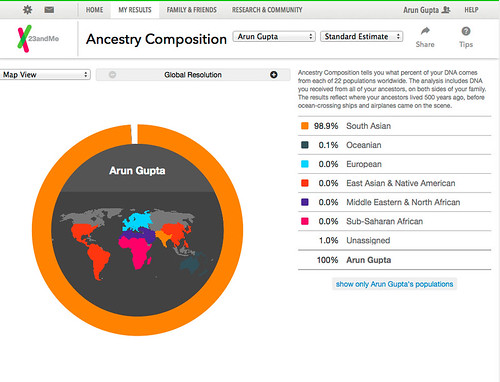
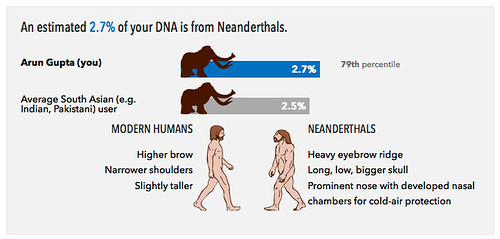
23 and Me

Inspired by Bee,  I sent off a saliva sample to 23andme.com. This was back in March. Finally, they've got my results.

Here's some stuff that should amuse:

heritage

neanderthal

Grünbaum on something rather than nothing

In his paper "The Poverty of Theistic Cosmology", Adolf Grünbaum thoroughly picks apart the question of "why is there something rather than nothing?" (termed PEQ - the Primordial Existence Question) and shows that it is ill-posed.  He has some thoughts on why this ill-posed question has exercised Western thinkers for many generations.

In traditional cultural anthropology, that such existential questions as PEQ are asked in a particular culture and not in others is merely an observed phenomenon.  In Balu's theory of religion, only a culture with religion will regularly come up with such existential questions. 

Whether you agree with my second paragraph or not, here are excerpts from Grünbaum:
 Yet, as some scholars have pointed out, 'To the ancient Indian and Greek thinker the notion of creation [ex nihilo {out of nothing}] is unthinkable'.  Thus, in Plato's Timaeus, there is no creation ex nihilo by the Demiurge, who is held to transform chaos into cosmos, although that notion is very vague. 

Indeed as John Leslie has pointed out informatively: 'To the general run of Greek thinkers the mere existence of things [or of the world] was nothing remarkable.  Only their changing patterns provoked [causal] inquisitiveness' (italics added).  And he mentions Aristotle's views as countenancing the acceptance of 'reasonless existence'.

It is a sobering fact that, before Christianity moulded the philosophical intuitions of our culture, those of the Greeks and of many other world cultures were basically different ontologically. {emphasis added}.  No wonder that Aristotle regarded the material universe as uncreated and eternal.  In striking contrast, SoN [**] is deeply engrained in traditional Christian heritage, even among a good many of those who reject Christianity in other respects.  And the Christian climate lends poignancy to Leslie's conjecture that 'When modern Westerners have a tendency to ask why there is anything at all, rather than nothing, possibly this is only because they are heirs to centuries of Judaeo-Christian thought' (italics added). 

[**] SoN is Grünbaum's designation of the idea of 'Spontaneity of Nothingness' that underlies PEQ, and is stated thus:
 "De jure, there should be nothing contingent at all, and indeed there would be nothing contingent in the absence of an overriding external cause (or reason), because that state of affairs is 'most natural' or 'normal'."
Grünbaum explains that "According to traditional Christian ontological doctrine, the very existence of any and every contingent entity other than God himself is utterly dependent on God at any and all times.....'without God's [constant creative] support [or perpetual creation] the world would instantly collapse into nothingness'."

Afterthoughts:

1. The modern "something rather than nothing" is a secularization of the religious question,  another phenomenon that Balu's theory of religion explains.

2.  A more precise statement of the dispute on these pages is that the cultural anthropologists' seeing religion everywhere is an ontological choice from philosophical intuitions guided by Christianity.  There is nothing scientific about it, and thinkers from other cultures would come up with other ontologies.   How to decide which ontology is closer to reality?  An assertion of the existence of religion requires us to understand and state what a religion is (i.e., a theory, not an encyclopedia, as in "whatever I included in this encyclopedia is a religion"), and then to seek empirical evidence for its existence.   Competing theories of religion are to be compared by their explanatory power.  

This essay by Balu is reasonably accessible, and will get you on the road to understanding his theory of religion.


Tuesday, June 04, 2013

Name this shrub

20130527-_MG_822720130527-_MG_822820130602-_MG_824220130602-_MG_824320130602-_MG_824520130602-_MG_8244

Name this shrub, a set on Flickr.

If you can identify this shrub, I'd really appreciate being told its name. Thanks in advance!

Sunday, June 02, 2013

Ron Unz on Race, IQ & Wealth

A common, annoying lapse in logic

An example is here.
Tran took pain to distance Richwine from accusations of racism. “I don’t think he is racist,” Tran told me. “His wife is an immigrant.”
By this logic, I don't think any married man ever was a sexist.  After all, their wives were women. 


What kind of question is: "Why is there something rather than nothing?"

In school as a kid, it took a while to understand why we needed to know about mathematical statements (e.g., "a meaningful composition of words which can be considered either true or false is called a mathematical statement"), it seemed obvious at first that one would never, unless insane, pose a non-statement.

I was reminded of that when Jim Holt's book, "Why Does the World Exist?" was discussed on Gödel's Lost Letter blog.

It is not at all clear to me whether the question,
"Why is there something rather than nothing?"
is meaningful. I cannot think of what an acceptable answer might look like; and I have a suspicion that the question hides an assumption that makes it impossible for there to be nothing, and so the question is a trivial and frivolous question. For instance, in the Peano axioms for the natural numbers, 1 != 2 follows directly from the axioms, and thus asking "why is 1 !=2?" is frivolous and uninteresting.

A work in progress

20130601-_MG_8230 by macgupta
20130601-_MG_8230, a photo by macgupta on Flickr.
Taking a moment to smell the roses, but it remains a work in progress.

Tuesday, May 28, 2013

On the Nature of Belief

On "The Heathen in His Blindness..." yahoo group, vnr1995 had a perspicacious statement, which I paraphrase - Satan (the Devil) **believes that** God exists, but Satan does not **believe in** God (which is why Satan is doomed).

We Hindus are not required to **believe in** anything, at least to the best of my knowledge of the Indic Traditions.  To my understanding, the Mimamsakas will tell you that the Vedic mantras retain their efficacy whether or not you **believe in** or **believe that** about anything about them.  In that sense, you are also not required to **believe that** about anything.

Of course, we Hindus **believe that** about many things.  However, no set of beliefs confers any kind of virtue.  In the Ramayana, both Rama and Ravana **believed that** about the same things.

One may be born into the Hindu fold.  One may join the fold and/or become a practitioner by only by practicing; one leaves the fold by explicit exit.

In bringing up Hindu children, I don't think they need to be told to **believe that** or **believe in** anything.  They just need to get a general understanding of the daily life, festival, emotional, intellectual, etc., aspects of practice; and their parents' own actions will be their immediate guide.

I think the same applies to the followers of Mahavira and of the Buddha, as well.


Sunday, May 26, 2013

Ta-Nehisi Coates interviews geneticist Neil Risch

Here.
In our paper, we tried to show that a trait can appear to have high "genetic heritability" in any particular population, but the explanation for a group difference for that trait could be either entirely genetic or entirely environmental or some combination in between.

So, in my view, at this point, any comment about the etiology of group differences, for "intelligence" or anything else, in the absence of specific identified genes (or environmental factors, for that matter), is speculation.

Friday, May 24, 2013

Barbara Liskov - The Power of Abstraction


Software Defined Networking

My friend N.K. dislikes networking, and in the technical talk here, Professor Scott Shenker, from the University of California, Berkeley, in the first 16 minutes explains why. As the Professor says, if one of his computer science students designed some of these networking protocols, he'd be failed. The good thing is that Software Defined Networking can change that.

Be warned, this is a technical talk. The second frame below begins the talk from the beginning; but first link starts the talk in at a point where there is a message that is useful for everyone.
http://youtu.be/WVs7Pc99S7w?t=36m47s


Tuesday, May 21, 2013

Non-survivor

Dropped Quantum Diaries Survivor from the blog-roll for promoting a really bad pseudo-scientific pre-print.  Being open-minded is one thing, having your brain fall out is altogether another.

Monday, May 20, 2013

Definitely not a hummer!

Definitely not a hummer! by macgupta
Definitely not a hummer!, a photo by macgupta on Flickr.

Seen this morning.

Friday, May 17, 2013

Racism in India

The Washington Post published an article: A fascinating map of the world's most and least racially tolerant countries.  India shows on the map as the least racially tolerant country.

Tracing back from the newspaper article to the journal article to the source of data lands one at the World Values Survey  (WVS) (http://www.worldvaluessurvey.org).  The data on which the findings are based date to the WVS survey questionnaire from 2005, that was conducted in India in 2006.  The questionnaire was translated into Hindi by some of the researchers, back-translated to English by someone else, and the whole thing was approved by the WVS organization.  The Hindi master was used for translation into other Indian languages.   The way the polling was conducted was exit polling - random selection of voters at randomly selected polling stations at randomly selected constituencies in 19 or so states.

So this is a survey of opinions of actual voters, at the time of elections - which are emotionally charged times, when politicians appeal to caste and religion.

Apart from the WVS survey, there was an extensive questionnaire on the respondents's background.  I do not know whether this was done before or after the WVS questions.  I do know that question 18 of this background survey had a very fine-grained division into castes,  including e.g., just for Muslims - Muslim Ashraf, Muslim Mughal (Khan),  various Muslim OBCs, Muslim Dalit, so you can imagine the categorization of Hindus.  Why this is significant is if one asked the background questions before the WVS questions one has made the respondent intensely aware of his caste identity at the time of posing the WVS question. (Question 77 of the background survey is about language.)

Apart from that the survey question in Hindi was posed with "jaati" for "race".   "Jaati" does not have the meaning or connotations of "race".  "Jaati", IMO, is best defined as an endogamous group of people, and a connotation will be "having a common profession".  The survey question is at the end of this post.

Anyway, what is interesting is that the WVS survey was conducted in India in 1990, 1995, 2001 also.  I do not know how the survey sample was conducted or how the question was posed in those surveys. Let us assume that these are all comparable.   Then what is interesting - more so than the absolute numbers - is the trend.

(You would not like to have as neighbors people of different race.)
1990 - 34.9% (2500 respondents)
1995 - 36.0% (2040 respondents)
2001 - 41.8% (2002 respondents)
2006 - 48.8% (1786 respondents)

For comparison (You would not like to have as neighbors immigrants/foreign workers)
1990 - 36.6%
1995 - 33.1%
2001 - 38.2%
2006 - 39.2%

Interestingly, only in the 2001 survey the question was posed (You would not like to have as neighbors people of the same religion)
2001 - 41.8%.   I'm guessing this must be a data-entry error.

"Jaati"-intolerance seems to have risen, while intolerance of  immigrants/foreign workers - who are almost certainly of a different jaati,  but maybe common profession -  has not moved much.

Assuming the data at each survey is meaningful and the data is comparable across surveys, this trend in jaati-intolerance is to be explained - why has it risen so much in 15 years?

Wednesday, May 15, 2013

Krugman in the New York Review of Books

About the current economic woes, and the policy response, Krugman wrote:
I’d argue that what happened next—the way policymakers turned their back on practically everything economists had learned about how to deal with depressions, the way elite opinion seized on anything that could be used to justify austerity—was a much greater sin. The financial crisis of 2008 was a surprise, and happened very fast; but we’ve been stuck in a regime of slow growth and desperately high unemployment for years now. And during all that time policymakers have been ignoring the lessons of theory and history.

It’s a terrible story, mainly because of the immense suffering that has resulted from these policy errors. It’s also deeply worrying for those who like to believe that knowledge can make a positive difference in the world. To the extent that policymakers and elite opinion in general have made use of economic analysis at all, they have, as the saying goes, done so the way a drunkard uses a lamppost: for support, not illumination. Papers and economists who told the elite what it wanted to hear were celebrated, despite plenty of evidence that they were wrong; critics were ignored, no matter how often they got it right.
Please to read in full.

Stephen Colbert on the dark art of race craft

Tuesday, May 14, 2013

Ta-Nehisi Coates on the dark art of racecraft

Prof. Delong's preface is worth noting,  or you can jump straight to Ta-Nehisi Coates.
We should first be clear that there is nothing mysterious or forbidden about purporting to study race and intelligence. Indeed, despite an inability to define "race" or "intelligence," such studies are one of the dominant intellectual strains in Western history.

Friday, May 10, 2013

The Dumbification of America


A real school science quiz. Read and weep!

Tuesday, May 07, 2013

10% less of me

Since the last few pounds are quite hard, I'm posting this as a sort of public promise that I'll have to honor. (Originally published May 7, 2013).


Weight taken twice a day, at identical points of my routine, not necessarily at the same hour of the day.

Sunday, May 05, 2013

Tarek Fateh on Global Terrorism and Islam


Published on Apr 30, 2013

Canadian writer and advocate of a progressive and liberal Muslim identity Tarek Fatah delivered his lecture in a seminar organise by India Foundation in New Delhi on Global Terrorism and Islam.


M J Akbar: The Indian Perspective on Global Terrorism and Islam

Published on May 2, 2013

NewAgeIslam TV presents a speech by a senior Indian Journalist M J Akbar on Global Terrorism and Islam. He provides an Indian Perspective to the global phenomenon of Islamist Terrorism. Indian has been a victim of terrorism exported from Pakistan through state and non-state actors for a long time. India has been a victim of Islamist terrorism much longer than Europe or America, almost since its inception as a modern democratic republic. Indian media personalities like Mr. Akbar have been reflecting on the issue for a long time and have far more experience to share than their European or American counterparts.


Friday, May 03, 2013

The P.I.E. metaphor - 2

On dailykos.com alevei continued:

In my previous post, I wrote about coming to terms with the metaphorical nature of Proto-Indo-European (PIE), which may or may not ever have existed as an actual language spoken by actual people at an actual moment in time but that is posited to be the common ancestor of most of the languages of Europe and many in western and central Asia.

To recap, the gist of that post is that the Indo-European hypothesis is large and contains multitudes and that the options seem to be to accept the astonishing inexactness of the metaphors or submit to the paralyzing mind-blowingness of what we use them to try to explain. I suggested that the latter option could be inconvenient if you're trying to discuss historical linguistics and language relatedness in a class that meets for an hour and fifty minutes twice a week for 15 weeks.

Anyway, continuing on the topic of the metaphors that we use to try to create some kind of manageable order out of the chaos that is the story of human language and how it got this way, we turn now to a fellow name of August Schleicher (1821-1868), a German linguist by training and profession who specialized in classical and Slavic languages. Schleicher, who may have had some of the same concerns that I have about how we can possibly even try to conceptualize an unattested 5,000 to 7,000-year-old super-ancestor Ur-language that might not even have actually existed, decided that it was time someone got around to the task of trying to reconstruct Proto-Indo-European.
....


....Anyway, in 1861, Schleicher published his reconstruction of PIE in a book called Compendium der Vergleichenden Grammatik der Indogermanischen Sprachen, known in English (and available in translation here) as A Compendium of the Comparative Grammar of the Indo-European Languages. Revisions and reissues appeared well into the 1870s, although Schleicher himself died in 1868 at age 47.

"What does all this have to do with metaphors?" you might be thinking. Everything. It has everything to do with metaphors. For one thing, even as Schleicher published his reconstruction of a 5- to 7,000-year-old dead language that might not have existed in the first place, he also made it clear that he knew all along that he was dealing in metaphors, and particularly in a big PIE-shaped metaphor, one that made it possible for him to reconstruct what was quite possibly a mythical language. As he wrote in the Compendium in 1861 (although of course he actually wrote it in German):
"A form traced back to the sound-grade of the Indo-European original language, we call a fundamental form. When we bring forward these fundamental forms, we do not assert that they really were once in existence." (Emphasis added.)

Wednesday, May 01, 2013

The P.I.E. metaphor

On dailykos.com, alevei writes, about Proto-Indo-European:

But the idea of PIE itself still remains mostly a metaphoric prop. It is more a way to try to make sense of something that so far remains firmly in the 'unknowable' column (although it sees plenty of action in the 'theorizable' column) than an actual unified language that was actually spoken by actual people at some actual point in time.