Sunday, October 18, 2009

Derivative evaluation in real life

The algorithmic complexity of pricing derivatives and possible intractability are, in a sense, irrelevant, given behavior like that reported below.

McClatchy reports:
As the housing market collapsed in late 2007, Moody's Investors Service, whose investment ratings were widely trusted, responded by purging analysts and executives who warned of trouble and promoting those who helped Wall Street plunge the country into its worst financial crisis since the Great Depression.

A McClatchy investigation has found that Moody's punished executives who questioned why the company was risking its reputation by putting its profits ahead of providing trustworthy ratings for investment offerings.

Instead, Moody's promoted executives who headed its "structured finance" division, which assisted Wall Street in packaging loans into securities for sale to investors. It also stacked its compliance department with the people who awarded the highest ratings to pools of mortgages that soon were downgraded to junk. Such products have another name now: "toxic assets."

Algorithm Complexity Theory meets Financial Derivatives

Derivatives are computationally intractable - so is the claim made by Sanjeev Arora, Boaz Barak, Markus Brunnermeier, and Rong Ge in their new paper Computational Complexity and Information Asymmetry in Financial Products.

One of our main results suggests that it may be computationally intractable to price derivatives even when buyers know almost all of the relevant information, and furthermore this is true even in very simple models of asset yields.

The lemon problem clearly exists in real life (e.g., "no documentation mortgages"), and there will always be a discrepancy between the buyer's "model" of the assets and the true valuation. Since we exhibit the computational intractability of pricing even when the input model is known (N - n independent assets and n junk assets), one fears that such pricing problems will not go away even with better models. If anything, the pricing problem should only get harder for more complicated models. (Our few positive results in Section 5 raise the hope that it may be possible to circumvent at least the tampering problem with better design.) In any case, we feel that from now on computational complexity should be
explicitly accounted for in the design and trade of derivatives.

Link to original paper.

Will watch with interest whether
(1) the result bears up under scrutiny from complexity theorists.
(2) the result has any practical implications.

Saturday, October 17, 2009

QOTD

I remember one day my seven-year old son Shakir came home to complain that he had been punished in his religious studies class. When I asked him why, he replied: “The teacher asked me what Islam taught us, and I replied Arabic. So she made me stand in the corner.” - Irfan Husain, in The Dawn, Karachi

Nathan Myhrvold isn't so smart after all

Bill Gates supposedly said: "I don’t know anyone I would say is smarter than Nathan."

Read this.

Well, Gates would probably also say that Windows is a wonderful operating system :)

Economists

People laugh at the common Indian preoccupation with astrology; and then turn around and consult economists!

Friday, October 16, 2009

Margaret Bourke-White's view of Pakistan

This was written around 1947. Bourke-White clearly saw then Pakistan's set-up as a rentier state.
What plans did he have for the industrial development of the country? Did he hope to enlist technical or financial assistance from America?

"America needs Pakistan more than Pakistan needs America," was Jinnah's reply. "Pakistan is the pivot of the world, as we are placed" -- he revolved his long forefinger in bony circles -- "the frontier on which the future position of the world revolves." He leaned toward me, dropping his voice to a confidential note. "Russia," confided Mr. Jinnah, "is not so very far away."

This had a familiar ring. In Jinnah's mind this brave new nation had no other claim on American friendship than this - that across a wild tumble of roadless mountain ranges lay the land of the Bolsheviks. I wondered whether the Quaid-i-Azam considered his new state only as an armored buffer between opposing major powers. He was stressing America's military interest in other parts of the world. "America is now awakened," he said with a satisfied smile. Since the United States was now bolstering up Greece and Turkey, she should be much more interested in pouring money and arms into Pakistan. "If Russia walks in here," he concluded, "the whole world is menaced."

In the weeks to come I was to hear the Quaid-i-Azam's thesis echoed by government officials throughout Pakistan. "Surely America will build up our army," they would say to me. "Surely America will give us loans to keep Russia from walking in." But when I asked whether there were any signs of Russian infiltration, they would reply almost sadly, as though sorry not to be able to make more of the argument. "No, Russia has shown no signs of being interested in Pakistan."

This hope of tapping the U. S. Treasury was voiced so persistently that one wondered whether the purpose was to bolster the world against Bolshevism or to bolster Pakistan's own uncertain position as a new political entity. Actually, I think, it was more nearly related to the even more significant bankruptcy of ideas in the new Muslim state -- a nation drawing its spurious warmth from the embers of an antique religious fanaticism, fanned into a new blaze.

Then it was the communists, today it is the Taliban, Islamic fundamentalism and the nuclear bomb.

My view of Pakistan

The ideology and establishment of Pakistan are a cancer upon the world. However, in this case, it is the tumor that is threatening the world with radiation therapy.

Thursday, October 15, 2009

The Kerry-Lugar Bill

Aid to Pakistan. Bears repeating, no good will come of it:
inset_cartoon_queue19170_7767251

Najam Sethi threatens a huge terrorist attack in India

The Friday Times continues its honorable tradition of delivering the message of terrorist blackmail.

The purpose would be to derail any push against the Taliban/al Qaeda in Pakistan and Afghanistan. It will happen unless Pakistan's powerful national security and military establishment is "accorded a greater role in America’s roadmap for determining Afghanistan’s future as a peaceful and stable state that is friendly and not hostile to Pakistan."

It is very clear (that as per Sethi) the recent attacks by Taliban/al Qaeda in Pakistan against Pakistan's "powerful national security and military establishment" are part of the dangerous game that that establishment continues to play. The Taliban/al Qaeda are after all, its long-term assets (despite the attacks):

"The Pakistani military leadership cannot concede the proposed American strategy to confront the Al-Qaeda-Taliban network because it will risk losing its long-term “assets” for political adjustment in Afghanistan."

What the world will not acknowledge is that the Pakistan national security and military establishment is a cancer.


From the Friday Times:

Options for war or peace

Najam Sethi’s E d i t o r i a l

Two inter-related and significant developments in Pakistan in the last seven days have hit world headlines. But there is an underlying third dimension that has not been explicitly debated. Consider.

Pakistan’s military leadership has whipped up the religio-nationalist media and opportunist political opposition to attack the Kerry-Lugar Bill as an unacceptable American attempt to undermine Pakistan’s sovereignty. But a close look at the Bill’s conditions doesn’t reveal any extraordinary trespass that is significantly different from the past under military regimes. So, why has GHQ rapped the US administration and the Zardari regime?

But the Pakistan army is also on the receiving end. The Al-Qaeda-Taliban network has smacked it squarely where it hurts. Four major terrorist attacks in seven days, including the audacious daylong siege of GHQ, and 114 killed, including a Brigadier and a Colonel. What is the message of the terrorists to the army’s leadership?

Is there a link between these two developments that explains what is going on?

A debate is raging in Washington DC. The US national security establishment led by the Pentagon in DC and General Stanley McChrystal in Kabul wants a 40,000-troop surge in Afghanistan. But the liberals in the Obama administration, media and think tanks want to bring the boys home and let Afghanistan boil in its own sordid juices. There is now a third option on the table from Joe Biden, the US vice-president. He wants the status quo on troop levels to be maintained. But he also wants US war-strategy to focus on the Al-Qaeda-Taliban network in Waziristan and Balochistan rather than in Afghanistan. In other words, he is advising a defensive and holding posture in Afghanistan and an offensive and forward position in Pakistan. Hence the recent debate about the pros and cons of targeting Mulla Umar’s “Quetta Shura” in Balochistan. This is also another way of pressuring the Pakistan army to go into Waziristan all guns blazing, stop protecting the Quetta Shura and finish the job itself.

Here’s the rub. The Pakistan army doesn’t like General McChrystal’s idea of an American troop surge or Mr Biden’s notion of an aggressive posture inside Pakistan’s tribal areas. Emotional issues of “occupation” and “sovereignty” aside, both options would amount to the same thing for GHQ: if successful, they would strengthen the current Washington-Kabul-New Delhi axis now calling the shots in Afghanistan and deprive Pakistan’s military of political leverage based on select pro-Pakistan and anti-India Taliban or Pakhtun “assets” in any future political dispensation in its backyard. The Pakistan military is also uneasy at the prospect of launching full–scale operations in Waziristan without first having fully mopped up Swat and motivated its soldiers for the tougher task ahead. The onset of winter and the regrouping of the Pakistan Taliban under Baitullah Mehsud’s successor Hakeemullah make the task even more daunting.

Obviously, the Al-Qaeda-Taliban network doesn’t like these options either. So the Afghan Taliban launched a well-planned and ferocious attack on the Indian embassy in Kabul and the Pakistani Taliban a desperate and audacious one on GHQ in Rawalpindi last week. This is meant to signal that, far from digging in to withstand the proposed US-Pakistan offensive in Waziristan, the Al-Qaeda-Taliban network is determined to carry the battle to the heartland of Afghanistan and Pakistan. Meanwhile, India and Pakistan are pointing to an ISI hand in the attack on India’s Kabul embassy and RAW’s behind the attack on GHQ respectively. Therefore the two America-sponsored options can be scuttled by a terrorist attack inside India that unleashes the demons of Mumbai and brings the two countries to the brink of war, diverting and diminishing attention from America’s “war against terror” and leading to political convulsion and possibly regime change in Pakistan.

The Pakistani military leadership cannot concede the proposed American strategy to confront the Al-Qaeda-Taliban network because it will risk losing its long-term “assets” for political adjustment in Afghanistan. It also cannot balk over a bold new operation in Waziristan alongside the Americans because that will lead to a blow to its wounded pride over the attack on GHQ. The media that backed it to the hilt over the red herring of the Kerry-Lugar Bill to deflect American pressure to up the ante against the Afghan Taliban in Waziristan is now demanding a similar “honour-saving” exercise from the army against the Pakistan Taliban. The problem, of course, is that, while we may talk of different categories and targets of Taliban, we are in fact dealing with a dangerous nexus between Al-Qaeda, Afghan Taliban, Pakistani Taliban and Pakistan Jihadi and sectarian parties and groups that has become one network aiming to seize Kabul and then Islamabad.

Clearly and realistically speaking, the powerful Pakistani military and national security establishment must be part of any regional solution. It must be accorded a greater role in America’s roadmap for determining Afghanistan’s future as a peaceful and stable state that is friendly and not hostile to Pakistan. If that doesn’t happen, the odds are that the Pakistani military will strike back. The Kerry-Lugar bill is the first casualty. If renewed tension with India and regime change in Pakistan follow, there will be no winners and losers in the region.

Yoga

NYT blog - The Art of Defying Death.

Wednesday, October 14, 2009

Comment on a Newsweek article

A brief Newsweek article suggests that American views on God and Life are turning Hindu. This is the contrast they draw:
The Rig Veda, the most ancient Hindu scripture, says this: "Truth is One, but the sages speak of it by many names." A Hindu believes there are many paths to God. Jesus is one way, the Qur'an is another, yoga practice is a third. None is better than any other; all are equal. The most traditional, conservative Christians have not been taught to think like this. They learn in Sunday school that their religion is true, and others are false. Jesus said, "I am the way, the truth, and the life. No one comes to the father except through me."

My point of view: while the overall contrast is perhaps a valid one, the people of the Indic traditions do not believe that all ways to "God"/"Truth"/etc., are equal. Each is as prone to the human frailty that his/her way is the best. All rivers may ultimately lead to the sea, but some are likely more direct and efficacious than others. However, traditionally, disputes over this do not go beyond debates and polemics, or are a matter of indifference.

Matt Taibbi on the Nobel Peace Prize crock

Brilliant!
You never, ever get a true dissident from a prominent Western country winning the award, despite the obvious appropriateness such a choice would represent. Our Western society quite openly embraces war as a means of solving problems and for quite some time now has fashioned its entire social and economic structure around the preparation for war.....That’s how this thing works. We ebb toward war most of the time. But sometimes, out of necessity, or when we run out of bullets, we ebb the other way. And it’s then that we give ourselves awards for our peace-loving behavior.

Tuesday, October 13, 2009

Unfair trade practices

US corporations can defer taxes on their profits made overseas, and that makes keeping jobs in the US even less competitive, I would think. And no reform is planned any time soon.
"Earlier this year, the business lobby went into high gear to prevent the Obama administration’s plans for corporate tax reform, with the Business Roundtable promising to spend “whatever it takes” to ensure that the reforms never saw the light of day. That determination seems to have had some effect, as the Wall Street Journal reported today that administration “has shelved a plan to raise more than $200 billion in new taxes on multinational companies following a blitz of complaints from businesses.”

As the Journal noted, the particular reform in question — which would have limited the ability of corporations to defer taxation on profits that they earn overseas — drew the ire of the corporate world, and “companies ranging from Microsoft Corp. to General Electric Co. to International Business Machines Corp. put the topic at the top of their Washington agendas.”

Your pilot may be on food stamps!

Your pilot, on food stamps - making less than a taxi driver or pizza delivery man. Are you sure you want to fly the friendly skies?

Jagdish Bhagwati

Economist Jagdish Bhagwati has a article on the feeble critiques of capitalism in World Affairs Journal.

You can read the Stiglitz essay which Bhagwati is criticizing here. Then read Bhagwati's essay and see if he is even coherent.

Friday, October 09, 2009

Nobel Peace Prize

We wake up to the news that President Obama has won the Nobel Peace Prize. Congratulations are in order, but still, I scratch my head in puzzlement - what for? It can only be for potential and not actual achievement. It is a highly political award, perhaps meant to make Americans realize how scary the previous administration was to the whole world.

His heart may be in the right place, but President Obama has not been able even to persuade the Israelis to stop building settlements on Palestinian land. Will the Nobel Prize add any weight to his voice?

Perhaps members of the Nobel committee had the ignoble goal of watching right-wing talking heads explode on TV. In any case, this Nobel is going to feed into their talking points that Obama is President of the rest-of-the-world and is not president of the "Real USA".

NYT:
As to whether the prize was given too early in Mr. Obama’s presidency, he [Mr. Jagland, a former prime minister of Norway] said: “We are not awarding the prize for what may happen in the future but for what he has done in the previous year. We would hope this will enhance what he is trying to do.”

PS: AP (might be a temporary link)
_ Myth: Candidates can be nominated until the last minute.

The nomination deadline is eight months before the announcement, with a strictly enforced deadline of Feb. 1.

Since Obama was inaugurated on January 20, 2009, one has to assume he was nominated simply for winning the election.

_ Myth: The prize can be awarded posthumously.

The prize was award posthumously only once — in 1961, to former U.N. Secretary-General Dag Hammerskjold, after he was killed in a plane crash in Africa. The rules were amended in 1974 to prohibit posthumous prizes.

They never did award Mahatma Gandhi the peace prize. Which tells you even more that the prize is political. (Some history.)
_ Myth: The prize is awarded to recognize efforts for peace, human rights and democracy only after they have proven successful.

More often, the prize is awarded to encourage those who receive it to see the effort through, sometimes at critical moments.

Yes, Obama is trying rather hard to perpetuate Bush's diminution of civil liberties, I"m sure he'll be greatly encouraged. Glenn Greenwald:

In February, the Obama DOJ went to court to block victims of rendition and torture from having a day in court, adopting in full the Bush argument that whatever was done to the victims is a "state secret" and national security would be harmed if the case proceeded.  The following week, the Obama DOJ invoked the same "secrecy" argument to insist that victims of illegal warrantless eavesdropping must be barred from a day in court, and when the Obama administration lost that argument, they engaged in a series of extraordinary manuevers to avoid complying with the court's order that the case proceed, to the point where the GOP-appointed federal judge threatened the Government with sanctions for noncomplianceTwo weeks later, "the Obama administration, siding with former President George W. Bush, [tried] to kill a lawsuit that seeks to recover what could be millions of missing White House e-mails."

In April, the Obama DOJ, in order to demand dismissal of a lawsuit brought against Bush officials for illegal spying on Americans, not only invoked the Bush/Cheney "state secrets" theory, but also invented a brand new "sovereign immunity" claim to insist Bush officials are immune from consequences for illegal domestic spying.  The same month -- in the case brought by torture victims -- an appeals court ruled against the Obama DOJ on its "secrecy" claims, yet the administration vowed to keep appealing to prevent any judicial review of the interrogation program.  In responses to these abuses, a handful of Democratic legislators re-introduced Bush-era legislation to restrict the President from asserting "state secrets" claims to dismiss lawsuits, but it stalled in Congress all year.  At the end of April and then again in August, the administration did respond to a FOIA lawsuit seeking the release of torture documents by releasing some of those documents, emphasizing that they had no choice in light of clear legal requirements.

In May, after the British High Court ruled that a torture victim had the right to obtain evidence in the possession of British intelligence agencies documeting the CIA's abuse of him, the Obama administration threatened that it would cut off intelligence-sharing with Britain if the court revealed those facts, causing the court to conceal them.  Also in May, Obama announced he had changed his mind and would fight-- rather than comply with -- two separate, unanimous court orders compelling the disclosure of Bush-era torture photos, and weeks later, vowed he would do anything (including issue an Executive Order or support a new FISA exemption) to prevent disclosure of those photos in the event he lost yet again, this time in the Supreme Court.  In June, the administration "objected to the release of certain Bush-era documents that detail the videotaped interrogations of CIA detainees at secret prisons, arguing to a federal judge that doing so would endanger national security."  In August, Obama Attorney General Eric Holder announced that while some rogue torturers may be subject to prosecution, any Bush officials who relied on Bush DOJ torture memos in "good faith" will "be protected from legal jeopardy."  And all year long, the Obama DOJ fought (unsuccessfully) to keep encaged at Guantanamo a man whom Bush officials had tortured while knowing he was innocent.

PPS: dkos: Nobel Shock shows America oblivious to its reign of terror expands on the thought above.

Monday, October 05, 2009

Michael Moore's Capitalism: A Love Story

See it. We need a revolution.

Michael Moore make an emotional case rather than an intellectual one about a system in which the bankers have taken control. But he takes on America's ruling dogma directly, and since the evidence of its failures, its fundamental injustice, are all around, he might cause some fervent believers to turn apostate.

Sunday, October 04, 2009

Madhuban mein Radhika nache re


A lovely song. Also a reminder of the Radha-Krishna story, which has not yet exhausted itself in literature, art, song and dance; and on whose many layers of meaning N Ph.D.s can be written. For they who know, it is good to contemplate. It banishes all world-weariness. And once again, a lovely song.

The Plutonomy

n. An economy that is driven by or that disproportionately benefits wealthy people, or one where the creation of wealth is the principal goal.
[Blend of pluto- (wealth) and economy.]

Read (get past the beginning of) this dkos post.
The main fear Citigroup has is that since one person-one vote still obtains, the rich have only 1% of the vote, and that may eventually end the plutonomy.  Presumably there are corporate skunkworks to try to remedy the situation.

Citigroup Plutonomy Report Part 1
Oct 16, 2005
- The World is dividing into two blocs - the Plutonomy and the rest.   The U.S., UK, and Canada are the key Plutonomies - economies powered by the wealthy. Continental Europe (ex-Italy) and Japan are in the egalitarian bloc.
- Equity risk premium embedded in "global imbalances" are unwarranted.   In plutonomies the rich absorb a disproportionate chunk of the economy and have a massive impact on reported aggregate numbers like savings rates, current account deficits, consumption levels, etc.
This imbalance in inequality expresses itself in the standard scary "global imbalances". We worry less.

Saturday, October 03, 2009

Verbena-2

They appear to be enjoying the fall weather.
star
They're supposed to be perennial, but a gardener at the nursery told me that they're delicate. I wonder if they'll return next year.

The Benefits of Nature

(via Andrew Sullivan) Jonah Lehrer notes:
I've written before about the powerful mental benefits of communing with nature - it leads to more self-control, increased working memory, lower levels of stress and better moods - but a new study by psychologists at the University of Rochester find that being exposed to wildlife also makes us more compassionate. Nature might be red in tooth and claw, but even a glimpse of greenery can make us behave in kinder, gentler ways.

1. I wonder if working in the garden counts?

2. No wonder India's ancient rishis always had forest ashrams, though life in the forest could not have been easy.

Monday, September 28, 2009

Harberger Triangle

Yglesias has a absolutely impenetrable explanation of the Harberger triangle. However, on thinking things through, it may not be that complicated. Here is what I think it all means.
Slide1

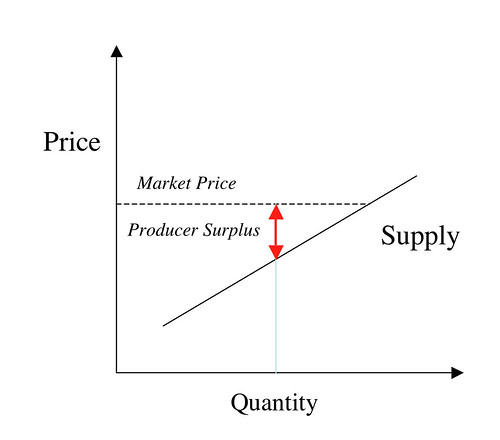
The chart above depicts the theoretical supply curve for some commodity. For simplicity it is shown as a straight line. As the price in the market increases, the quantity available for sale will likely increase, and so the the curve has a positive slope.

What determines how much supply will be there for a given price? Well, for a quantity like that shown on the graph and the price as shown (Market Price), the producers have a surplus. It is advantageous for the producers to put additional supply on the market. Of course, as they do so, the costs to themselves tend to increase, and so the surplus eventually goes to zero. At that point, producers will not put any more supply on the market, and you've got a point on the supply curve.

In reality, given the nature of production, the supply curve for any one producer probably looks like this, a staircase.
Slide3
Once the price crosses a threshold, it is economical for the producer to add on certain production capacity. Incremental costs of increasing production remain constant upto a certain point, so the producer will put as much as they can on the market. The overall market is a sum over all producers who have different staircase curves. Looked at a fine scale, a sum of staircase curves remains a staircase. However,

1. A smooth curve is a good enough approximation. The uncertainties/errors of measurement of the staircase is probably larger than its discontinuities.

2. Doing efficient market theory becomes mathematically very inefficient without this approximation.

______________

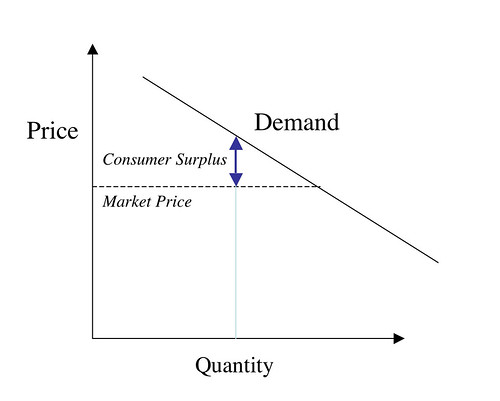
We can in a similar way, look at the demand curve for the commodity. In this case, as the price goes up, we expect the amount consumers are willing to buy goes down, and the demand curve has a negative slope.
Slide2

In exactly the like fashion as in the supply curve, we have the notion of a consumer surplus. Consumers keep buying until at some point, the benefit to additional purchases among consumers is zero.

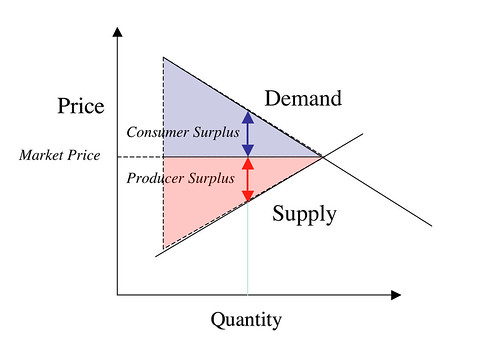
Putting it all together, we have the efficient market equilibrium.
Slide4

The colored areas - which really should extend all the way to the price axis - represent the net benefit to the economy (the consumers and producers) at this equilibrium. Every consumer that had a benefit that still existed at the market price makes purchases, those purchases that had no economic benefit (at the market price) for the consumers don't happen. Similarly only the sales that had a net benefit for the producers happened.

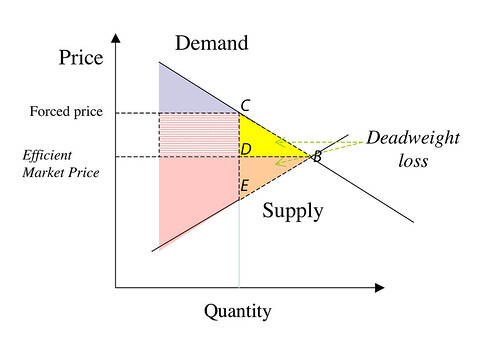
Now suppose something (some government intervention) moves the market away from its efficient equilibrium. A situation like that below might obtain (it is one of several possible scenarios. In general, both the supply and demand curves will move from their efficient market instances. In my diagram, we simply moved along the efficient market curves.) The quantity sold/consumed and the price at which it is consumed is represented by the point C.
Slide5
Because of the higher price, the demand quantity is lower than it could have been. The yellow and orange colored areas are the net loss to the economy because it is no longer efficient. The technical term, I believe, is deadweight loss. One or both of those triangles BCD or BDE, or the overall large triangle BCE is the Harberger triangle(s) (pure reason does not enable one to determine which.)

BDE represents lost value to the producers, BCD represents the lost value to the consumers, compared to the efficient market scenario. The hatched area between the Forced Price and the Efficient Market Price appears to be a loss to consumers or gain to producers. It depends.

Suppose the departure from the market equilibrium is because the government imposed as sales tax. One would expect the tax to be partly borne by producers and partly by consumers. I think (but can't currently prove) the price received by the producers is represented by the price at point E, the price paid by consumers is represented by the price at point C, and the ratio of the burden of sales tax on consumers to producers is CD/DE. The revenue collected by the government is represented by the rectangular region to the left of the line segment CE.

Suppose C was the price set by a monopoly. C would be set by the monopoly producer maximizing price * quantity, with C on the demand curve. BCE still represents the loss to the economy compared to the efficient case. In this case the producer is reaping additional benefit represented by the hatched area minus BDE.

Overall I don't understand what Yglesias is writing. Maybe CIP or someone will be able to explain.

PS: I think BCE is The Harberger Triangle.

PPS: Wiki is unclear. They seem to imply government revenue is represented by some fraction of the Harberger triangle. But it seems to me that BCE represents economic activity that simply doesn't take place - it doesn't represent government revenue. Now I'm totally confused.

PPPS: Uncharitably, I tend to think Yglesias is the hopelessly confused one. When I read Krugman's paragraph that started off Yglesias, then it doesn't seem to be saying anything like what Yglesias or Wiki writes. The Harberger triangle is not captured by government revenues, etc.
Now, a key point in all this is that the emissions tax or, equivalently, the rent on emissions permits, does not represent a net loss to society. It’s just a transfer from one set of people to another — from the emitters, and ultimately those who buy their products, to whoever collects the taxes or gets the permits, and ultimately whoever benefits from the revenue or rents thus generated. The only net loss is the Harberger triangle created by the reduction in emissions — which has to be set against the benefits of reduced pollution.

To Krugman's larger point: not taking into account the costs of pollution (i.e., assuming that the efficient market is one in which pollution is costless) is a mistake. I.e., today's "efficient market" really embodies a pollution subsidy.

Sunday, September 27, 2009

Fast computers

After a super-duper fast Nehalem Mac Pro, it is very painful to use any other computer.

Intense Debates

Commenter RK suggested this. To install it I had to upgrade from classic templates to layouts in blogger. Let's see if it works.

Sunday, September 20, 2009

Reflection on John Norton's argument

Here and referred to below.

Suppose we have a physical quantity Q that must take its value between 0 and 1, inclusive. Let us stipulate that our current knowledge has absolutely nothing to say about the possible value of Q. It is very tempting to say that a priori, Q is uniformly distributed on [0,1]. This is nothing but a theoretical prejudice. We would in effect be saying that our utter lack of evidence means that it is nine times more likely for Q to lie between 0 and 0.9 than for Q to lie between 0.9 and 1. In reality the support for Q to take on some set of values is exactly equal to that for Q not to take on that set of values (as long as the set is not the entire set or equivalently we do not try to assert that Q takes on no value whatsoever.)

This may be easier to see if we map [0,1] to [0,infinity). There is no uniform distribution on [0, infinity); and our theoretical prejudice explicitly manifests itself when we try to assign a probability measure for Q on [0,infinity).

In a physical theory, we need a physical reason to believe that Q has a probability distribution. In Norton's language, we need a randomizer in order to induce probabilities. E.g., in many situations we have a good reason to believe that a quantity follows a normal distribution, because it arises as an aggregate from a large number of underlying processes and the law of large numbers holds. In statistical mechanics, we have good reason from Hamiltonian mechanics to assume that a system in thermal equilibrium is well represented by assuming a uniform distribution over its microstates. And so on.

The Trouble With Physics

Heretical punchline: cosmic parameters can’t be judged as “improbable,” so long as they’re consistent with theory and observation.

The trouble in physics is that the punchline above was judged to be heretical.

John Norton's paper, "Cosmology and Inductive Inference: A Bayesian Failure" is available here. It is both a pity and a blessing that this was formalized.

(emphasis added)

John Norton talks about the “Bayesian failure” of cosmology and inductive inference. (He admits off the bat that it’s kind of terrifying to have all these cosmologists in the audience.) Basic idea: the Bayesian analysis that cosmologists use all the time is not the right tool. Instead, we should be using “fragments of inductive logics.”

The “Surprising Analysis”: assuming that prior theory is neutral with respect to some feature (e.g. the value of the cosmological constant), we observe a surprising value, and then try to construct a framework to explain it (e.g. the multiverse). This fits in well with standard Bayesian ideas. But that should worry you! What is really the prior probability for observing some quantity? In particular, what if our current theory were not true — would we still be surprised?

We shouldn’t blithely assume that the logic of physical chances (probabilities) is the logic of all analysis. The problem is that this framework has trouble dealing with “neutral evidence” — almost everything is taken as either favoring or disfavoring the hypothesis. We should be talking about whether or not a piece of evidence qualifies as support, not simply calculating probabilities.

The disaster that befell Bayesianism was to cast it in terms of subjective degrees of belief, rather than support. A prior probability distribution is pure opinion. But your choice of that prior can dramatically effect how we interpret particular pieces of evidence.

Example: the Doomsday argument — if we are typical, the universe (or the human race, etc.) will probably not last considerably longer than it already has (or we wouldn’t be typical). All the work in that argument comes from assuming that observers are sampled uniformly. But the fact that 60 billion people have lived so far isn’t really evidence that 100 trillion people won’t eventually live; it’s simply neutral.

Heretical punchline: cosmic parameters can’t be judged as “improbable,” so long as they’re consistent with theory and observation.


PS: at least the beginning of the paper was very readable for me. BTW, this also requires a climbdown from me - I have to admit that philosophers can be useful.

PPS: While the conclusion, as reported by cosmicvariance, is intuitively satisfying ("obvious"), Norton's paper is deep.

Saturday, September 19, 2009

A few thoughts

Reminder to self - need to make the comments on this blog more useable. Haloscan, maybe?

Bee wrote in the comments to my previous post: "Unless you are talking of a mathematical proof, right and wrong are context dependent. If you want to reach xyz, something might be the right thing to do, something else the wrong thing. Even if you know that, the question remains, do you want to reach xyz in the first place?"

---

Yes, right and wrong can be context dependent - but they are more or less absolute within the context. There is a right way (or a few right ways) to start a car, for instance. That doesn't change, regardless of the purpose for starting the car - going somewhere, or running over someone. Right and wrong are for dealing with "factual" reality.

"Why do you want to reach Atlantic City in the first place?"
"To bet at the blackjack tables".

That may be good or less good (morally bad) depending on your perspective.

---


Bee's question - why do you want to reach xyz in the first place, also reminds me of the question - why be good?

"Why be good (moral)?" is a perennial problem in Western systems of ethics. This was Glaucon's challenge to Plato. Apparently this question cannot even be meaningfully framed in most Indic systems - at least, so I understand. In Indian thought there is simply that which is life-sustaining and that which is not. By life-sustaining, I do not simply mean the physical body, but include the psyche,mind,etc., and the family/community/society,etc. One's actions are more or less conducive to the health of these things. The question "why be good?" morphs into "why should I choose to live?". But that is a private question, not susceptible to universalist answers.

---

Anyway, I picked up at the library, what from the first few pages seems like an interesting read: "A Case for Amorality: The Moral Fool" by Hans-Georg Moeller.

---

Sunday, September 13, 2009

Thought for the day

There is no good and evil — or rather, good and evil are subjective, not objective. There is however, right and wrong. (Paraphrase of Swami Dayananda Saraswati from a Q&A session at Arsha Vidya Gurukulam on its 23rd anniversary.)

Wednesday, September 09, 2009

WTC 7

From the NIST report on the collapse of World Trade Center 7 (this building collapsed hours after the two main towers went down):
wtc7

The important point is that during Stage 2, the collapse was accelerating at 32 ft/sec^2, i.e., it was essentially in free fall.

The 9/11 truthers claim that this could happen only if the building was deliberately demolished (i.e., it requires simultaneous catastrophic failure of structural members all over the building, and therefore the free fall indicates that the building fell for some other reason than being damaged by falling debris from the main towers and the fires that raged uncontrolled for six hours.

This article on implosionworld.com by a building demolition specialist says that a collapse due to structural damage is consistent with all the known facts.

The truthers also claim that the NIST did not do the analysis summarized in the graph above, until pressed by them, and that this is a sign of a cover-up.

Your mileage may vary.

The text from the NIST report states the following:
3.6 TIMING OF COLLAPSE INITIATION AND PROGRESSION

The timing of global collapse of WTC 7, as indicated by downward motion of the north exterior face, was investigated using a video of the collapse taken from the vantage point of West Street near Harrison Street (Camera No. 3, Figure 5-183 of NIST NCSTAR 1-9). An initial analysis compared the observed time it took for the roofline to fall approximately 18 stories to the free fall time under the force of gravity. A more detailed analysis examined the vertical displacement, velocity, and acceleration through different stages of the collapse process. (NIST NCSTAR 1-9, Chapter 12)

The time that the roofline took to fall 18 stories or 73.8 m (242 ft) was approximately 5.4 s. The theoretical time for free fall (i.e., at gravitational acceleration) was computed from
t=sqrt(2 h/g)

where t = time, s; h = distance, m (ft); and g = gravitational acceleration, 9.81 m/s2 (32.2 ft/s2). This time was approximately 3.9 s. Thus, the average time for the upper 18 stories to collapse, based on video evidence, was approximately 40 percent longer than the computed free fall time.

A more detailed examination of the same video led to a better understanding of the vertical motion of the building in the first several seconds of descent. NIST tracked the downward displacement of a point near the center of the roofline, fitting the data using a smooth function. (The time at which motion of the roofline was first perceived was taken as time zero.) The fitted displacement function was then differentiated to estimate the downward velocity as a function of time, shown as a solid curve in Figure 3- 15. Velocity data points (solid circles) were also determined from the displacement data using a central difference approximation. The slope of the velocity curve is approximately constant between about 1.75 s and 4.0 s, and a good straight line fit to the points in this range (open-circles in Figure 3-15) allowed estimation of a constant downward acceleration during this time interval. This acceleration was 32.2 ft/s2 (9.81 m/s2), equivalent to the acceleration of gravity g.

For discussion purposes, three stages were defined, as denoted in Figure 3-15:

• In Stage 1, the descent was slow and the acceleration was less than that of gravity. This stage corresponds to the initial buckling of the exterior columns in the lower stories of the north face. By 1.75 s, the north face had descended approximately 2.2 m (7 ft).

• In Stage 2, the north face descended at gravitational acceleration, as the buckled columns provided negligible support to the upper portion of the north face. This free fall drop continued for approximately 8 stories or 32.0 m (105 ft), the distance traveled between times t = 1.75 s and t = 4.0 s.

• In Stage 3, the acceleration decreased somewhat as the upper portion of the north face encountered increased resistance from the collapsed structure and the debris pile below. Between 4.0 s and 5.4 s, the north face corner fell an additional 39.6 m (130 ft).

As noted above, the collapse time was approximately 40 percent longer than that of free fall for the first 18 stories of descent. The detailed analysis shows that this increase in time is due primarily to Stage 1. The three stages of collapse progression described above are consistent with the results of the global collapse analyses discussed in Chapter 12 of NIST NCSTAR 1-9.

Tuesday, September 08, 2009

Full-blown Corporatocracy

The NYT editors fear that the Supreme Court is about to strike down all limits on corporations' involvement in elections.
The court, which is scheduled to hear arguments on this issue on Wednesday, is rushing to decide a monumental question at breakneck speed and seems willing to throw established precedents and judicial modesty out the window.


After establishing that the court is in an unseemly rush, the editors continue:
The scheduling is enormously troubling. There is no rush to address the constitutionality of the corporate expenditures limit. But the court is racing to do that in a poorly chosen case with no factual record on the criticalquestion, making careful deliberation impossible.

Most disturbing, though, is the substance of what the court seems poised to do. If corporations are allowed to spend from their own treasuries on elections — rather than through political action committees, which take contributions from company employees — it would usher in an unprecedented age of special-interest politics.

Corporations would have an enormous say in who wins federal elections. They would be able to use this influence to obtain subsidies, stimulus money and tax loopholes and to undo protections for investors, workers and consumers. It would take an extraordinarily brave member of Congress to stand up to agents of big business who then could say, quite credibly, that they would spend whatever it takes in the next election to defeat him or her.

Monday, September 07, 2009

Rahu and Ketu

The traditional Indian astrology/astronomy is concerned about the following nine objects

# 1 Surya
# 2 Chandra
# 3 Mangala
# 4 Budha
# 5 Brihaspati
# 6 Shukra
# 7 Shani
# 8 Rahu
# 9 Ketu

In English, Surya is identified with the Sun, Chandra the Moon, Mangala Mars, Budha Mercury, Brihaspati Jupiter, Shukra Venus, Shani Saturn, and Rahu and Ketu the lunar nodes - the two points of intersection of the moon's orbit and the ecliptic (i.e., points of potential solar and lunar eclipses). Rahu is the ascending node (the point where the moon moves to the north of the ecliptic), and Ketu is the descending node (the point where the moon moves to the south of the ecliptic). Further reading here.

The interesting thing about this organization is how Rahu and Ketu are reified (Wiki: "Reification in thought occurs when an abstract concept describing a relationship or context is treated as a concrete "thing"").

There is a case to be made that Hindus reified virtually every concept. That may be the basis of murti puja ("idol worship"), the source of its "polytheism" and their sacred geography (scare quotes around concepts that make sense only in the context of the Abrahamic religions).

Sunday, September 06, 2009

Not Even Wrong

Browsing through the pages of "Conceptual Foundations of Quantum Field Theory" edited by Tian Yu Cao, I see the following (in John Stachel's essay):
Others were less cautious in their approach to quantum gravity. In their first paper on quantum electrodynamics, Heisenberg and Pauli asserted that:
quantization of the gravitational field, which appears to be necessary for physical reasons [in a footnote, they refer to works of Einstein and Klein cited above], may be carried out without any new difficulties by means of a formalism fully analogous to that applied here.
Almost seventy years [1999] have elapsed since this casual prediction, and we are still without a quantum theory of gravity!


Well, strictly, Pauli was wrong, rather than not even wrong.

More Princeton

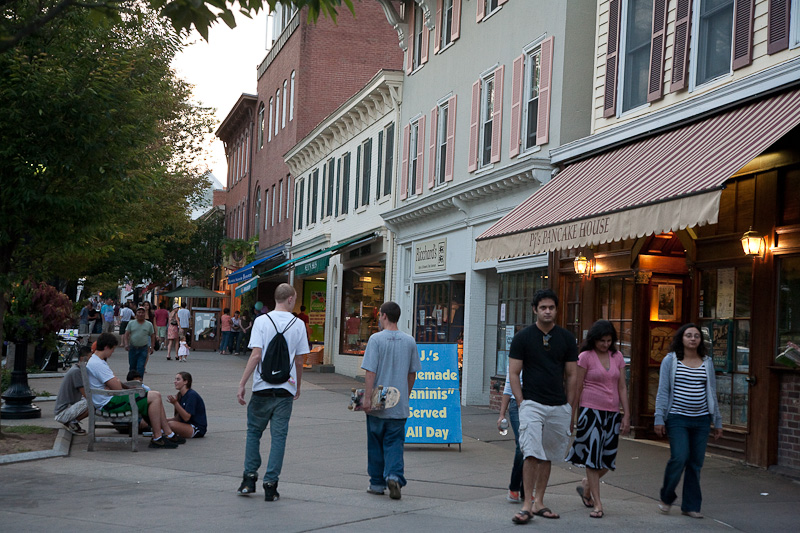
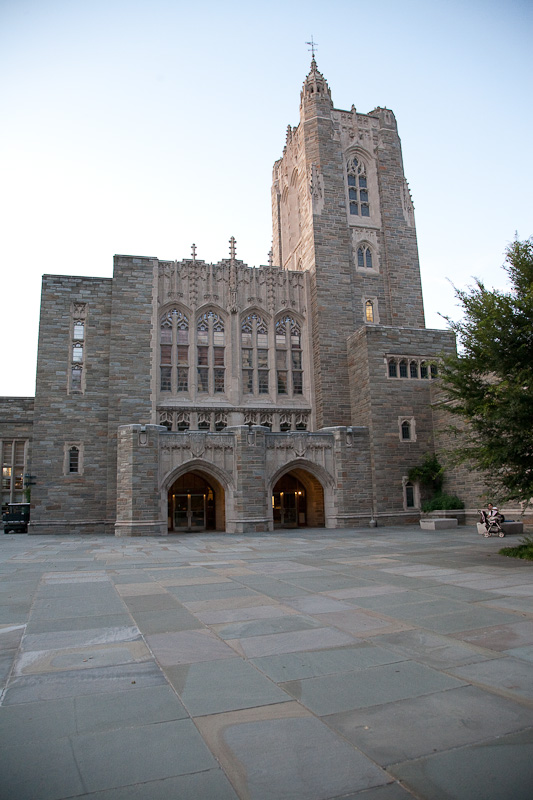
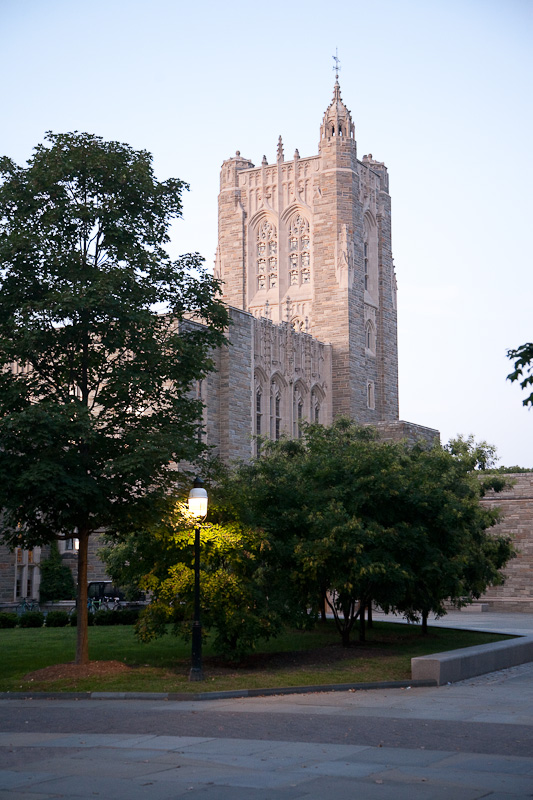
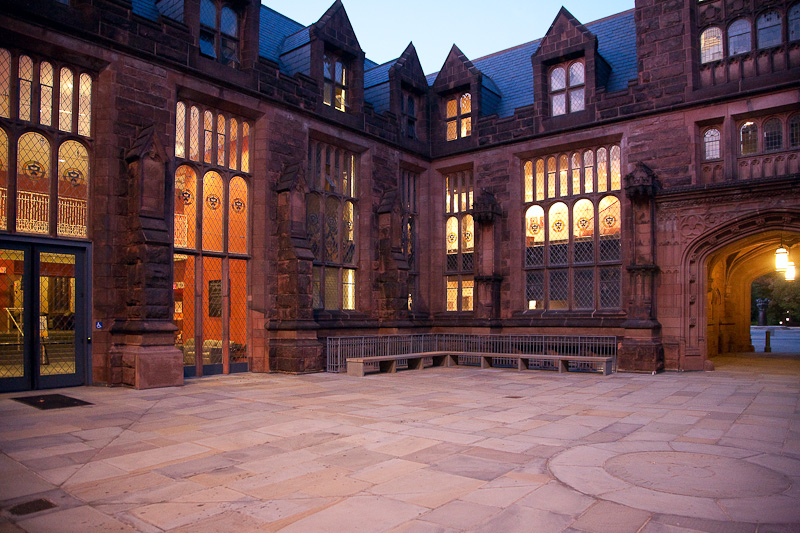
Princeton University campus has great potential for photographic exploration. My primary expedition was to the Borders bookstore near Princeton for some Photoshop and cookbooks that were in stock there. I then stopped at the bridge, and then feeling hungry, stopped for a meal. So I squandered much of the light. So, apart from Hogwarts, on which I got lucky, the following are random uncorrected snapshots, put here as a reminder of a promise. There is a nice interactive map here which also provides a photographic glimpse of the buildings.

Nassau Street, in front of the restaurant where I ate.
nassau

Firestone Library:
tower-2

tower

University Chapel
:
cathedral

One of the chapel doors:
door

Crop from the above:
door-crop


Whig Hall
:
building

Books - detail of the Witherspoon statue. What amused me is that Principia is used rather than Newton.

books

Bridge

Bridge

Washington Road Bridge over Lake Carnegie at Princeton.

Another try: uncropped and less sharpened.
bridge-2

The whole bridge - had I arrived earlier, maybe the whole bridge would be glowing in the sunlight. Heavily cropped and heavily sharpened.

bridge-3

Hogwarts

Actually Princeton. But that is what the atmosphere was on the end-of-summer evening.

Hogwarts

Saturday, September 05, 2009

Bill Moyers to the President: We need a fighter

via dailykos:

BILL MOYERS: The editors of THE ECONOMIST magazine say America's health care debate has become a touch delirious, with people accusing each other of being evil-mongers, dealers in death, and un-American.

Well, that's charitable.

I would say it's more deranged than delirious, and definitely not un-American.

Those crackpots on the right praying for Obama to die and be sent to hell — they're the warp and woof of home-grown nuttiness. So is the creature from the Second Amendment who showed up at the President's rally armed to the teeth. He's certainly one of us. Red, white, and blue kooks are as American as apple pie and conspiracy theories.

Bill Maher asked me on his show last week if America is still a great nation. I should've said it's the greatest show on earth. Forget what you learned in civics about the Founding Fathers — we're the children of Barnum and Bailey, our founding con-men. Their freak show was the forerunner of today's talk radio.

Speaking of which: we've posted on our website an essay by the media scholar Henry Giroux. He describes the growing domination of hate radio as one of the crucial elements in a "culture of cruelty" increasingly marked by overt racism, hostility and disdain for others, coupled with a simmering threat of mob violence toward any political figure who believes health care reform is the most vital of safety nets, especially now that the central issue of life and politics is no longer about working to get ahead, but struggling simply to survive.

So here we are, wallowing in our dysfunction. Governed — if you listen to the rabble rousers — by a black nationalist from Kenya smuggled into the United States to kill Sarah Palin's baby. And yes, I could almost buy their belief that Saddam Hussein had weapons of mass destruction, only I think he shipped them to Washington, where they've been recycled as lobbyists and trained in the alchemy of money laundering, which turns an old-fashioned bribe into a First Amendment right.

Only in a fantasy capital like Washington could Sunday morning talk shows become the high church of conventional wisdom, with partisan shills treated as holy men whose gospel of prosperity always seems to boil down to lower taxes for the rich.

Poor Obama. He came to town preaching the religion of nice. But every time he bows politely, the harder the Republicans kick him.

No one's ever conquered Washington politics by constantly saying "pretty please" to the guys trying to cut your throat.

Let's get on with it, Mr. President. We're up the proverbial creek with spaghetti as our paddle. This health care thing could have been the crossing of the Delaware, the turning point in the next American Revolution — the moment we put the mercenaries to rout, as General Washington did the Hessians at Trenton. We could have stamped our victory "Made in the USA." We could have said to the world, "Look what we did!" And we could have turned to each other and said, "thank you."

As it is, we're about to get health care reform that measures human beings only in corporate terms of a cost-benefit analysis. I mean this is topsy-turvy — we should be treating health as a condition, not a commodity.

As we speak, Pfizer, the world's largest drug maker, has been fined a record $2.3 billion dollars as a civil and criminal — yes, that's criminal, as in fraud — penalty for promoting prescription drugs with the subtlety of the Russian mafia. It's the fourth time in a decade Pfizer's been called on the carpet — and these are the people into whose tender mercies Congress and the White House would deliver us?

Come on, Mr. President. Show us America is more than a circus or a market. Remind us of our greatness as a democracy. When you speak to Congress next week, just come out and say it. We thought we heard you say during the campaign last year that you want a government run insurance plan alongside private insurance — mostly premium-based, with subsidies for low-and-moderate income people. Open to all individuals and employees who want to join and with everyone free to choose the doctors we want. We thought you said Uncle Sam would sign on as our tough, cost-minded negotiator standing up to the cartel of drug and insurance companies and Wall Street investors whose only interest is a company's share price and profits.

Here's a suggestion, Mr. President: ask Josh Marshall to draft your speech. Josh is the founder of the website talkingpointsmemo.com . He's a journalist and historian, not a politician. He doesn't split things down the middle and call it a victory for the masses. He's offered the simplest and most accurate description yet of a public insurance plan; one that essentially asks people: would you like the option — the voluntary option — of buying into Medicare before you're 65? Check it out, Mr. President.

This health care thing is make or break for your leadership, but for us, it's life and death. No more Mr. Nice Guy, Mr. President. We need a fighter.

Thursday, September 03, 2009

Not just the economists

As I see it, the economics profession went astray because economists, as a group, mistook beauty, clad in impressive-looking mathematics, for truth. - Paul Krugman
The physicists, too.

Only in America

In the "First World", the following kind of thing happens only in America. When I first read it in Nicholas Kristof's NYT column, I thought maybe it is a one-of-a-kind.

This is a nation that some constituents trumpet is based on "Christian values". About marriage:
The Bible, Matthew 19:6 (King James Version):

Wherefore they are no more twain, but one flesh. What therefore God hath joined together, let not man put asunder.
IMO, it is pretty much those who speak loudest about this who are most against fixing the rotten system. Rotten? Read on.

Kristof

The hospital arranged a conference call with a social worker, who outlined how the dementia and its financial toll on the family would progress, and then added, out of the blue: “Maybe you should divorce.”

“I was blown away,” M. told me. But, she said, the hospital staff members explained that they had seen it all before, many times. If M.’s husband required long-term care, the costs would be catastrophic even for a middle-class family with savings.

Eventually, after the expenses whittled away their combined assets, her husband could go on Medicaid — but by then their children’s nest egg would be gone, along with her 401(k) plan. She would face a bleak retirement with neither her husband nor her savings.

A complicating factor was that this was a second marriage. M.’s first husband had died, leaving an inheritance that he had intended for their children. She and her second husband had a prenuptial agreement, but that would not protect her assets from his medical expenses.

The hospital told M. not to waste time in dissolving the marriage. For five years after any divorce, her assets could be seized — precisely because the government knows that people sometimes divorce husbands or wives to escape their medical bills.

“How could I divorce him? I loved him,” she told me.

“I explored a lot of options with an attorney here in town,” she added. “The attorney said, ‘I don’t see any other options for you.’ It took about a year for me to do the divorce, it was so hard.”


sylvarose on dailykos
"Rep. Hill you said this fight for health care has been going on a long time. Twenty some years ago my family did everything right. My father had a job. My mother was self employed. We had insurance. My parents had bought their own home. Then my mother's MS had become too bad where she needed 24 hour care. My father went to three different lawyers who all told them the same thing, 'Sir you have a choice. Divorce your wife, abandon her, or lose everything you have now and everything you will have and your ability to help your kids.' My brother was already starting college and I was in high school. My parents' divorce was finalized on my 17th birthday. My family was shattered so that my Mom could get on medicaid which provided her care for the next 17 years of her life.

Contrast that to my sister-in-law who is from Spain. When her family member with three young kids was diagnosed terminal they died in peace knowing their family was together. They didn't lose their home and the family wasn't burdened with health care bills. How in this country can we let this happen where a man has to divorce his wife of 15 years..the mother of his two children just so she can get the care she needs? Go ahead and boo me if you want..that's Ok. I've already lived through the pain."

Where I was booed at the beginning by those against health care..those for it stood up and clapped. I sat down and my hands were shaking.

Sunday, August 30, 2009

GG's Snark

Glenn Greenwald in fine form.

GG makes it clear, but just in case, the people named in his article all appear all over the media. Their primary achievements are as follows:

Jenna Bush Hager is famous for being one of President George W. Bush's daughters.
Luke Russert's primary recommendation is that he is the son of Tim Russert, deceased host of NBC's "Meet the Press". Liz Cheney is known to us only because of her father, VP Dick Cheney. Megan McCain is likewise has visibility only because of her father, Senator John McCain. Regarding Jonah Goldberg, Wikipedia tells us "Goldberg's career as a pundit was launched following his mother Lucianne Goldberg's role in the Clinton-Lewinsky scandal, when he wrote about the "media siege" on his mother's apartment in the The New Yorker." He has managed to leverage that into a career. Chris Wallace perhaps has some claim to have earned his position, though he is well-connected, too.

Lisa Murkowski, Senator from Alaska, got that seat because she was appointed to it by her father, who vacated it upon being elected governor of Alaska. I don't know what Senator Evan Bayh owes to his father who was a Senator too. Jeb Bush is one more of the Bush family. Bob Casey (Jr) is another Senator whose father was a Senator (Sr). Mark Pryor, Senator from Arkansas repeats the pattern. Jay Rockefeller is of course, beneficiary of the Rockefeller fortune. Representative Dan Lipinski followed his father's footsteps to Congress, as did Harold Ford, Jr. Re: Bill Kristol, I pull this from my archives
(The Economist, via dailykos)I remember back in the late '90s when Ira Katznelson, an eminent political scientist at Columbia, came to deliver a guest lecture to an economic philosophy class I was taking. It was a great lecture, made more so by the fact that the class was only about ten or twelve students and we got got ask all kinds of questions and got a lot of great, provocative answers. Anyhow, Prof. Katznelson described a lunch he had with Irving Kristol back either during the first Bush administration. The talk turned to William Kristol, then Dan Quayle's chief of staff, and how he got his start in politics. Irving recalled how he talked to his friend Harvey Mansfield at Harvard, who secured William a place there as both an undergrad and graduate student; how he talked to Pat Moynihan, then Nixon's domestic policy adviser, and got William an internship at The White House; how he talked to friends at the RNC and secured a job for William after he got his Harvard Ph.D.; and how he arranged with still more friends for William to teach at UPenn and the Kennedy School of Government. With that, Prof. Katznelson recalled, he then asked Irving what he thought of affirmative action. "I oppose it", Irving replied. "It subverts meritocracy."


Tucker Carlson and John Podhoretz have the advantage of family too — I do not know if they used it, however.

With that under your belt, perhaps this from GG makes more sense to you? Well, maybe you have read or hear what some of those mentioned above were saying during the period that Justice Sotomayor was being confirmed.
Just to underscore a very important, related point: all of the above-listed people are examples of America's Great Meritocracy, having achieved what they have solely on the basis of their talent, skill and hard work -- The American Way. By contrast, Sonia Sotomayor -- who grew up in a Puerto Rican family in Bronx housing projects; whose father had a third-grade education, did not speak English and died when she was 9; whose mother worked as a telephone operator and a nurse; and who then became valedictorian of her high school, summa cum laude at Princeton, a graduate of Yale Law School, and ultimately a Supreme Court Justice -- is someone who had a whole litany of unfair advantages handed to her and is the poster child for un-American, merit-less advancement.

I just want to make sure that's clear.


PS: GG has not spared the Kennedys in the past, and is silent about them only because of their recent bereavement.

The Free Market for Ideas

The beauty of the free market for ideas is discussed here, by Paul Krugman.

Sunday, August 23, 2009

Adam Smith revisited

David Leonhardt in a NYTimes book review:
Six years ago, Bantam Classic published a mass-market volume of Smith’s 1776 masterwork, “The Wealth of Nations,” with an introduction by Alan B. Krueger, an economics professor at Princeton. Krueger argued that Smith’s modern image had become unhinged from his actual writings. “Smith was a nuanced thinker. He was not nearly as doctrinaire a defender of unfettered free enterprise as many of his late-20th-century followers have made him out to be,” Krueger wrote. “He recognized that human judgment was not infallible.”

Smith was indeed a champion of individual liberty and worried about how governments might muck up an economy. But he also wrote that the goal of employers, “always and everywhere,” was to keep wages as low as possible. “When the regulation, therefore, is in favor of the workmen, it is always just and equitable; but it is sometimes otherwise when in favor of the masters,” he concluded. He supported a tax on luxury carriages and taxes on alcohol, sugar and tobacco. He said that “negligence and profusion” inevitably occur when corporate managers control shareholders’ money. And as the historian Emma Rothschild has noted, “The Wealth of Nations” uses the phrase “invisible hand” precisely once. In the 1,231-page Bantam edition, it appears on Page 572.

Saturday, August 22, 2009

The Road to Good Governance

Government, too, is a commodity that is bought and sold. The vote is not enough. The way to a citizens' government is for the citizens to outbid the corporations. With respect to health care reform, please go here.
...you know you're doing the right type of thing when a source like The Economist agrees that progressive groups are finally understanding the nature of the battle they face...

Thursday, August 20, 2009

Why the Death Penalty Will Remain in the USA

This is why. The convicted bomber got a hero's welcome back in Libya, as per NPR. Why would a man who denied so many people life, let alone the privilege of dying at home, be eligible for compassion? Well, according to some relatives of the victims, it is because the British government is currying favor with Libya's dictator Qaddafi, because of oil.

A lot of people are going to reflect on this and conclude that the death penalty must remain. If life in prison doesn't really mean life in prison, and government officials have the right to decide on their own to release prisoners, then people are going to conclude that the death penalty must remain.

The Scottish Justice Secretary blathers on about compassion and high values and other such BS, but he really had none at all for the victims' families.

Monday, August 17, 2009

Icarus

Icarus
icarus

Photographically speaking, this is known as making lemonade out of lemons. :)

What is reality?

This is what the camera saw at the Readington Balloon Festival:
ps-6
With mild Photoshop changes, one can get this:
ps-5

Now, here is a completely untouched shot from last year, showing what things looked like in better light:
ps-3

Now what the camera "sees" itself is a choice made by Canon engineers as they put together their algorithms for converting sensor voltages into colors. So above, I was perhaps bringing the photograph closer to some ideal reality, where the sun was shining in a blue sky.

But it is possible to exaggerate. If I turn this:
ps-2
into this:
ps-1

When is the photograph obscuring instead of illuminating reality?

The Fate of Whistleblowers

The US government puts them in prison.

Sunday, August 16, 2009

Readington Balloon Festival

These are from July 25 morning. It was misty and gray, and not the best conditions for photography.
r3

So I didn't really look at the photographs I took till now. Here are some.

The AT&T balloon firing up:
r4

Some more colorful pictures (with mild digital enhancement)
r2
r5
r1

More on butterflies

The Readington Balloon Festival had a stall that was selling mounted butterflies, like below. Supposedly there are butterfly farms, from which these butterflies are harvested, coated with some preservative and mounted like shown below.

I overheard the sales people telling some children that, no, the butterflies were not killed, that they were gathered after the butterflies' rather short natural life, and it made me smile.

bfly2

Butterfly Bush - 2

Butterfly

As noted by NYT's Theresa Burns, (sorry, print edition only) "in a world replete with false advertising, darned if many of them {butterfly bushes} aren't covered in butterflies this week."

The deep purple flower is likely "Dark Knight", i.e., one of my "Peacock"'s is mislabelled. This might be a problem, because "Dark Knight" grows to two-three times the size of "Peacock".

Saturday, August 15, 2009

Photoshop

Rajan did some improvements to the pictures of flowers posted earlier.

Day Lily - improved
arun-lily-lab
Day Lily - original
Day Lily
In this case, the improved version is closer to reality. Rajan, of course, has not seen the original; in the case of the rose, this would be a new rose association winner.
(Or perhaps when the bush grows up, it will produce deeper colored blooms.)
Improved version:
rose-1-LAB
Original:
Tahitian Sunset

How To Win Friends and Influence People

Here. This is the last sentence of the story:
Last month U.S-based carrier Continental Airlines apologized to former Indian president A.P.J. Abdul Kalam for frisking him at New Delhi airport.

Friday, August 14, 2009

Obambi

Paul Krugman in the NYT:
(In early 2008)...I warned that his [Obama's] vision of a “different kind of politics” was a vain hope, that any Democrat who made it to the White House would face “an unending procession of wild charges and fake scandals, dutifully given credence by major media organizations that somehow can’t bring themselves to declare the accusations unequivocally false.”....

....The truth is that the factors that made politics so ugly in the Clinton years — the paranoia of a significant minority of Americans and the cynical willingness of leading Republicans to cater to that paranoia — are as strong as ever...

...So far, at least, the Obama administration’s response to the outpouring of hate on the right has had a deer-in-the-headlights quality. It’s as if officials still can’t wrap their minds around the fact that things like this can happen to people who aren’t named Clinton, as if they keep expecting the nonsense to just go away.

Thursday, August 13, 2009

Tahitian Sunset - contd

Tahitian Sunset

This is a very classical rose, very formal. Compare this to Don Juan (the lone flower on a plant just barely clinging on to life), business casual.

Don Juan

Or the hippie Red Knockout — this so saturates the red channel on the Canon 5D that I had to resort to underexposure. In bright sunlight the eye cannot focus on the flower, and it appears sort of blurred.

Red Knockout

The Tahitian Sunset and Don Juan are moderately scented. The Red Knockout has very little scent in one flower, but since usually the bushes are covered with blooms, the surroundings tend to smell nice.

PS: The butterfly from a few days ago could be a male Eastern Tiger Swallowtail

Your router can be hijacked

An old one, but I learned of it only today. Malware can try to silently change the settings in your home router, guessing the user id and password needed to access the router. If you haven't changed them from factory defaults, it will likely succeed.

All that the malware has to do is to change the DNS setting - the server which translates "www.mybank.com" into an IP address - to a server controlled by the malware author. Now when you try to reach mybank.com, your traffic goes to where the malware author directs it; (s)he can intercept it and also forward it to its right destination.

This WaPo blog describes it further,
and how you might protect yourself against it.

Wednesday, August 12, 2009

More Day Lily

Day Lily

Tahitian Sunset at sunrise

Tahitian Sunset

Monday, August 10, 2009

Day Lily

I believe the name is because a flower remains open only for a day. The picture below is a severe crop of a picture taken with 300mm.

daylily

Identify the butterfly

Yes, I know the wings are blurred. But can you identify the butterfly? Is it a zebra swallowtail?
Butterfly

Lady Liberty Carries a Taser!

The incomparable Digby:
Tasers are routinely used by police to torture innocent people who have not broken any law and whose only crime is being disrespectful toward their authority or failing to understand their "orders." There is ample evidence that police often take no more than 30 seconds to talk to citizens before employing the taser, they use them while people are already handcuffed and thus present no danger, and are used often against the mentally ill and handicapped. It is becoming a barbaric tool of authoritarian, social control.
And it's happening with nary a peep of protest.
It was the third incident, however, that should get civil libertarians' serious attention. It featured an Idaho man on a bicycle who happened to ride past a police stop in progress on the side of the road. He had nothing to do with the stop, but was pulled over by the police and told to produce his ID. He said, correctly, that he had no legal obligation to produce ID and the police insisted he must. The situation escalated and he demanded that they call a supervisor to the scene when the police said they were going to arrest him. He ended up being tasered seven times -- you can hear him moaning in pain on the tape at the end. (In an especially creepy moment, the police try to confiscate the tape of the incident.)

Now, many people will say that he should have just showed his ID, that it's stupid to confront police, that like Henry Louis Gates you get what you deserve if you mouth off to the cops. And on a pragmatic level this is certainly true (although I would reiterate what I wrote here about a free people not being required to view the police in the same way they view a criminal street gang, which is to say in fear.) But the fact remains that there is no law against riding a bicycle without ID, and there is no law against mouthing off to the police. Certainly, there can be no rationale behind using a weapon designed to replace deadly force seven times against someone under these circumstances.

These are just three incidents that happened last week. There's nothing special about them. They happen every day. Even this horrific scene, which is so shockingly authoritarian (excuse the pun) that it makes you feel sick, is not unusual:

A former Southern Virginia University and Brigham Young University adjunct professor of political philosophy and jurisprudence, Dr. Lowery entered the Utah Third District courtroom alone on November 22, 2004, to make oral argument before Judge Anthony Quinn. Two Salt Lake County Deputy Sheriffs sat at the back of the courtroom, one on each side of the door. Other deputies were in the foyer of the courtroom. No members of the public were present.

Dr. Lowery suffered from major depression, bipolar disorder, paranoia disorder, delusional disorder, and psychotic disorder. Judge Quinn granted one of Dr. Lowery's motions made under the Americans with Disabilities Act, Title II, which allowed for reasonable modifications of court rules, policies, or practices in order to accommodate Dr. Lowery's multiple mental disabilities.

Near the end of his oral argument, the traumatic content of the argument moved Dr. Lowery into moderate mania, and he characterized a previous crabbed ruling by Quinn as "bullshit."

Impatient for the speech to end, Judge Quinn took that as an opportunity to order the bailiffs to take the professor into custody and cool him off.

The plaintiff's state of agitation was caused by his mental disabilities. The deputy sheriffs' approach only caused the situation to escalate. As five or more Salt Lake County deputy sheriffs/bailiffs seized Lowery from behind, he shouted, "I am cooled off; I deserve to be heard. I deserve to be heard, your Honor, and you are violating my access to due process at this very moment. I am not violent and --"

Judge Quinn interrupted him with ordering the bailiffs to take Dr. Lowery to a holding cell. A split second later -- unclear whether following the judge's orders or acting on his own accord, a bailiff sent 50,000 volts of incapacitating electricity into the lower back of the unsuspecting professor. As the courtroom video shows, nothing in Dr. Lowery's behavior suggests that the bailiffs had any reasonable motive to believe they or the judge were in physical danger.

Yet the taser gun fired more than once.

The repeated electric shocks blew Dr. Lowery over the podium, and he landed face down on the floor, with two bailiffs on his back. The electric blasts caused Dr. Lowery's bowels to empty twice. He screamed, "Help me!" while he complied with a bailiff's order to stay on his belly, neither capable nor willing to offer resistance. Then, suddenly, he went unconscious.

Remembering they were still on camera, the bailiffs shouted at Dr. Lowery to not resist again (though his resistance was only instinctive) and threatened him with more electrocution. When they realized that he could no longer hear them, they dragged the man across the floor, put him in a chair, and massaged his heart. One bailiff called for paramedics. [...]

Since no one but the victim and the abusers were in the courtroom, this crime remained unknown to the public until recently.

(Read on if you can stomach it.)

Here's the Youtube of the event. You can see for yourself if there was justification for the reaction of the judge or the police.

Representatives of the government torture innocent citizens into unconsciousness, on camera, in United States courtrooms with tasers. They use them on prisoners and on motorists and on political protesters and bicycle riders, on mentally ill and handicapped people and on children And it's happening with nary a peep of protest.

The Deceitful Media

Quoting from Paul Krugman:

...here’s the latest in the “Obama’s health reform will kill people” news: Investor’s Business Daily — which poses as a reputable source of financial information — opines that

People such as scientist Stephen Hawking wouldn’t have a chance in the U.K.,
where the National Health Service would say the life of this brilliant man,
because of his physical handicaps, is essentially worthless.

That would be Stephen Hawking, British professor, who was born in the UK and has lived there for his whole life.

Sunday, August 09, 2009

John Kerry can be witty

Proof.

Example:

Q: What’s a common and accepted practice for Americans nowadays that you think we’ll look back on with regret?

A: Up until this November, it was voting Republican.

The Deep Sickness of America

A collective insanity has struck some 30% of the US population.
Hunter describes it.

Perhaps I should say that the world in which the premises which these 30% operate on are true would be truly strange and scary.

Sometimes, the news is good

From the NYT:

Scientists figure out how to return oysters to Chesapeake Bay.

Herring return to the Bronx River.

The Wisdom of Crowds?????

After all, John McCain wanted her to be one heartbeat from the presidency -- and 60 million Americans agreed. — Steve Benen on Sarah Palin

Human multitasking and computers

Humans start multi-tasking (to their detriment) when sitting in front of a computer, because computers are too slow - more precisely, are not responsive enough. Of course, I have only anecdotal evidence for this.

E.g., when I'm reading a book, flipping the page is subjectively immediate. Not so when browsing the web. There is a perceptible lag between pages and that gives time for the attention to stray. (I'm talking about subjective time here, this may not be borne out in real time.)

Saturday, August 08, 2009

QOTD

Context: A few weeks ago, Professor Gates of Harvard was arrested in his own home for at worst being rude to a policeman. Meanwhile, town hall meetings by Democratic members of Congress to discuss health care reform are being disrupted all over the country (typical example)

DougJ
When someone talks back to a cop in his own house, that’s disorderly conduct.

When people make death threats and start fights in public, that’s exercising their First Amendment rights.


PS: Worth reading


PPS: People unclear on the concept:
President Obama at a town hall meeting last week described a letter he received from a Medicare recipient:
"I got a letter the other day from a woman. She said, 'I don't want government-run health care. I don't want socialized medicine. And don't touch my Medicare.'"

At a town hall meeting held by Rep. Robert Inglis (R-SC):
Someone reportedly told Inglis, "Keep your government hands off my Medicare."

"I had to politely explain that, 'Actually, sir, your health care is being provided by the government,'" Inglis told the Post. "But he wasn't having any of it."
(via HuffPo)

Your system's color profiles

Take a look at this.
Windows users - try the most recent version of Firefox - this should be ICC Version 2 ready.
Internet Explorer does no color management, period.

Mac users, Safari 4 should be ICC Version 2 and 4 ready. Firefox is only ICC Version 2 ready.

Tuesday, August 04, 2009

QOTD

From Bob Herbert's NYT column:
No one is too young. I traveled to Avon Park, Fla., a couple of years ago to write about the arrest of a black 6-year-old named Desre’e Watson. She threw a tantrum in her kindergarten class. The police were called, and the terrified child was arrested, handcuffed (the handcuffs were too large to fit her wrists, so she was cuffed on her upper arms) and driven off to headquarters.

When I asked the police chief about the incident, he said: “Do you think this is the first 6-year-old we’ve arrested?”

Saturday, August 01, 2009

Bob Herbert on Gates

Bob Herbert in the NYT makes an interesting observation: "If Professor Gates ranted and raved at the cop who entered his home uninvited with a badge, a gun and an attitude, he didn’t rant and rave for long. The 911 call came in at about 12:45 on the afternoon of July 16 and, as The Times has reported, Mr. Gates was arrested, cuffed and about to be led off to jail by 12:51."

You can yell at a cop in America. This is not Iran. And if some people don’t like what you’re saying, too bad. You can even be wrong in what you are saying. There is no law against that. It is not an offense for which you are supposed to be arrested.

That’s a lesson that should have emerged clearly from this contretemps.


I continue to be dismayed at the number of people who dispute this point.

It was the police officer, Sergeant Crowley, who did something wrong in this instance. He arrested a man who had already demonstrated to the officer’s satisfaction that he was in his own home and had been minding his own business, bothering no one. Sergeant Crowley arrested Professor Gates and had him paraded off to jail for no good reason, and that brings us to the most important lesson to be drawn from this case. Black people are constantly being stopped, searched, harassed, publicly humiliated, assaulted, arrested and sometimes killed by police officers in this country for no good reason.


Bob Herbert is increasingly disillusioned about President Obama. Earlier on the matter of preventive detentions, the refusal to investigate torture and illegal surveillance, and now this:

Most whites do not want to hear about racial problems, and President Obama would rather walk through fire than spend his time dealing with them. We’re never going to have a serious national conversation about race. So that leaves it up to ordinary black Americans to rant and to rave, to demonstrate and to lobby, to march and confront and to sue and generally do whatever is necessary to stop a continuing and deeply racist criminal justice outrage.

America's Corporate Press

The corporate owners of the news media squelch anything that would inconvenience them.