Saturday, March 21, 2009

Matt Taibbi in Rolling Stone

Read it here.

People are pissed off about this financial crisis, and about this bailout, but they're not pissed off enough. The reality is that the worldwide economic meltdown and the bailout that followed were together a kind of revolution, a coup d'état. They cemented and formalized a political trend that has been snowballing for decades: the gradual takeover of the government by a small class of connected insiders, who used money to control elections, buy influence and systematically weaken financial regulations.

The crisis was the coup de grâce: Given virtually free rein over the economy, these same insiders first wrecked the financial world, then cunningly granted themselves nearly unlimited emergency powers to clean up their own mess. And so the gambling-addict leaders of companies like AIG end up not penniless and in jail, but with an Alien-style death grip on the Treasury and the Federal Reserve — "our partners in the government," as Liddy put it with a shockingly casual matter-of-factness after the most recent bailout.

The mistake most people make in looking at the financial crisis is thinking of it in terms of money, a habit that might lead you to look at the unfolding mess as a huge bonus-killing downer for the Wall Street class. But if you look at it in purely Machiavellian terms, what you see is a colossal power grab that threatens to turn the federal government into a kind of giant Enron — a huge, impenetrable black box filled with self-dealing insiders whose scheme is the securing of individual profits at the expense of an ocean of unwitting involuntary shareholders, previously known as taxpayers.

Wednesday, March 18, 2009

Untitled

goose

PS: the mellow light Rajan mentioned in the comment was on the trees as follows (facing east; the pic above is facing south):
mellowlight

PPS: trial crop - perhaps a telephoto would have been good here, because the structure of the trees is mildly interesting :)
mellowlight2

The Real AIG Scandal

While the firestorm rages about the bonuses for the very individuals in that one unit of AIG that brought down the whole company writing toxic CDSes, the real scandal is that AIG was used as a conduit to give Goldman Sachs, JP Morgan Chase, Bank of America, etc., 100 cents on the dollar on their worthless assets. Elliot Spitzer reminds us of this (via dkos)

The AIG bailout has been a way to hide an enormous second round of cash to the same group that had received TARP money already.

Who are the parties really benefitting? The usual suspects: Goldman, Bank of America, Merrill Lynch, UBS, JPMorgan Chase, Morgan Stanley, Deutsche Bank, Barclays, etc. etc.

The same parties who had ALREADY milked us for billions.

They are now getting MORE billions through AIG.

Why did Goldman have to get back 100 cents on the dollar? Didn't we already give Goldman a $25 billion capital infusion, and aren't they sitting on more than $100 billion in cash? Haven't we been told recently that they are beginning to come back to fiscal stability? If that is so, couldn't they have accepted a discount, and couldn't they have agreed to certain conditions before the AIG dollars—that is, our dollars—flowed?

Saturday, March 14, 2009

Satyameva Jayate!

Truth alone triumphs — this is proclaimed by the Upanishads, and is India's national motto. However, here is a contemporary view of the truth (from a letter on salon.com)
...Jeb Bush {George W Bush's brother}, allegedly speaking to retired Naval Intelligence Officer Al Martin:

“The truth is useless. You have to understand this right now. You can't deposit the truth in a bank. You can't buy groceries with the truth. You can't pay rent with the truth. The truth is a useless commodity that will hang around your neck like an albatross -- all the way to the homeless shelter. And if you think that the million or so people in this country that are really interested in the truth about their government can support people who would tell them the truth, you got another think coming. Because the million or so people in this country that are truly interested in the truth don't have any money.”
- (cited by Uri Dowbenko in Bushwhacked, Sept. 2002).

Tuesday, March 10, 2009

The US is ruled by Israel

Glenn Greenwald.
In the U.S., you can advocate torture, illegal spying, and completely optional though murderous wars and be appointed to the highest positions. But you can't, apparently, criticize Israeli actions too much or question whether America's blind support for Israel should be re-examined.

Monday, March 09, 2009

American R&D crisis?

From Light Reading:
MOUNTAIN VIEW, Calif. -- A lack of emphasis on basic research could make it harder for the United States to climb out of the current economic crater, according to some Silicon Valley experts from the research community.

The result is that the country lacks a trove of big-deal technologies at a crucial time. "We have come off a major cycle, and we do not have the wherewithal to kick into the next cycle," said Judy Estrin, former Cisco Systems Inc. CTO and Packet Design Inc. founder.

She was one of the speakers at a panel discussion titled, "The Innovation Economy: R&D and a Crisis," put on by the Churchill Club and hosted by the Silicon Valley offices of Microsoft Corp.

Scholes on Over-The-Counter

Bloomberg reports:
March 6 (Bloomberg) -- Myron Scholes, the Nobel prize- winning economist who helped invent a model for pricing options, said regulators need to “blow up or burn” over-the-counter derivative trading markets to help solve the financial crisis.

The markets have stopped functioning and are failing to provide pricing signals, Scholes, 67, said today at a panel discussion at New York University’s Stern School of Business. Participants need a way to exit transactions and get a “fresh start,” he said.

The “solution is really to blow up or burn the OTC market, the CDSs and swaps and structured products, and let us start over,” he said, referring to credit-default swaps and other complex securities that are traded off exchanges. “One way to do that, through the auspices of regulators or the banking commissioners, is to try to close all contracts at mid-market prices.”

Scholes also recommended moving the trading of credit- default swaps, asset-backed securities and mortgage-backed securities to exchanges to allow for “a correct repricing” of the assets. The securities are currently traded between banks and investors, without any price disclosure on exchanges.


Further:
A total of $531 trillion in outstanding derivatives contracts traded over-the-counter as of June, according to the International Swaps and Derivatives Association. They were mostly interest-rate swaps, but also included CDS and equity derivatives.

“Take the pricing mechanism from the desks in banks, which have made a huge amount of profits over the last number of years, and facilitate price discovery,” Scholes said.

.....

Among other recommendations, Scholes urged changes to the accounting rules to give better disclosure on risks, said that banks should focus on their return on assets instead of return on equity, and said central bankers shouldn’t try to quell market volatility, which provides a natural brake on risk- taking.

Sunday, March 08, 2009

QOTD

Frank Rich in the NYT
...in the bubble culture, money ennobled absolutely.


(context:
"In a class apart is the genteel Walter Noel, whose family-staffed Fairfield Greenwich Group fed some $7 billion into Madoff’s maw. The Noels promoted themselves, their business and their countless homes by posing for Town & Country. Their firm took in at least $500 million in fees (since 2003 alone) for delivering sheep to the Madoff slaughterhouse. In exchange, Fairfield Greenwich claimed to apply “due diligence” to every portfolio transaction — though we now know Madoff didn’t actually trade a single stock or bond listed in his statements for at least the past 13 years.

But in the bubble culture, money ennobled absolutely. A former Wall Street executive vouched for his pal Noel to The Times: “He’s a terribly good person, almost in the sense of Jimmy Stewart in ‘It’s a Wonderful Life’ combined with an overtone of Gregory Peck in ‘To Kill a Mockingbird.’ ”)

PS: from here:

"In this country, more than any other, esteem is based on wealth. Talent is trampled underfoot. How much is this man worth? they ask. Not much? He is despised. One hundred thousand crowns? The knees flex, the incense burns, and the once-bankrupt merchant is revered like a god."

--Baron de Montlezun, a French expatriate travelling in the United States, as written in 'Voyage fait dans les annees 1816 et 1817'

Sunday, March 01, 2009

Ketaki Gulab Juhi

Sorry, translation is beyond me.

Saturday, February 28, 2009

Joe Nocera says that your blood should boil

More than even Citi or Merrill, A.I.G. is ground zero for the practices that led the financial system to ruin...Other firms used many of the same shady techniques as A.I.G., but none did them on such a broad scale and with such utter recklessness. And yet — and this is the part that should make your blood boil — the company is being kept alive precisely because it behaved so badly.


Joe Nocera explains this very lucidly in his NYT column.


The story is that A.I.G. traded on its reputation of being a well-run company, with an rare AAA credit rating, to convert all kinds of junk into AAA by backing it.

Jumping to the middle of the story:
The regulatory arbitrage was even seamier. A huge part of the company’s credit-default swap business was devised, quite simply, to allow banks to make their balance sheets look safer than they really were. Under a misguided set of international rules that took hold toward the end of the 1990s, banks were allowed use their own internal risk measurements to set their capital requirements. The less risky the assets, obviously, the lower the regulatory capital requirement.

How did banks get their risk measures low? It certainly wasn’t by owning less risky assets. Instead, they simply bought A.I.G.’s credit-default swaps. The swaps meant that the risk of loss was transferred to A.I.G., and the collateral triggers made the bank portfolios look absolutely risk-free. Which meant minimal capital requirements, which the banks all wanted so they could increase their leverage and buy yet more “risk-free” assets. This practice became especially rampant in Europe. That lack of capital is one of the reasons the European banks have been in such trouble since the crisis began.


At its peak, the A.I.G. credit-default business had a “notional value” of $450 billion, and as recently as September, it was still over $300 billion. (Notional value is the amount A.I.G. would owe if every one of its bets went to zero.) And unlike most Wall Street firms, it didn’t hedge its credit-default swaps; it bore the risk, which is what insurance companies do.

It’s not as if this was some Enron-esque secret, either. Everybody knew the capital requirements were being gamed, including the regulators. Indeed, A.I.G. openly labeled that part of the business as “regulatory capital.” That is how they, and their customers, thought of it.

There’s more, believe it or not. A.I.G. sold something called 2a-7 puts, which allowed money market funds to invest in risky bonds even though they are supposed to be holding only the safest commercial paper. How could they do this? A.I.G. agreed to buy back the bonds if they went bad. (Incredibly, the Securities and Exchange Commission went along with this.) A.I.G. had a securities lending program, in which it would lend securities to investors, like short-sellers, in return for cash collateral. What did it do with the money it received? Incredibly, it bought mortgage-backed securities. When the firms wanted their collateral back, it had sunk in value, thanks to A.I.G.’s foolish investment strategy. The practice has cost A.I.G. — oops, I mean American taxpayers — billions.

Here’s what is most infuriating: Here we are now, fully aware of how these scams worked. Yet for all practical purposes, the government has to keep them going. Indeed, that may be the single most important reason it can’t let A.I.G. fail. If the company defaulted, hundreds of billions of dollars’ worth of credit-default swaps would “blow up,” and all those European banks whose toxic assets are supposedly insured by A.I.G. would suddenly be sitting on immense losses. Their already shaky capital structures would be destroyed. A.I.G. helped create the illusion of regulatory capital with its swaps, and now the government has to actually back up those contracts with taxpayer money to keep the banks from collapsing. It would be funny if it weren’t so awful.

I asked Mr. Arvanitis, the former A.I.G. executive, if the company viewed what it had done during the bubble as a form of gaming the system. “Oh no,” he said, “they never thought of it as abuse. They thought of themselves as satisfying their customers.”

Saturday, February 21, 2009

Yet another...

Yet another Sri Ganesh.
sg-1

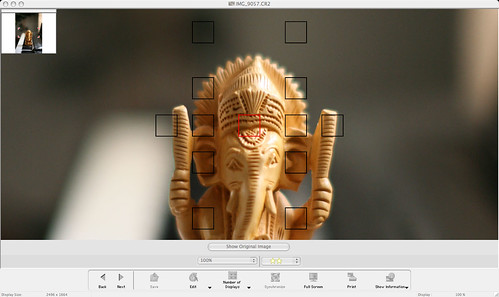
This lens has a reputation for being tricky. I hope that is not what I'm seeing (100% crop) - see the halo?

sg-2

PS: I think that halo is bokeh. The Depth of Field is incredibly small. ImageBrowser screenshot showing the focus point below:
sg-bokeh

Thursday, February 19, 2009

Truth-O-Meter

PolitiFact is tracking the status of each of Obama's 500 campaign promises.

Wednesday, February 18, 2009

Merry-Go-Round

The carousel in the Freehold Raceway Mall, supposedly one of half-a-dozen or seven of its kind.
Each is ISO 800, 16mm, f/5.6, 1/25 seconds. Full scale images are on flickr, showing lots of good detail,
or here, and here (warning - large!)

carousel-1

carousel-2

Monday, February 16, 2009

Beginner's guide to the Financial Crisis

Beginner's guide to the Financial Crisis—the best I've found so far.

California

The State of California is in bad shape financially, and is set to raise all kinds of taxes on regular people, to issue IOUs instead of tax refunds and the like. Amidst all this, the Republicans that run the state insist on a tax cut on corporations.

As digby points out
:
Conservatism has been stripped of everything but its essence --- cheap thugishness. I honestly can't remember a time in the last 30 years when they weren't holding a gun to the states' head no matter what the economic climate. If times are good they have to cut taxes. If times are bad they have to cut taxes. It's no wonder that the regular folks decided they shouldn't have to pay taxes either.

I guess it puts the federal stimulus package in perspective. The reason the Republicans didn't vote for it was simply because it didn't include enough goodies for their corporate owners. In that sense, I guess it was a huge win for liberal principles.

Sunday, February 15, 2009

Thrown for a curve

Remember Murray and Hernnstein and their book, The Bell Curve? Since obviously America is a pretty good meritocracy, and obviously IQ measures intelligence, IQ determines where Americans land up in life's race. It is just too bad that IQ is mostly inherited and that blacks have an IQ gap relative to whites. No program can ameliorate the natural inequality in society. So they said.

Well, here's some news.

A Los Angeles study suggested that four consecutive years of having a teacher from the top 25 percent of the pool would erase the black-white testing gap. — Nicholas Kristof in the NYT


PS: Remember then-Harvard President Lawrence Summers' speculations on whether biological differences between men and women resulted in women being at a disadvantage in mathematics, and that explained the relative absence of women in certain sciences? Well, funnily, it turns out that this so-called math gap doesn't exist in societies with high gender equality. See this.
The researchers also studied the percentage of students of each sex among the top scorers on the test. In the gender-equal countries, girls made up half or more of those who scored in the top one percent. The sex ratio of top performers is especially important because these students are the ones most likely to excel in careers in science and engineering. Summers had suggested that because of biological differences, it is nearly inevitable that a much higher percentage of these top performers will be boys.
A difference does persist - girls do better at arithmetic than geometry; boys do better at geometry.

My takeaway is that biological differences may be real; but we are currently no where near being able to attribute persistent inequality to those differences - cultural or environmental factors are currently much more important. The tendency of the conservative is to try to justify the status quo as both correct and immutable, at one time as God-given, and now as determined by genetics and biology.

Adventure of a Wedding Photographer

What a story! Murphy's law applied. Preparation and some luck carried the day.

PS: I don't think you have to register to read the story. If for some reason, it doesn't work, leave me a comment.

Acceptance of Evolution

Stolen from Andrew Sullivan:

Hunger in New Jersey

Food Banks need help!

Saturday, February 14, 2009

Where's the Revolution

Billmon observes the resistance to caps on executive compensation at companies that are bailed out with federal funds, and employers trying to block former employees from receiving unemployment benefits, and wonders why no one sees the possibility of revolution.

Cablevision - Optonline - Outbound Mail Filtering?

Cablevision's customer support for Optonline says that they do not do outbound mail filtering. They certainly do inbound mail filtering to catch spam.

However, for the last week or so, my email from my Optonline address has not been delivered. So this morning I started experimenting between my (web-based) yahoo, gmail accounts and my optonline account both from my laptop and from Optonline's web-email interface.

I discovered that

1. Email, when delivered between the three services, is virtually instantaneous.
2. All outbound email from Optonline, whether from my laptop or from the web-email account, that contains my blog URL: http://arunsmusings.blogspot.com is not delivered (or, more accurately, as of writing has not been delivered).
3. All outbound email from Optonline, whether from my laptop or from the web-email account, that does NOT contain my blog URL, has been delivered.
4. Optonline does not deliver inbound email from Yahoo and Gmail if it contains my blog URL.
5. Optonline does deliver inbound email form Yahoo and Gmail if it does NOT contain my blog URL.
6. Between Yahoo and Gmail, all mail is delivered, both with and without my blog URL.

My email signature commonly has my blog URL.

Seems clear as fine camera lens glass to me that Optonline does outbound mail filtering, even though their service desk denies it.

Using their webmail demonstrates that software on my PC cannot be responsible.

The three questions are:

1. Why?

2. How did my blog URL get on their list? I do not send out email to anyone who is spiteful enough to put my blog URL on a spam list. BTW, I tested using another blogspot URL, and those emails were not blocked.

3. How does one even submit a URL or other text string to be blocked? I don't see how going through the optonline pages. However this is happening, I think a hacker has to be involved.

Slashdot has a thread from 2008 on outbound mail filtering. Cox Cable also does it, and a blocked URL is mentioned there.
I tried to send an email. The email only contained text. The text Cox objected to was "http://my_homebox_IP_number/"


PS: My best guess is that someone has put my URL on a internet gambling or child pornography list - those are the only reasons I can think of for blocking a URL in email.

Tuesday, February 10, 2009

On the Edge of the Abyss

Quoting from this dkos story
According to Rep. Paul Kanjorski (D) (PA-11), in mid-September of 2008, the United States of America came just three hours away from the collapse of the entire economy. In a span of 2 hours, $550 billion was drawn out of money market accounts in an electronic run on the banks.

Rep. Kanjorski: " I was there when the secretary and the chairman of the Federal Reserve came those days and talked to members of Congress about what was going on... Here's the facts. We don't even talk about these things.

On Thursday, at about 11 o'clock in the morning, the Federal Reserve noticed a tremendous drawdown of money market accounts in the United States to a tune of $550 billion being drawn out in a matter of an hour or two.

The Treasury opened up its window to help. They pumped $105 billion into the system and quickly realized that they could not stem the tide. We were having an electronic run on the banks.

They decided to close the operation, close down the money accounts, and announce a guarantee of $250,000 per account so there wouldn't be further panic and there. And that's what actually happened.

If they had not done that their estimation was that by two o'clock that afternoon, $5.5 trillion would have been drawn out of the money market system of the United States, would have collapsed the entire economy of the United States, and within 24 hours the world economy would have collapsed.

Now we talked at that time about what would have happened if that happened. It would have been the end of our economic system and our political system as we know it."

....

" Ya know, we're not any geniuses in economics or finances... We're representatives of people. We ought to take our time, but let the people know this is a very difficult struggle.

Somebody threw us into the middle of the Atlantic Ocean without a life raft and we're trying to determine what's the closest shore and whether there's any chance in the world to swim that far. We. Don't. Know."

Sunday, February 08, 2009

Novel: The Messenger

The Messenger by Daniel Silva

Israeli Intelligence battles Saudi terrorists - one of these books will one day be a major motion picture. Reads well, and difficult to put down once started. As with all fiction, suspend belief when reading it and all will be well. For its genre, it rates four stars out of five.

Saturday, February 07, 2009

Pace Andrew Sullivan

One of uniform features of blogs by conservatives is that comments are not allowed. You have to write to the author, and you never know whether they've read it, or simply discarded it into the bit bucket. Andrew Sullivan, at the Atlantic, often admired by leftie types, is no exception. His quote of Will Wilkinson, Cato Institute flack, therefore led to this response:

Will Wilkinson:

Government-subsidized borrowing gave us the housing bubble, precipitated financial Armageddon, helped prompt recession and mass unemployment. But, as the infomercials say, that's not all! By zealously pushing home-ownership, federal housing policy has pinned to the map many now-jobless Americans who otherwise would have moved to find new work.


------
I'm reading James Grant's book "Mr Market Miscalculates : The Bubble Years and Beyond". Grant is the editor of Grant's Interest Rate Observer. (http://www.grantspub.com/).

The book consists of essays written from 1999 to May 2008. Many essays touch on the residential mortgage and derived markets.

Grant writes about the "too-big-to-fail" syndrome, which he believes led investors to take greater risks than they would have otherwise, and the low interest rates promoted by the Federal Reserve; but nowhere does he write about government-subsidized lending as having contributed to this mess. (Where he stands philosophically - e.g., he writes that Glass-Steagal 1933 was misguided, and was happy at its demise).

Here is a quote from June 15, 2007, commenting on a speech by Kevin Warsh, a Federal Reserve Governor:

"Reading between Warsh's lines, it's apparent that the Federal Reserve carries a torch for the Efficient Markets Hypothesis. Are investors invariably cool and calculating? Are markets frictionless? Is information universally disseminated to all the lucid participants? Do they act on it? If you answer "yes" to these questions, you, too, may find the board of Governors of the Federal Reserve System a collegial place to work.

I will meet Warsh halfway. I will concede that markets are just as efficient as the people who operate in them. How efficient is that? Let us turn to mortgage finance to find out. Here is a living laboratory in complexity gone wrong. During the long upswing, lenders were happy to credit a highly counterintuitive proposition. They accepted that a clump of low-rated mortgages could be transformed into a highly rated security. Only very smart people could dream up such a wonderful idea. And only educated people could accept it (they are taught to respect great minds, no matter what cockamamie conclusion those minds arrive at). What was the source of this alchemy? The reordering of cash flows to assure continuous payments to the holders of the senior claims. Risk of nonpayment, such as it was, was borne by the holders of the mezzanine and equity tranches. They bore it willingly. The ratings agencies lent their imprimatur to the assumptions and calculations on which the projections were based.

Investors bought with confidence. It reassured them to know that the ratings agencies deployed default probability generator models featuring a Monte Carlo multi-step default probability apparatus -- whatever that was. Besides, the mortgage scientists and ratings agency quants believed that diversification was their shield and armor. A given residential mortgage-backed security would contain mortgages from every region of the country. The diversity of collateral delivered low correlation in credit performance; they could hardly all default at once. As for house prices, the mortgage scientists observed that they almost invariably went up. And all agreed that home ownership was an unalloyed social benefit.

And if the lenders, borrowers, ratings agency analysts, investment bankers, appraisers, etc., hadn't been human, the story might have a happy ending. But it won't, because people in markets neglected to judge the effects of their actions on others. Uniquely uninhibited underwriting practices pushed up house prices and thereby coaxed more borrowers to employ greater leverage. Not wanting to be left behind, lenders completed with one another to offer the easiest terms. Loans tumbled out of the origination mills into the securitization factories, emerging as ABS or CDOs, investment-grade for the most part and thereby suitable for widows, orphans and foreign central banks. Thankfully, too, there were hedge funds and proprietary trading desks to absorb the residual credit risk of the lower-rated tranches. Warsh paid tribute to these social benefactors in his talk the other day: "By serving as willing counterparties in a variety of contracts, these institutions, in my view, are serving as a critical linchpin in the development of more complete markets."

Interjection - where is the government subsidized-lending in the cycle described here? This is entirely a creation of the private sector.
______
'
A little later, Grant states:

"My bet is that, come the next bear market in credit, correlations will prove to be shockingly high across the full spectrum of debt instruments. It will turn out that everything ws correlated to credit itself -- to the ability to borrow on terms over which posterity will shake its head, muttering, "What were they thinking?"


----------
I know you're a conservative, and thus by habit must blame the government. But you also strive to see what's under your nose, and surely that trumps your ideology.

Grant has an essay from Nov 4, 2005, "In Kansas We Busted" which describes what happened in the Great Plains segment of the real estate market of 1886. "...the lesson of the Great Plains levitation is that, in order to create a really big asset-price bubble, a central bank is neither necessary nor sufficient. A critical mass of human beings is all that's required".

PS: A consistent theme in Grant's writing is that investors see what they want to see, which is not necessarily consistent with reality. The nature of large masses of people is, on occasion, to create bubbles. In this case, the housing bubble was contributed to by "lenders, borrowers, ratings agency analysts, investment bankers, appraisers, etc." and the effects of their actions on each other. It had nothing to do with government-subsidized lending.

Our Liberal Media - 2

(via dailykos)


---
National Public Radio, too!
In Reporting On White House Economic Stimulus Package, NPR Interviews Six GOP Congressmen For Every Democrat
Based on NPR’s own data, NPR demonstrated a preference for Republican members of Congress in its reporting on President Obama’s Economic Stimulus Package. A review of NPR’s “Morning Edition” and “All Things Considered” broadcast records for the month ending February 3, 2008 indicates in the 50 stories on the stimulus, NPR interviewed and quoted 12 GOP Congresspersons, while only quoting 2 Democrats.....When viewed in context - that NPR’s sole Washington news analyst is FOX News’ employee and O’Reilly Factor guest host, Juan Williams, combined with numerous interviews with Heritage Foundation, Cato Institute, American Enterprise Institute, and National Review pundits, with no members of the progressive movement given equal time - NPR demonstrates a clear and unambiguous conservative bias in its reporting. Additionally, during this same period no White House spokesperson was interviewed or quoted by NPR.

McCain: "an appalling fraud"

Andrew Sullivan points out:
McCain campaigned on rural broadband as a way to stimulate the entire American economy. In fact it was a centerpiece of one of his economic plans: "Broadband access needs to be a top priority." But now that he's senator, he's against it. In fact, he brought it up on FOX news last week as being the epitome of wasteful and unnecessary spending, but I've been to a campaign rally where he campaigned for it.
And he once introduced legislation supporting it.

QOTD

ondelette:
...That mentality is rampant in a much larger domain than the traditional press. It appears as a natural follow on to treating any domain more like a business than its original nature. The press has always had an earning a living side, but it wasn't the main reason for its existence. A decent living was also the goal of many businesses without being their primary purpose for existing. Academia has non-business goals, non-entrepreneurial goals. When the mentality of business management gets in where it doesn't really belong, it reduces the organization to one where business is the primary goal, where maintaining power or gathering wealth are primary and the original purpose is a sideshow.

Point of fact, 'business principles' are very useful for organizing and presenting some things. But they properly are only the primary purpose of, well, business management. What they were originally invented for. Assigning most of life to the status of a facade, always with the same, dreary ulterior motive, blanches out our social organizations and makes them unable to function according to their true purpose. A news organization needs to be passionate about news, not power or money or security. If someone wants an organization that is passionate about business, or money, or power, one should find such organizations, and not corrupt one whose purpose is different.

Excerpt from Fruitless Fall

An excerpt from Fruitless Fall: The Collapse of the Honey Bee and the Coming Agricultural Crisis, by Rowan Jacobsen.
Webster has nothing against technology itself. He's aware that the scientific method has brought much progress. But he also sees that it isn't always the best approach. Controlled studies can handle only one or two variables at a time. So science breaks down a problem into the smallest units possible, then studies them one at a time to see what manipulating that one variable will do. It establishes tiny blocks of knowledge.

But when dealing with complex systems, with countless variables and feedback loops, science must throw up its hands. Look at the amount of attention paid to human nutrition, with rudimentary progress. Or our continuing inability to predict weather. Science's goal is to understand why something works so that it can manipulate and control that system. We have an obsession with knowing and controlling, and disdain more intuitive relationships with the world. But sometimes it isn't necessary to master a system in order to work harmoniously with it.

Webster, steeped in non-Western wisdom traditions, knew what his goal was: to establish an apiary that wasn't reliant on heroic human intervention and technology. If all the problems he and his beekeeping colleagues were having stemmed from human technology, then he was happy to let go of the reins and let the bees guide the development of their own apiary. He would be the caretaker, taking cues from the bees.

In his essays, he explained, "I tried to design a system where all the components of health (stability, resilience, diversity, and productivity) could function and grow —whether the mechanisms were known or unknown. Nature is much bigger than we are, and just allowing her methods to work could be the key to the future— both for the bees and for us." Later he added, "We'll never understand everything about Nature, but we can learn to live and work under her benevolent care and protection. Many have done this in the past, and there's no overriding reason why we can't do the same now and in the future. Working this way not only allows us to move away from the predatory and destructive economic and social system we live in now—it creates a real alternative. Making a living this way allows Nature to heal because of our work, rather than be continually degraded."

Of course, it also meant years of poverty. But what is poverty? "The state of one who lacks a usual or socially acceptable amount of money or material possessions," according to Merriam-Webster's. It exists only in the context of an economic system. If you can't afford the same sneakers or minivans or steak as your neighbors and you feel humiliated or inferior or just plain sad as a result, then poverty can cause real mental and physical duress. But if your goal is "to have a nice life in the country, centered around farming, gardening, and especially—keeping bees" (that's Kirk Webster), then poverty starts to look an awful lot like a traditional, healthy existence.

The problem, as Webster might see it, is that farms have been co-opted into the modern economy, and farmers are forced to start acting and thinking like other businessmen. There's nothing wrong with a farmer having a good head for business, but farms— at least, environmentally conscious ones— can't be run like other businesses. Businesses are predicated on the assumption of endless growth. When starting a business, you write your five-year business plan, then borrow a big wad of money and hope that your growth stays ahead of your interest payments. It's a Ponzi scheme based on new waves of consumers funneling money into your business. And it depends on the assumption that you can always make more product. No matter how mature your company gets, you are expected to keep making more product. If Coca-Cola or Exxon has a flat year, shareholders savage the company.

But in the world of biological systems, nothing grows unstoppably except a cancer. A healthy farm is immersed in the cycles of nature: steady growth, steady decay, a well-maintained balance. To grow economically, it has to either eat up more land or produce more on the same land. Those have been the basic farming trends for half a century or more. But neither can go on indefinitely. Land is finite, and many technological innovations that have allowed farmers to wring more product from their land have come by sacrificing the long-term health of the soil. In other words, the innovations weren't really offering something for nothing. Like fossil fuel, they were taking a resource built up over millennia (fertility) and liquidating it in a one-time spree.

There are good reasons why we shouldn't measure farms with the same yardstick we use for other businesses, but how do we do that in a culture where the economy has become the default measure of value? Weekly grosses of movies are printed in more newspapers than movie reviews are. When any disaster befalls the country, from September 11 to Hurricane Katrina, we look to the Dow Jones to gauge the nation's trauma.

For many years beekeepers have felt the tension of trying to work within a growth-based economic system while shepherding animals who don't thrive under that pressure. Why are there so few young beekeepers? Children watched their parents struggle to make a living in an inflationary world and decided they wanted no part of that life. Beekeepers wanting to stay in business have followed "economies of scale" principles, borrowing lots of money, buying out other apiaries, getting larger and larger, and expanding their pollination coverage to stay afloat.

Kirk Webster had other ideas. He understood that all the trends in the industry—indeed, in the country—would only lead him and his bees to greater misery, so he decided to step off the train and follow a different path. He counseled his colleagues wanting to opt out of the industrial model to cultivate self-sufficiency.
Beekeepers must become experts at producing honey, pollen, queens or other bee products, and enjoying a simple, low-cost lifestyle in a rural place. By investing some of your time and money in the self-sufficiency aspects—raising your own queens, building your own equipment and buildings, welding, gardening,etc.—you become partially removed from the instability of the overall economic system. It takes really good management to make all these jobs fit together right, and some income is sacrificed in the boom years; but over the long run the apiary is more stable, resilient and enjoyable to work with.


Friday, February 06, 2009

QOTD

Steven Pearlstein writes in the WaPo that many in Congress (Republicans) need personal economic trainers; they would fail Economics 101. He provides a metric for measuring stimulus items:
Spending is stimulus, no matter what it's for and who does it. The best spending is that which creates jobs and economic activity now, has big payoffs later and disappears from future budgets.


Me:

Corporate tax cuts, for instance, have a multiplier effect of between 1 and 0.7, and does not disappear from future budgets, unless the tax cuts are repealed. Food stamps, we are told, have a multiplier effect of 1.5 or so; and will decrease if the economy improves.

Thursday, February 05, 2009

Rep. Brad Miller on the financial crisis

Are We Going to Buy the Bezzle, is a well-written piece on dailykos by Rep. Brad Miller, which explains some things about the current financial crisis. Recommended read.

PS: Bezzle

PPS: I mentioned previously that I'm reading James Grant's "Mr Market Miscalculates". There are some essays in there from September-October 2006, which elucidate the rather rotten structure of CDOs (Collateralized Debt Obligations) based on subprime mortgages. The financial industry really indulged in free market malfeasance.

Wednesday, February 04, 2009

QOTD

Glenn Greenwald on salon.com:
Due to traveling, I've been subjected to far more cable news over the last 24 hours than I typically endure in an entire month.....And, just as a general note: if you watch cable television news during the daytime, you can actually physically feel your brain shrinking.

David Brin on how bad it has been

David Brin is one of my favorite science-fiction authors, in particular I enjoyed his "Uplift" series. He is also a dailykos contributor. Here is an excerpt.
2. AN ILLUSTRATION OF HOW BAD IT’S BEEN

Which leads me to an article published recently in the Wall Street Journal by Eliot A. Cohen, Condoleeza Rice’s foreign policy advisor, or the (supposedly) smart guy who guided the smart people who guided Pax Americana for all but two months (so far) of the 21st Century. In "How Government Looks at Pundits" Cohen offered his list of reasons why government insiders have little patience or use for input from others, beyond the narrow circle of those who receive "three-to-six-inch-thick briefing books, every day."

On the discussion list of SIGMA (the "think tank of scientific science fiction authors") several members were all-aflutter over how this splash of cold water should remind us outside consultants to keep our expectations low, no matter who is in power or what philosophies or personalities guide our myriad agencies.

Appalled at this complacent acceptance, I’m afraid I went a bit ballistic! Nobody else seemed to recognize Cohen’s article as a lengthy and utterly horrific apologia by one of the chief architects of the demolition of the American Pax,. In-effect, a longwinded whine about how nobody but a uniform and self-referential ingroup should ever expect to be heeded.

In vain, I searched his article for any mention of processes that might track outcomes and/or re-appraise policies in light of predictive success or failure. No mention of the pragmatic aim of finding people - both inside and outside of government - who happen to be right a lot and bringing them into the "briefing books" layer. No interest - or curiosity - about how his own error-avoidance methods might improve. Nor, of course, any awareness that the self-limiting perspective that he described might be a pathology. A perniciously destructive one, that merits correction by smart, sincere, skilled and patriotic people. What I did find was the following especially bizarre excerpt:

"Do not prescribe a policy that the current group of officials cannot hope to implement because of who they are. I have had highly intelligent individuals -- including some with senior government experience -- sit in my office and lay out perfectly plausible policies that the current team, limited by time remaining in office, the pressure of competing and more urgent crises, and the all important mix of personalities, could never hope to put into effect. Moreover, core beliefs and style constrain policy makers profoundly. So don't ask them to do something outside their range of psychological possibility by, for example, proposing cold-eyed realpolitik to a band of idealists or vice versa."

So, let me get this straight. We are to be guided by a core "band" that steers the ship of state with gut-level certainty, while accepting no advice, no feedback or course-correction based on ongoing metrics, having culled themselves of not only diversity of philosophy, but any difference in personality? As if any leader worth more than a bucket of warm seawater would not make sure to employ realists and idealists and all kinds that might both temper and challenge one another? Questioning assumptions and seeking good ideas, whatever the source?

Reminder, this was the best and most highly-touted kind of "expert" that we got under Bush. The very brightest of the brightest of those who have been ruling us, all but two months of the 21st century. With results and outcomes that are blatantly obvious to all.

Saturday, January 31, 2009

Arthur Silber: The Ravages of Tribalism

It is a thought-provoking set of essays. They're long and you might find much to be skeptical about. Still, it is worth the effort.

Part 1
This series will examine some of the many ways that love goes wrong, the ways in which love destroys the genuine vitality of another soul.


Part 2

(Not the main theme of the essay, but quoteworthy:
We should never treat having fun as something unimportant or trivial: having fun is a deeply serious matter. It is one of the primary ways we experience the inexpressible joy of being alive.


Waiting for part 3.

Say Yes to MOM!

MOM is a proposed rail route through Monmouth-Ocean-Middlesex counties in New Jersey. It has been held up by NIMBY (Not In My Back Yard) types; but perhaps its time has come.

Dismantling Greenspan

James Grant, Editor of "Grant's Interest Rate Observer", has a collection of essays published in a book "Mr. Market Miscalculates: The Bubble Years and Beyond". This I am reading in an attempt to understand our Wall Street-driven world.

An essay, "Nasdaq's Peak was Greenspan's", from August 3, 2001, had a take down of the fabled Federal Reserve Chairman, excerpts below.

...Insofar as Greenspan leads the market, it is a case of a one-eyed man leading people with two. Perhaps after they refresh themselves on the chairman's errant judgment — especially off the beam on the eve of the 2000 stock-market peak — the sighted will have more confidence in their own judgment.
...
The fundamental cause of the bubble was the mispricing of capital and credit, therefore of risk. In the hottest, most bubble-like sectors of the economy, investment projects were undertaken purely because money or credit was available to finance them.
...
Money was easy late in the decade, and when the capital markets chose to make it tight, as in the wake of the 1998 Long-Term Capital Management affair, the Fed insisted on making it easy again.

....
{Greenspan made a speech on March 6, 2000, before the Boston College Conference on the New Economy, on "The revolution in information technology".} As he spoke, orders for high-tech durable goods in the second quarter were on their way to registering a year-over-year gain of 25%. Four quarters later, in April-June 2001, following a sharp rise in the cost of speculative capital, they would register a 31% decline, the steepest on record. John Lonski, Moody's chief economist, aptly described the surge and plunge as "the picture of a bubble".

It was no bubble to the chairman when he rhapsodized on information technology and productivity growth. Thanks to computer technology, Greenspan declared, business managers were increasingly able to formulate decisions using "real-time" information.......
At a fundamental level the essential contribution of information technology is the expansion of knowledge and its observse, the reduction of uncertainty. Before this quantum jump in information availability, most business decisions were hampered by a fog of uncertainty. Businesses had limited and lagging knowledge of customers' needs and of the location of inventories and materials flowing through complex production systems. In that environment, doubling up on materials and people was essential as a backup to the inevitable misjudgments of the real-time state of play in a company. Decisions were made from information that was hours, days or even weeks old.
Thanks to the clarity afforded by instantaneous communications, Cisco Systems have to write off only $2.25 billion in excess inventories during its third fiscal quarter, in addition to just $1.17 billion in restructuing and other special charges. Using the older technologies — telephone, fax, the mails, citizens' band radio, etc., — the loss would undoubtedly have been greater. Throughout Silicon Valley, makers of PCs, chips, servers, printers, and other digital products have admitted to monstrous miscalculations of final demand. Lucent, Corning, Nortel and JDS Uniphase have been devastated by one of the greatest misallocations of capital outside the chronicles of the Soviet Gosplan. Who can conceive of the size of this waste had there been no email?
....
....
The fact that the capital spending boom is still going strong indicates that businesses continue to find a wide array of potential high-rate-of-return, productivity-enhancing investments. And I see nothing to suggest that these opportunities will peter out any time soon.
At least, not for the next 96 hours (the Nasdaq peaked on March 10).

Here was a remarkable set of ideas. What drives a capital spending boom, said the central banker is not — even in part — an excess of bank credit or an artificially low money-market interest rate. Rather, it is the cold and detached analysis of cost and benefit.....

Thursday, January 29, 2009

Our Liberal Media

The TV magnates used to say that because the Republicans are in power, they get more air time. Of course, now that Republicans are in the minority and have lost the White House, CNN gets seven Republicans and just one Democratic congress person in the last few days.

Wednesday, January 28, 2009

...with liberty and justice for all

The purveyors of the conventional wisdom are strongly rallying to the idea that Bush Administration officials should not be held accountable for their possibly manifold instances of breaking the laws regarding torture and illegal surveillance.

Glenn Greenwald points out how we're creating a two-tiered justice system, and just how harsh the system is on ordinary citizens. He actually has an entire series of articles, they should be read.

But even if you don't, read below:

Homeless man gets 15 years for stealing $100

A homeless man robbed a Louisiana bank and took a $100 bill. After feeling remorseful, he surrendered to police the next day. The judge sentenced him to 15 years in prison.

Roy Brown, 54, robbed the Capital One bank in Shreveport, Louisiana in December 2007. He approached the teller with one of his hands under his jacket and told her that it was a robbery.

The teller handed Brown three stacks of bill but he only took a single $100 bill and returned the remaining money back to her. He said that he was homeless and hungry and left the bank.

The next day he surrendered to the police voluntarily and told them that his mother didn’t raise him that way.

Brown told the police he needed the money to stay at the detox center and had no other place to stay and was hungry.

In Caddo District Court, he pleaded guilty. The judge sentenced him to 15 years in prison for first degree robbery.

If $100 means 15 years in prison, there wouldn't be enough prison space for all the white collar criminals who steal much more than $100 without the least bit of remorse.

Trade is not good for America?

It ranks up there with Alan Greenspan's discovery of a flaw in his ideology - he thought that financial institutions would be adequately self-regulating out of self-interest. Now, after a financial collapse unlike any seen in the last six decades and the US economy on the verge of a great depression, he goes "oops!".

The "it" that I began with is here:
A few months ago, Robert Cassidy found himself pondering whether trade actually benefited the American economy. "I couldn't prove it," he says. "Did it benefit U.S. multinational corporations? Yes. But I cannot prove that it benefits the economy."......

....More elementally, he {Cassidy} argues, U.S. trade policy should be based on America's economic self-interest. It speaks volumes about the last couple of decades of U.S. trade policy that the man who negotiated many key points of that policy now thinks that they were calculated not to enhance our national interest but, rather, those of U.S. financial and corporate interests.


How many of these "Oops! I was wrong" can we endure?

Tuesday, January 27, 2009

American Reality - It Isn't Pleasant

Commentary.
This is a BBC documentary:


An excerpt from The Heathen....

An excerpt from "The Heathen in His Blindness..."

Reconsider Spiro’s claim (1966: 91):

Since ‘religion’ is a term with historically rooted meanings, a definition
must satisfy not only the criterion of cross-cultural applicability but also
the criterion of intra-cultural intuitivity; at the least it should not be counter-
intuitive. For me, therefore, any definition of ‘religion’ which does not
include, as a key variable, the belief in superhuman…beings who have
power to help or harm men is counter-intuitive.

Now it is a matter of established consensus that the Hindus worship
trees, serpents, various animals (cow, monkey, and condor), images and
idols. Are we to consider these people religious? It all depends, one may
want to retort, whether or not Hindus consider the animals as “superhuman
beings that have the power to help or harm men”. In non-trivial
ways, animals can help or harm human beings, but Spiro does not probably
have this in mind. The problem might well be about the beliefstates
of the Hindus: do they believe that animals are ‘superhuman’ beings?
This is a question about the hierarchy of life on earth. Humans are
at the summit of ‘creation’ and animals are well below them in the ladder
of life constituting the ‘infra’ or ‘sub-human’ species. Consequently,
and only because of it, can gods be ‘super-human’. Cultures do exist
which recognise the differences between species, but do not recognise
any hierarchy of life on earth. Even if human life is a desirable form of
life, or even as a privileged form of existence, this does not imply that
either goal or direction is attributed to the emergence and ‘evolution’ of
life. One such culture is India and, in fact, one of the problems of the
Christian missionaries with the Brahmins had to do precisely with this
issue, as Rogerius (1651: 110) records it:

Hier toe an zijn sy niet te brenghen datse souden toe-staen dat een Mensch,
de Beesten overtreffe, end dat den Mensch een edelder Creatuere zy, dan
de Beesten, om dat hy met een voortreffelijcker Ziele zy begaeft. VVant soo
ghy dat haer voor hout, sy sullen segghen, dat oock dierghelijcke Zielen
de Beesten hebben. Indien ghy dit wilt betuygen door de werckingen
van de redelijcke Ziele, die in den Mensch, ende niet in de Beesten, haer
vertoont: soo heb je tot antwoort te verwachten…dat de reden, waerom
de Beesten niet soo wel reden, ende verstant, voor den dagh en brengen,
ende soo wel als de Menschen, en spreken, zijn, om datse gheen Lichaem
en hebben ghekregen, dat bequaem is, om de qualiteyten van haer Ziele
te voorschijn te brengen…
[You cannot make them admit that Man outstrips the beasts and that
he is a nobler creature than the animals because he has a superior soul.
If you try to remonstrate with them on this, they would say, animals also
have a similar kind of Soul. If you try to demonstrate this by the workings
of the rational soul, which is evident in Man and not in the beasts: you
may expect an answer…that the reason why the animals do not exhibit
the kind of rationality and understanding that human beings can show,
why they cannot speak as man does, is because they are not given a body
capable of exhibiting the qualities of their soul…]

In other words, to the Christians, Man was/is at the summit of creation.
To the Hindus, it was/is not so. Where does this take us with respect to
Spiro’s definition? His definition cannot be ‘useful’ to us unless we presuppose
at least some amount of (suitably diluted) Christian theology:
gods are superhuman, which is why they are worshipped; humans are
at the top of the hierarchy of life with animals well below them, and so
on.

This ‘minimal’ definition, which appears reasonable, merely expresses
a linguistic and historical intuition of a religious culture: how could
a religion not acknowledge the existence of ‘superhuman’ powers? This
is a secularised theology, as far from ‘science’ as anything could possibly
be.

Sunday, January 25, 2009

QOTD

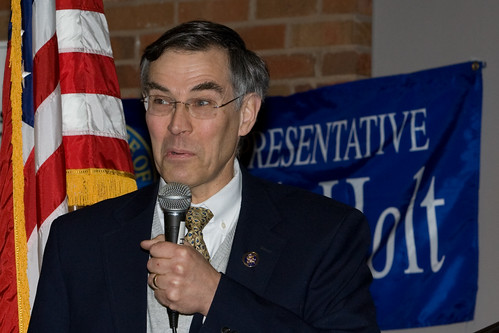
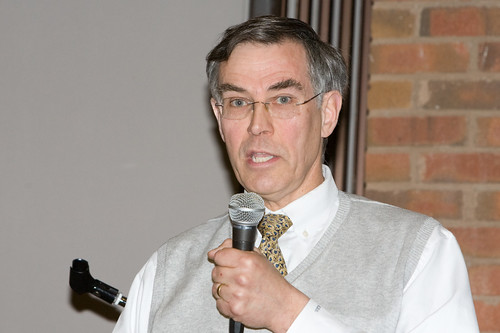
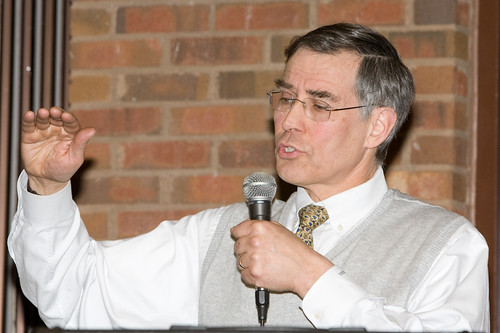
A self-governing country works only if you believe it does -- and we were at risk of losing that belief.
(approximately what Rep. Rush Holt (NJ-D) said today at a townhall meeting.)

holt-4
holt-3
holt-2
holt-1

The Gaudi Key

The Gaudi Key
Esteban Martin & Andreu Carranza, translated from the Spanish by Lisa Dillman.

This is a book of the "The Da Vinci Code" mode; actually better than that book - which is not saying much. However, I had never heard of Antonio Gaudi and now want to see his creations.

I give the book somewhere between two and three stars out of five.

PS: corrected a URL.
PPS: Made an attempt at a google map showing key locations in the story.

Also, here are some more images of Gaudi's work. It is also from where I lifted most of the addresses for the map.

PPPS: The most comprehensive site on Gaudí and Catalan Art Nouveau

Pakistan - what's happening

SSridhar on bharat-rakshak:
{PA=Pakistani Army; FC=Frontier Corps; TTP=Tehrik-e-Taliban, an umbrella group of Taliban }

We know certain facts about what is going on in FATA. Connecting these data points should give us a picture of what is happening there.

  1. PA’s tall claims of killing so many Taliban are entirely untrue. This untruth has been corroborated by independent witnesses of Pakhtuns fleeing from that area and Pakistani journalists.Here is one from DAWN, today
    Quote:
    “The government isn’t targeting the Taliban,” says Azka, her voice raised. “We don’t hear about any Taliban deaths. We’re the only victims.” . . .Frustrated by his own narrative, Ishaq insists that he has not seen government forces hurt any Taliban commanders or vice versa. “It’s all a drama -- no army officers or Taliban have died, but the ordinary people are losing their lands and missing a harvest.”
  2. As soon as he took over power, Gen. Kayani concentrated on the India border and the PA troops were either withdrawn or were confined to the garrisson in FATA/NWFP. The PA even created incidents in Samba sector to manufacture ‘justification’ for withdrawal of PA units from FATA.
  3. Kayani also resisted successfully the US presuure and asked them to equip & train the Pakhtun-dominated FC in COIN operations. {The FC foot soldiers are all Pashtun while officers are seconded from the regular PA. As an aside, it is this Pakhtun component that causes so much heartburn in Balochistan when FC is deployed there.}
  4. It is the general public that have been subjected to massive gunship and artillery fire with close to about 600,000 Internally Displaced People from Waziristan, Bajaur and Swat now rotting in refugee camps. Entire villages have been demolished in many places and even proudly displayed to foreign journalists as trophies.
  5. Almost all operations against the Taliban were announced ahead of time with a neat timetable of how many days it would last and what places will see action etc. A few days before the start of operations, the Taliban disappeared from these places and re-appeared promptly after the operations were over.
  6. The ANP government complained bitterly that the federal government bypassed it in discussing with the Taliban even in PATA areas which are sole responsibility of the provincial government.
  7. As recently as last month, the ISI Chief described open calls for jihad by the Taliban as ‘freedom of expression’.
  8. Recently, noted journalists like Amir Mir, Yousufzai and Farhat Taj have openly accused the PA of standing by while the Taliban were enforcing their rule and committing atrocities in their full view.
  9. All over FATA, the military checkposts (manned by levies or khasadar or FC) are replaced by the Taliban or wherever the military checkposts do exist, they are supplanted by nearby Taliban checkposts
  10. The quick offer of support against India by the TTP after the 26/11 Mumbai attacks and the double-quick acceptance of the same by the PA are clear indications of the synergies between the two. Munir Akram has openly admitted as to why Pakistan cannot withdraw support to jihadists and Taliban, in an article recently in Daily Times.
  11. The US has repeatedly voiced concern that shared intel reaches the Taliban and have stopped doing that.
  12. The NWFP Governor, Owais Ahmed Ghani, recently asked the US to talk to the Taliban Chief, Mullah Omar and also other mujahideen commanders like Gulbadin Hekmetyar and Jalaluddin Haqqani in order to bring peace to the region and he warned that otherwise peace was not possible.The Americans are being led down a garden path by the Pakistanis.
  13. The unanimous resolution that was passed recently in the Pakistani National Assembly, pressed for a dialogue, did not appreciate the actions of the Army so far and did not condemn the atrocities of the Taliban and their frequent violations of peace agreements.
  14. Maj. Gen. Amir Faisal Alvi's assassination is a pointer too.

I had said in a different context that a massively deceptive operation was going on in Pakistan by a coterie. It is to give an appearance of fighting against the Islamists, terrorists and the Taliban while actually making the situation conducive for them. Some Army officers may actually carry out genuine operations without knowing they were being sent in as cannon fodder to camouflage a more sinister plan. The slaughter of the PA at Khar was no sham, it was genuine. In some instances, the surrender of the PA was genuine. So, while some sections of the Establishment and the PA will be mounting efforts against the Taliban, others will be doing presisely the opposite, all controlled by the coterie. All of these groups subscribe to a common denominator that India needs to be vanquished and destroyed. There is no divergence in the view of the Pakistani Establishment or the masses or the political parties or the Islamists or the PA regarding how they view the Hindus and the Jews. Some may have a larger interest of establishing an Islamic Caliphate while others may want to grab power or accumulate wealth or settle scores with others but they will not hesitate to use the Islam and India cards. Islamist political parties like JI, JUI, PPP-Q etc. openly admire the Taliban, mainstream political parties like PML-N provide tacit support and sometimes even overt support, PPP walks a fine line between appearing to be ‘liberal’ while supporting terrorism etc. There is therefore an overlap of reinforcing interests among the various groups.

So, while loss of FATA & NWFP is genuine, it gives the several blind men of Hindoostan enough opportunity to describe the elephant.

Saturday, January 24, 2009

Books

Fruitless Fall : The Collapse of the Honey Bee and the Coming Agricultural Crisis

Rowan Jacobsen examines the recently emerged phenomenon of Colony Collapse Disorder - the mysterious death of honey bee hives, almost all over the world. Science has unable to pin it on any one cause; so there may be a systemic problem and a combination of stresses on honey bees may have crossed a threshold. This is a scientific whodunit narrated in a very engaging style. I'm ordering my own copy as I return this to the library. I strongly recommend it, five stars out of five.

An American Story: The speeches of Barack Obama
David Olive gives us a useful collection of Obama's campaign speeches along with commentary. It will be interesting to come back to this book after a hundred days of the Obama Presidency and compare with the programs outlined in his speeches. Four stars out of five.

The Last Theorem
Arthur C. Clarke and Frederik Pohl are/were giants of science fiction, yet this joint effort of theirs failed to hold me. The Last Theorem is that of Fermat - the hero discovers a short proof using only the knowledge that Fermat likely had. Yawn. Two stars out of five.

Emergent Design: The Evolutionary Nature of Professional Software Development
The creators of software ought to be professionals, like doctors and lawyers. Scott L. Bain sets out some of what should constitute professional practice in software design. For its intended audience, I'd rate it three to four stars out of five.

Wednesday, January 21, 2009

B. Raman on Londonistan

B. Raman eviscerates the British for their longstanding support of terrorism:

After Pakistan and Afghanistan, the UK has been traditionally for many years the largest sanctuary to foreign terrorists and extremists. Everybody, who is somebody in the world of terrorism, has found a rear base in the UK -- the Khalistanis in the past, the Liberation Tigers of Tamil Eelam, the Mirpuris from PoK, the Chechens, the Al Muhajiroun, the Hizbut Tehrir etc. Having allowed such a medley of terrorists and extremists to operate unchecked from their territory for so long, British intelligence just does not have a correct estimate of how many sleeper cells are operating from their country and of which organisations.


"The intelligence agencies of the US and the UK went along with Zia's policy of Arabising/Wahabising the Muslims of Pakistan because this contributed to an increase in the flow of jihadis to fight the Soviet troops in Afghanistan. Till 1983, the members of the Pakistani Diaspora in the UK were considered a largely law-abiding people. The first signs of the radicalisation of the Diaspora appeared in 1983 when a group of jihadi terrorists kidnapped Ravi Mhatre, an Indian diplomat posted in the Indian Assistant High Commission in Birmingham, and demanded the release of Maqbool Butt, the leader of the Jammu and Kashmir Liberation Front, who was then awaiting execution in Tihar jail in Delhi following his conviction on charges of murder. When India rejected their demand, the terrorists killed Mhatre and threw his body into one of the streets. This kidnapping and murder was allegedly orchestrated by Amanullah Khan, a Gilgiti from Pakistan. He was assisted by some Mirpuris. The British were uncooperative with India in the investigation and declined to hand over those involved in the kidnapping and murder to India for investigation and prosecution. By closing their eyes to the terrorist activities of the Mirpuris from their territory, they encouraged the further radicalisation of the Diaspora.

"Just as the radicalisation of the Muslims of Pakistan suited the US-UK agenda in Afghanistan, the radicalisation of the Diaspora in the UK, particularly the Mirpuris, suited their agenda for balkanising Yugoslavia in the 1990s. Many Pakistanis from the UK went to the training camps of the Harkat-ul-Ansar (now called the Harkat-ul-Mujahideen) and the Lashkar-e-Tayiba in Pakistan and got themselves trained with the knowledge and complicity of the British. They then went to Bosnia and Kosovo to wage a jihad against the Serbs with arms and ammunition and explosives allegedly supplied by the Iranian intelligence with the tacit consent of the Bill Clinton administration and paid for by the Saudi intelligence. As the Pakistani prime minister between 1993 and 1996, Benazir Bhutto had visited these jihadis in the UK. After waging their jihad against the Serbs, they moved from the UK to Pakistan to join the HUA and the LeT and participate in the jihad against India.

"The most notable example of the home-grown UK jihadis who turned against them is Omar Sheikh. From Bosnia, he came to India to wage a jihad and was arrested by the Indian security forces. He was released following the hijacking of an Indian Airlines plane to Kandahar by a group of Harkat-ul-Maujahideen terrorists. After his release, he went to Pakistan and orchestrated the kidnapping and murder of journalist Daniel Pearl. The second notable example is Rashid Rauf, a Mirpuri, who went to Pakistan from the UK to join the Jaish-e-Mohammad after marrying a relative of Maulana Masood Azhar, the Jaish amir. He was allegedly involved in the plot detected by the London police in August 2006 to blow up a number of US-bound planes. This plot was hatched by some members of the Pakistani Diaspora in the UK. (Rauf was recently killed in a US Predator strike on an al Qaeda hide-out in the Federally-Administered Tribal Areas of Pakistan).

Tuesday, January 20, 2009

POTUS!

Barack Hussein Obama Mubarak!

Finally! Finally!

Bidabunch reminds us of The Onion, January 17, 2001.
Mere days from assuming the presidency and closing the door on eight years of Bill Clinton, president-elect George W. Bush assured the nation in a televised address Tuesday that "our long national nightmare of peace and prosperity is finally over."

Enlarge Image nation nightmare

President-elect Bush vows that "together, we can put the triumphs of the recent past behind us."

"My fellow Americans," Bush said, "at long last, we have reached the end of the dark period in American history that will come to be known as the Clinton Era, eight long years characterized by unprecedented economic expansion, a sharp decrease in crime, and sustained peace overseas. The time has come to put all of that behind us."

Bush swore to do "everything in [his] power" to undo the damage wrought by Clinton's two terms in office, including selling off the national parks to developers, going into massive debt to develop expensive and impractical weapons technologies, and passing sweeping budget cuts that drive the mentally ill out of hospitals and onto the street.

During the 40-minute speech, Bush also promised to bring an end to the severe war drought that plagued the nation under Clinton, assuring citizens that the U.S. will engage in at least one Gulf War-level armed conflict in the next four years.

"You better believe we're going to mix it up with somebody at some point during my administration," said Bush, who plans a 250 percent boost in military spending. "Unlike my predecessor, I am fully committed to putting soldiers in battle situations. Otherwise, what is the point of even having a military?"....

Bush concluded his speech on a note of healing and redemption.

"We as a people must stand united, banding together to tear this nation in two," Bush said. "Much work lies ahead of us: The gap between the rich and the poor may be wide, be there's much more widening left to do. We must squander our nation's hard-won budget surplus on tax breaks for the wealthiest 15 percent. And, on the foreign front, we must find an enemy and defeat it."

"The insanity is over," Bush said. "After a long, dark night of peace and stability, the sun is finally rising again over America. We look forward to a bright new dawn not seen since the glory days of my dad."

Monday, January 19, 2009

QOTD

Obama in the WaPo:
Question: To what extent is the promotion of freedom or democracy something that you think should be part of the foreign policy and, if it is a part, how would you do it differently than it has been done in the past eight years?

President-elect Obama: Well, I think it needs to be at a central part of our foreign policy. It is who we are. It is one of our best exports, if it is not exported simply down the barrel of a gun.

And one of the mistakes, I think, [that] has been made over the last eight years, and, by the way, I'm not somebody who discounts the sincerity and worthiness of President Bush's concerns about democracy and human rights, and I think a lot of the ways that he spoke about it were very eloquent, but I think the mistake that was made is drawing an equivalence between democracy and elections.

Elections aren't democracy, as we understand it. They are one facet of a liberal order, as we understand it. And so in a lot of countries, you know, the first question is, if you go back to Roosevelt's four freedoms, the first question is freedom from want and freedom from fear.

If people aren't secure, if people are starving, then elections may or may not address those issues, but they are not a perfect overlay.

And, you know, issues like arbitrary arrest or corruption may or may not be addressed by an election. So I think what we need to be thinking about is, in various countries, and I use my father's home country of Kenya as an example, what we should be spending more time thinking about is, how can we provide them tools so that somebody doesn't get stopped on the street by a police officer and shaken down, or how do we create a system in which you don't have to pay a large bribe in order to get a job or get a phone installed?

And if we ignore those things, then oftentimes an election can just backfire or at least won't deliver for the people the kinds of -- it may raise expectations but not deliver what they're looking for. And, you know, so we will be working with -- you know, one of the things that I have pledged to do in foreign policy is to ramp up our State Department and restore some balance between the civilian and the military side, to -- and right now we have already begun conducting a thorough review of our various aid programs, our democracy programs, how do these all fit together and how do we view it through a lens that it is actually delivering a better life for people on the ground and less obsessed with form, more concerned with substance.

---------------------

The above is not very profound or original - but this is the off-the-cuff response of our President Elect, and it is sweet water after eight years of drought. G. 'Dubya' Bush is the eternal badge of shame of the American people.

Saturday, January 17, 2009

QOTD

Regarding the US Airways plane that ditched into the Hudson river, and where seemingly miraculously, all 155 people on board survived:
People keep saying that this was a tribute to competence but it goes well beyond that. This was expertise. Expertise in knowing every ounce of capability of that plane to fly and land without engines. Expertise in setting up training programs for flight crews in emergency situations. Expertise in getting rescue vessels to the plane in minutes. Expertise in diving into icy waters and rescuing the last few passengers inside the plane. Expertise in getting those two women out of the water before they could sink beneath the surface.

We've been living in a time when even mere competence was distained and smartness considered 'elitism' as if that was a bad thing.

Had that fuel filled jet crashed into any part of NYC, the tragedy would have been one of total horror. Sully and his crew, and all the rescuers showed us what the best of the best can do when the chips are down. Let's hear it for experts! - SusanL143 on dailykos.com


I found it fitting that this display of expertise was on the same day as the most incompetent President in US history gave his farewell address to the nation. We can hope that this following is true:
....the one thing that we're not running out of in my view and that's American technological ingenuity. That little piece of Benjamin Franklin's legacy is alive and well - Simon Schama on Bill Moyers (h/t R.P.)

Counting down the hours...

...for Bush to be off the national stage.


Transcript available here.

Friday, January 16, 2009

QOTD

It's from 2005, so maybe it should be Quote of the Decade. This is from Vladimir Bukovsky, in the Washington Post (via N.K.)
Every Russian czar after Peter the Great solemnly abolished torture upon being enthroned, and every time his successor had to abolish it all over again. These czars were hardly bleeding-heart liberals, but long experience in the use of these "interrogation" practices in Russia had taught them that once condoned, torture will destroy their security apparatus. They understood that torture is the professional disease of any investigative machinery.

Sunday, January 11, 2009

Democrats - good for the economy!

In the past 64 years, net job creation when Democrats were President totaled 57.5 million jobs. When a Republicans were, net job creation totaled 36.2 million jobs. But even that stark difference doesn't show the the whole picture. Republicans held the Presidency for 36 of those years, meaning they accounted for an average of just over 1 million jobs generated per year. The Democrats for just over 2 million jobs a year.

That's right, average annual job creation under Democratic presidencies since 1944 has been twice as good as under Republicans. Is this correlation mere coincidence?


via dailykos

It is not just jobs. Democrats are good for Wall Street as well. (The NYT had some great statistics on this; will post when I find the link.)

Friday, January 09, 2009

Slumdog Millionaire

See it.

PS: A review that greatly disagrees. It forces me to pinpoint the exact reasons I liked the movie. In large part it is the unquenchable spirit of the young Jamal Malik. Moreover it is a Dickensian story but without the objectionable Dickens' assumption that pedigree shows.

Also, after following the news this week, a loose metaphor floating in my mind was that Jamal is a Gazan Palestinian; and she whom he seeks is the Palestinian state. So despite it all one can hope for a happy ending.

Wednesday, January 07, 2009

QOTD-2

Glenn Greenwald:
Actually, even when it comes to something as relatively petty (and misguided) as their pledge to exclude Burris from entering the glorious, imperial Senate, Senate Democrats -- "led" by Harry Reid -- can't avoid capitulating completely. Jane Hamsher has all of the embarrassing details here ("A seventy-one year old dude who hasn't held office for 14 years, appointed by a crook, takes the Senate Majority Leader to the cleaners"). When you look at the people who have led both parties for the last eight years, was there any outcome even theoretically possible for the country other than what we got: total disaster in every realm?

QOTD

Christopher Hitchens:
To read Benny Morris is to be quite able—and quite free—to doubt that there should ever have been an Israeli state to begin with. But to see Hamas at work is to resolve that whatever replaces or follows Zionism, it must not be the wasteland of Islamic theocracy.

Dragonback Adventures

The set of six books: Dragon and Thief, Dragon and Soldier, Dragon and Slave, Dragon and Herdsman, Dragon and Judge, and Dragon and Liberator, by Timothy Zahn is an entertaining read, even if directed at young adults (in fact, it won a young adult book award). Our heroes are a boy, Jack Morgan, age 14, and a symbiotic tiger-sized dragon, Draycos, a poet-warrior of the K'Da. The symbiosis is that the K'Da regularly need to assume a two-dimensional form and need a host to sustain them during that period. The setting of the novels is a space-faring galactic culture. Jack and Draycos need to collaborate to clear up Jack's problems and to save Draycos's people from genocide.

Nicely done set of books. Only because they will not be universally to everyone's taste and therefore are not must-reads, I give them a 4 out of 5 stars rating.

Monday, January 05, 2009

QOTD

Actually this is from 2002. In a story on how Israel aided Hamas as a means of weakening the PLO, only to find Hamas refusing to acquiesce in Israel's existence; and yet to find advantage in that ("But even then, some in Israel saw some benefits to be had in trying to continue to give Hamas support: "The thinking on the part of some of the right-wing Israeli establishment was that Hamas and the others, if they gained control, would refuse to have any part of the peace process and would torpedo any agreements put in place," said a U.S. government official who asked not to be named."), we have the following:
According to former State Department counter-terrorism official Larry Johnson, "the Israelis are their own worst enemies when it comes to fighting terrorism."

"The Israelis are like a guy who sets fire to his hair and then tries to put it out by hitting it with a hammer."

"They do more to incite and sustain terrorism than curb it," he said.

Aid to Hamas may have looked clever, "but it was hardly designed to help smooth the waters," he said. "An operation like that gives weight to President George Bush's remark about there being a crisis in education."


Lot of Indians see Israel and India fighting a common Islamic foe. Not so. Israel's Islamic foe (like America's Islamic foe) is much of its own creation. In fact, to some extent, India's foe is a colonial British and post-colonial American creation.

QOTD

Via Paul Krugman's blog:
“Most academics are really reluctant to take part in the public dialog, because the public dialog requires you to have an opinion about things you can’t really be sure about,” says Mr. Rajan. “They fear talking about things where everything is not neatly nailed in a model. They stay away and let the charlatans occupy the high ground.” -- Free market economist Raghuram Rajan; his 2005 paper which said that markets could sometimes get things terribly wrong was pooh-poohed by the leading lights of the profession.

Misalignment

Alan Greenspan:

""I have found a flaw," said Greenspan, referring to his economic philosophy. "I don't know how significant or permanent it is. But I have been very distressed by that fact.....I made a mistake in presuming that the self-interests of organisations, specifically banks and others, were such that they were best capable of protecting their own shareholders and their equity in the firms."

Sunday, January 04, 2009

Summary of the Pakistan Problem

I don't think one can be more concise than Vanni Cappelli in stating the truth about Pakistan:

That the Bush administration in the wake of 9-11 turned to the very entity responsible for turning South-Central Asia into a stronghold of Islamic militancy as a “key ally” against these same forces must stand as an instance of conceptual lag unequalled in the history of American foreign policy. Given Rawalpindi’s irreducible geostrategic paradigm of employing Islamic fundamentalism to crush progressive forces at home and extend its power abroad, it is as oxymoronic to look to it as an ally against radical Islamism as it would have been to seek to extend the wartime alliance with the Soviet Union into one against communism.

Pakistan’s army has shown persistence in its endeavours over many decades. Its ties to militants are not the vagaries of “rogue elements” but represent the integrated policies of the military-security services complex itself. Such an entity does not make a sea-change in its ethos merely because it has been threatened with dire consequences unless it switches sides—it only pretends to, especially if receiving billions of dollars in renewed military aid will be the result.

And if some of Rawalpindi’s jihadi assets have slipped beyond its control while the army conducts desultory campaigns against militants to appease America, all the better for portraying Pakistan as a victim of terrorism, rather than the state sponsor of terror it has long been. Allowing a powerless civilian administration in Islamabad to be the public face of the country completes the illusion.

American military assistance to Pakistan over the last half century has enabled Islamic fundamentalism, perpetuated the India-Pakistan conflict, and led over and over again to death and destruction. It has prevented the development of democracy, civil society, and equitable economic relations in Pakistan. With mounting evidence that Rawalpindi continues to support the Taliban in pursuit of its historic goals, it is now being used to kill American and other coalition soldiers.

The incoming Obama administration must confront this fact, and bring American national security policies in line with reality.

Front Yard Warming

What are the iris doing, poking green shoots out of the ground by January 4?

It occurs to me that plants' responses to the seasons may be much clearer indications of climate change than the measurement of glaciers or the global average temperature. It is not dependent on any computer model. Best of all, they are right at your doorstep.

My front yard (north side of the house) seems to be warming. The east side of my house also appears to have a warming trend. Further observations will be posted here.

The credit default swap casino

Credit-default swaps may not be Exhibit No. 1 in the case against financial complexity, but they are useful evidence. Whatever credit defaults are in theory, in practice they have become mainly side bets on whether some company, or some subprime mortgage-backed bond, some municipality, or even the United States government will go bust. In the extreme case, subprime mortgage bonds were created so that smart investors, using credit-default swaps, could bet against them. Call it insurance if you like, but it’s not the insurance most people know. It’s more like buying fire insurance on your neighbor’s house, possibly for many times the value of that house — from a company that probably doesn’t have any real ability to pay you if someone sets fire to the whole neighborhood. The most critical role for regulation is to make sure that the sellers of risk have the capital to support their bets. - Einhorn and Lewis

QOTD

The Madoff scandal echoes a deeper absence inside our financial system, which has been undermined not merely by bad behavior but by the lack of checks and balances to discourage it. “Greed” doesn’t cut it as a satisfying explanation for the current financial crisis. Greed was necessary but insufficient; in any case, we are as likely to eliminate greed from our national character as we are lust and envy. The fixable problem isn’t the greed of the few but the misaligned interests of the many. - Michael Lewis and David Einhorn in the New York Times.


The "misaligned interests" is why I quote it.

OUR financial catastrophe, like Bernard Madoff’s pyramid scheme, required all sorts of important, plugged-in people to sacrifice our collective long-term interests for short-term gain. The pressure to do this in today’s financial markets is immense. Obviously the greater the market pressure to excel in the short term, the greater the need for pressure from outside the market to consider the longer term. But that’s the problem: there is no longer any serious pressure from outside the market. The tyranny of the short term has extended itself with frightening ease into the entities that were meant to, one way or another, discipline Wall Street, and force it to consider its enlightened self-interest.


In my opinion, this is more widespread a problem than American financial firms.

Saturday, January 03, 2009

A curious symmetry

Al Biruni wrote {around 1020 AD, Edward Sachau translation of Tarikh al-hind}
Now in the following times {after Muhammad bin Kasim, c. 700} no Muslim conqueror passed beyond the frontier of Kabul and the river Sindh until the days of the Turks, when they seized the power in Ghazni under the Samani dynasty, and the supreme power fell to the lot of Nasir-addaula Sabuktagin. This prince chose holy war as his calling, and therefore called himself Al-Ghazi (i.e., warring on the road of Allah). In the interests of his successors he constructed, in order to weaken the Indian frontier, those roads on which afterwards his son Yamin-addaula Mahmud marched into India during a period of thirty years and more.


In July 2008, after several years of effort, and a few lives lost to the Taliban, India completed the Zaranj-Delaram highway, opening a route into Afghanistan via the Iranian port of Chabahar.

Thursday, January 01, 2009

Will 2009 be a better year for civil liberties?

Glenn Greenwald reviews the last eight years, and 2008 in particular, when civil libertarians were handed a string of defeats.

We lost on redress for illegal surveillance by the government, on the restoration of habeas corpus and on the prohibition of torture. Sadly, the Democrats yielded more to Bush than did his pocket Republicans.

Will 2009, and the Obama Administration be any better? That the Democrats control the House and Senate means next to nothing.