Friday, August 24, 2012

On the origin of Indians - 2

Michel Danino summarizes the past several years of genetics research

Quote:

Conclusions

It is, of course, still possible to find genetic studies trying to interpret differences between North and South Indians or higher and lower castes within the invasionist framework, but that is simply because they take it for granted in the first place. None of the nine major studies quoted above lends any support to it, and none proposes to define a demarcation line between tribe and caste. The overall picture emerging from these studies is, first, an unequivocal rejection of a 3500-BP arrival of a “Caucasoid” or Central Asian gene pool. Just as the imaginary Aryan invasion / migration left no trace in Indian literature, in the archaeological and the anthropological record, it is invisible at the genetic level. {Arun's note: The only evidence for an Aryan invasion/migration is linguistic; the problem is that linguistic evidence is interpreted in the framework of an invasionist scenario, and thus props it up. } The agreement between these different fields is remarkable by any standard, and offers hope for a grand synthesis in the near future, which will also integrate agriculture and linguistics.

Secondly, they account for India’s considerable genetic diversity by using a time- scale not of a few millennia, but of 40,000 or 50,000 years. In fact, several experts, such as LluĂ­s Quintana-Murci,20 Vincent Macaulay,21 Stephen Oppenheimer,22 Michael Petraglia,23 and their associates, have in the last few years proposed that when Homo sapiens migrated out of Africa, he first reached South-West Asia around 75,000 BP, and from here, went on to other parts of the world. In simple terms, except for Africans, all humans have ancestors in the North-West of the Indian peninsula. In particular, one migration started around 50,000 BP towards the Middle East and Western Europe:

“indeed, nearly all Europeans — and by extension, many Americans — can trace their ancestors to only four mtDNA lines, which appeared between 10,000 and 50,000 years ago and originated from South Asia.” 24

Oppenheimer, a leading advocate of this scenario, summarizes it in these words:
“For me and for Toomas Kivisild, South Asia is logically the ultimate origin of M17 and his ancestors; and sure enough we find the highest rates and greatest diversity of the M17 line in Pakistan, India, and eastern Iran, and low rates in the Caucasus. M17 is not only more diverse in South Asia than in Central Asia, but diversity characterizes its presence in isolated tribal groups in the south, thus undermining any theory of M17 as a marker of a ‘male Aryan invasion’ of India. One average estimate for the origin of this line in India is as much as 51,000 years. All this suggests that M17 could have found his way initially from India or Pakistan, through Kashmir, then via Central Asia and Russia, before finally coming into Europe.”25

We will not call it, of course, an “Indian invasion” of Europe; in simple terms, India acted “as an incubator of early genetic differentiation of modern humans moving out of Africa.”26

Genetics is a fast-evolving discipline, and the studies quoted above are certainly not the last word; but they have laid the basis for a wholly different perspective of Indian populations, and it is most unlikely that we will have to abandon it to return to the crude racial nineteenth-century fallacies of Aryan invaders and Dravidian autochthons. Neither have any reality in genetic terms, just as they have no reality in archaeological or cultural terms. In this sense, genetics is joining other disciplines in helping to clean the cobwebs of colonial historiography. If some have a vested interest in patching together the said cobwebs so they may keep cluttering our history textbooks, they are only delaying the inevitable. .

Wednesday, August 22, 2012

On the origin of Indians

http://baibaswata.blogspot.de/2011/06/r1a1-and-its-indian-origins.html

Genetics does not support an "Aryan Invasion/Migration Theory".

Monday, August 20, 2012

Douglas Engelbart : The Mother of All Demos

Douglas Engelbart : The Mother of All Demos, December 9, 1968
Quote:
On December 9, 1968, Douglas C. Engelbart and the group of 17 researchers working with him in the Augmentation Research Center at Stanford Research Institute in Menlo Park, CA, presented a 90-minute live public demonstration of the online system, NLS, they had been working on since 1962. The public presentation was a session in the of the Fall Joint Computer Conference held at the Convention Center in San Francisco, and it was attended by about 1,000 computer professionals. This was the public debut of the computer mouse. But the mouse was only one of many innovations demonstrated that day, including hypertext, object addressing and dynamic file linking, as well as shared-screen collaboration involving two persons at different sites communicating over a network with audio and video interface.

Thursday, August 16, 2012

Michelle Alexander: The New Jim Crow

"The New Jim Crow: Mass Incarceration in the Age of Colorblindness" by Michelle Alexander is a disturbing read.  Quite contrary to the ideal of "equal justice for all", the War on Drugs has unleashed a nightmare of unequal justice for the African-American community. 

The laws against drugs are harsh, and unequally applied.  Police and prosecutorial discretion makes sure that it is blacks rather than whites (who have an equal rate of drug use) that are targeted.  The wide powers given to the police result in many casualties, even of people quite innocent of drugs.

Possession of a small amount of marijuana can entangle one in the justice system.  Poor people get very poor quality legal representation.  Once convicted, people lose their right to vote, their ability to get any kind of government help and of course, future employment is a problem.   

All in all, the war against drugs has made the US be the country with the largest percentage of its population in jail - more than repressive dictatorships even, and it is creating a permanent underclass with little means of climbing out of its poverty and misery.

The laws are unjust in their content and in their application, but the laws involve drugs, and I wonder why in the face of severe penalties people continue to use them.  I do not understand the diminution of freedom or of quality of life if one eschews drugs.  But then I come from a culture where self-restraint is a cardinal virtue; while American culture is generally permissive.  Michelle Alexander has no good explanation, except that "we all are sinners, we all suffer from lapses" and that Barack Obama, in his youth, used drugs fairly extensively.

It is a depressing book, that anyone interested in America should read.

PS: added on January 17, 2015. To clarify my last paragraph: the "Old Jim Crow" laws kept blacks from exercising their fundamental rights. The "New Jim Crow" however is unequal application of laws regarding behavior that society has legitimate reasons to criminalize. (Maybe criminalization is not the best policy, but that is a different debate.) The easiest way not to get caught up in "New Jim Crow" (except as an innocent bystander, which does happen) is not to indulge in this behavior. An explanation is needed as to why people don't respond rationally to this (dis)incentive, and is lacking. This is not like say, outlawing of traditional use of peyote in American-Indian ceremonies.

Wednesday, August 15, 2012

Insanely Simple

Once I had started Ken Segall's book "Insanely Simple - The Obsession That Drives Apple's Success", I could not put it down till I reached the last page.

Simplicity requires strong character, smarts, courage, creativity, even obsession, and very hard work.  When achieved, it might just help move the human race forward.
Remembering that I'll be dead soon is the most important tool I've ever encountered to help me make the big choices in life.   Because almost everything - all external expectations, all pride, all fear of embarrassment or failure - these things fall away in the face of death, leaving only what is truly important.  Remembering that you are going to die is the best way I know to avoid the trap of thinking you have something to lose.   You are already naked.  There is no reason not to follow your heart....  (Steve Jobs, Stanford commencement address, June 12, 2005)
Your heart, presumably, wants to lead you to excellence.   (Otherwise, be distrustful of your heart.)


Tuesday, August 14, 2012

Ayn Rand: sociopath


In brief, she found the epitome of her philosophy - "I am like the state, what is good for me is right" - in a repeat criminal who kidnapped and brutally murdered a 12-year old girl.

And this assessment which I endorse:
By the appraisal of any normal mind, there can be little doubt that William Edward Hickman was a vicious psychopath of the worst order. That Ayn Rand saw something heroic, brilliant, and romantic in this despicable creature is perhaps the single worst indictment of her that I have come across. It is enough to make me question not only her judgment, but her sanity.

At this point in my life, I did not think it was possible to significantly lower my estimate of Ayn Rand, or to regard her as even more of a psychological and moral mess than I had already taken her to be.

I stand corrected.

Sunday, August 12, 2012

Are Indians corrupt?

Wednesday, August 01, 2012

Is Oscar Wilde wrong?

Oscar Wilde:You can always judge a man by the quality of his enemies. 

Think about it.  By that measure, Obama is a pathetic loser.

PS: It might not be Oscar Wilde, it might be Dr Who or Joseph Conrad or someone else.  That is the danger of relying on the Internet for quotes.  However, in "The Picture of Dorian Gray", Oscar Wilde does have this passage:
"I choose my friends for their good looks, my acquaintances for their good characters, and my enemies for their good intellects.  A man cannot be too careful in the choice of his enemies.  I have not got one who is a fool.  They are all men of some intellectual power, and consequently they all appreciate me."

Tuesday, July 31, 2012

And the Flag Was Still There

On the Moon, that is.

(Photographs reveal that 5 of 6 American flags planted on the Moon are still standing.)

Sunday, July 29, 2012

Is Algebra Necessary?

Andrew Hacker, emeritus Professor of Political Science at City University of New York, has an op-ed in the New York Times today, asking Is Algebra Necessary?  ( CIP found this article provocative, too!)

Hacker's main point is that flunking in algebra is the cause for students to drop out of high school, not qualify for university, or to drop out of university.   Therefore, eliminating such math requirements would lead to more success, and anyway most people don't use these skills later.

To my view, high school algebra is the simplest first exercise of abstract thinking; and if students are failing it, it should be viewed as the canary in the coalmine of school - it is a signal that the students have not acquired the learning process.  Eliminating the canary will not improve matters.

But there is something else Hacker writes that I want to focus on here:

Saturday, July 28, 2012

Eurozone Debt 2011

This BBC page from 2011 has a nice interactive graphic of who owes what to whom.  It also contains this:

Country         Foreign Debt/GDP    Govt Debt/GDP
France           235%                    87%
Spain            284%                    67%
Portugal         251%                   106%
Italy            163%                   121%
Ireland         1093%                   109%
Greece           252%                   166%
Japan             50%                   233%
Germany          176%                    83%
UK               436%                    81%
US               101%                   100%

As you can see, for some of these countries, private debt dominates. Take the first row, for example - France. French government debt, even if it was all foreign debt, would still leave private foreign debt to be 235% - 87% = 148% of GDP.

As Krugman pointed out, it was private, not public, borrowing that created the mess in many of these countries.   And when both private and public sectors simultaneously try to reduce debt, the result is an economic recession or depression.

PS: Four year old information from the McKinsey Global Institute, but still useful I think to get a qualitative understanding of what is going on.


Thursday, July 26, 2012

The future of renewable energy

(Via Krugman), this interesting list of underestimates of renewable energy growth, examples:

In 2000, the International Energy Agency (IEA) published its World Energy Outlook, predicting that non-hydro renewable energy would comprise 3 percent of global energy by 2020. That benchmark was reached in 2008.

In 1999, the U.S. Department of Energy estimated that total U.S. wind power capacity could reach 10 gigawatts by 2010. The country reached that amount in 2006 and quadrupled between 2006 and 2010.

In 1996, the World Bank estimated 0.5 gigawatts of solar photovoltaic in China by 2020, but China reached almost double that mark—900 megawatts by 2010.

PS: In other news, Ravindra Sunagar on Facebook tells us: ( 1 crore = 10 million)

This solar panel laid on the vast stretches of agricultural channels in Gujarat generates 1 MW of electricity per KM & prevents evaporation of 1 crore liters of water every year.

Monday, July 23, 2012

Canon's new mirror-less camera

Read about it here: http://www.bhphotovideo.com/indepth/canon/announcements/canons-first-mirrorless-camera-eos-m?BI=8911&kw=CanonMirrorlessArticle

Thursday, July 19, 2012

Garden - July 9, 2012

20120709-_MG_555620120709-_MG_555720120709-_MG_555920120709-_MG_556620120709-_MG_556720120709-_MG_5568

Garden - July 9, 2012, a set on Flickr.

The petunias are regularly decimated by deer.

Tuesday, July 17, 2012

True wealth

D.V. Sridharan's website, (India is a million new initiatives now and GoodNewsIndia is dedicated to publicizing them) is active again. His message:

In search of India's wealth-makers

I stopped updating GoodNewsIndia in 2006 when the question arose in my mind if publishing 'good' stories about India by itself was good enough as a service. I have narrated my thoughts in greater detail in this article. Thus began work to restore a parcel of abandoned land near Chennai, christened pointReturn.

Six years on, I am comforted the land is responding to the efforts put in. A small team of young volunteers are into growing food and taking care of the land. By their kind courtesy, I am free now to resume my travels in search of 'good' stories in India.

It is a changed India today. I no longer retain my early confidence that a sustained economic boom will be like the tide that raises all the boats. Indeed, I am certain today, that it will not. I further believe that a 'modern' economy cannot create true wealth, let alone one shared with all. On the other hand, it can be destructive of what wealth we inherited and still possess. The true wealth of any nation is in fertile soil, abundant water, clean air, safe food and its people educated for independent action and free to practice it.

I shall go searching for people who are trying to make India wealthy in this manner.

-D V Sridharan
Apr 6, 2012

Friday, July 13, 2012

Frugal innovation

Worth a read - India's frugal dynamism.

But India’s leadership in “frugal innovation” goes beyond downsizing: it involves starting with the needs of poor consumers – itself a novel term (who knew the poor could be consumers?) – and working backwards. Instead of complicating or refining their products, Indian innovators strip them down to their bare essentials, making them affordable, accessible, durable, and effective.

Indians are natural leaders in frugal innovation, imbued as they are with the jugaad system of developing makeshift but workable solutions from limited resources. Jugaad essentially conveys a way of life, a worldview that embodies the quality of making do with what you have to meet your needs.

But jugaad is not about pirating products or making cheap imitations of global brands. It is about innovation – finding inexpensive solutions, often improvised on the fly, within the constraints of a resource-starved developing country full of poor people. An Indian villager constructs a makeshift vehicle to transport his livestock and goods by rigging a wooden cart with an irrigation hand pump that serves as an engine. That’s jugaad.

Thursday, July 12, 2012

The Regressive Plan to Sabotage America

Robert Reich:

Tuesday, July 10, 2012

Florida's Crazy Legislators

A NYT editorial begins:
A federal court has struck down one of the more nonsensical of Florida’s many risky gun laws — one that banned the state’s thousands of doctors from ever discussing firearms with their patients. There was no evidence that this was ever a problem or a common occurrence, yet the law was enacted last year on the strength of an anecdote from a couple who complained to their gun-obsessed legislator that their physician inquired if they owned guns.

The court wisely upheld the free-speech rights of physicians.
It remains to be seen if the Florida voters throw the bums out or are equally crazy.

Monday, July 09, 2012

Tax plans - Obama vs the Republicans

Sunday, July 08, 2012

Indians in denial

(via S.)   It is Indians that are in denial, about the fundamental nature of the Pakistani state.

However, there is need to discuss who is in a state of denial, Pakistan or India. We all know what the Pakistani state is all about, so if we still have not understood what they are up to, and why they won’t acknowledge the role of Abu Jundal (or Zabiuddin Ansari) in directing the 26/11 terrorists, we are in a state of denial.

The prime purpose of the Pakistani state is to oversee India’s failure as a state. Which is why when we brandish Abu Jundal’s dossiers, they smirk. They will toss it into a dustbin and ask us “what evidence?” When we sent them the dossier on Hafiz Saeed, the Pakistani foreign secretary in February 2010 called it mere “literature.”

We should never be in denial of this reality till Pakistan itself, through an internal process of rediscovering their relatedness to us, shed their anti-Indian identity.
PS: The article linked above is by R. Jagannathan.  Tavleen Singh has more on the issue.

Friday, July 06, 2012

If you could talk to yourself 20 years later

20 years ago, actor and filmmaker Jeremiah McDonald used a video camera to send a message to his future self. This year McDonald — now 32-years-old — took that message and created this awesome video of himself as an adult talking himself as a child.

IPC 295(a) raises its evil head again

Section 295 of the Indian Penal Code and its extensions are from the British India era and carried over into independent India.  It was an abomination then, passed in the name of Hindu-Muslim unity, passed to pacify those who rose up in mob violence and mayhem against perceived insults to Islam.  It has since been used by every powerful group, including Hindu groups, to silence anyone they don't agree with.  As seen below, here it is being used by the Catholic Church in Mumbai.

From here:

Sanal Edamaruku, President of the Indian Rationalist Association, has for decades been a tireless campaigner for science and against superstition. He is widely known for his exposure of the tricks used by self-professed ‘God-Men’ and gurus and has often been on Indian television explaining the everyday science behind supposed miracles.

After one such exposure – he pointed out that "miraculous" water dripping from a statue of Christ at the Catholic Church of Our Lady of Velan Kanni in Vile Parle, Mumbai in fact originated from a leaky pipe – Mr Edamaruku was widely condemned by the Catholic authorities in Mumbai, with the Auxiliary Bishop of Bombay, Agnelo Rufino Gracias calling on him to apologise for "hurting" the Catholic community. Formal complaints about Mr Edamaruku were then made to the Mumbai police by three local Catholic groups, the Catholic Secular Forum, the Association of Concerned Catholics and the Maharashtra Christian Youth Forum.

He stands accused of “deliberately hurting religious feelings and attempting malicious acts intended to outrage the religious sentiments of any class or community”, an offence under Section 295(a) of the Indian Penal Code. No arrest warrant has been issued but the case is "cognisable" meaning the police can arrest without warrant at any time. He is being harassed daily by the Mumbai authorities who, under pressure from Catholic groups, are insisting that he turn himself in. His petition for “anticipatory bail” was turned down on 3 June 2012  on the bizarre grounds that he would be safer in custody. If he is arrested he will therefore most likely be detained in jail until court proceedings are concluded, which could take several years. Fearing arrest, he dares not stay long at home or work.
India has long suffered sectarian hatred and violence and section 295(a) is designed to prevent speech being used to foment hatred and disorder. It is not designed to enable a powerful religious institution to silence those whose message it finds embarrassing. India’s constitution explicitly protects free speech: article 19(a) guarantees the right to free speech and expression and clause 13(2) forbids the state to pass laws which take away or abridge such rights. It follows that the courts of India are required to interpret the Penal Code so as to protect free speech. Mr Edamaruku would be happy to answer his accusers in court, confident that the Indian justice system will vindicate him. However the threat of peremptory imprisonment for an undefined period is a very serious one.

Thursday, July 05, 2012

Serena Williams

The press is full of this picture of Serena Williams, as she powered her way with 24 aces into the finals at Wimbledon. Power, determination, aggression, athleticism personified.


Wednesday, July 04, 2012

Why atheism is a belief system at present

Jayanth Kannan tweeted thusly: " shows how ignorant you are. Atheism is not a belief system, its just acceptance of facts, based on verifiable data not bullshit." 

Since I do not have the time or space or inclination to put together all the capital needed to make this argument, I'll pose my reply as a "What if..." - that is, suppose what I say below is true, would my conclusion, that atheism is a belief system, follow.

1. Atheists generally accept the validity of the UN's Universal Declaration of Human Rights.

2. The modern conception of human rights, however, arises from a specific theological, not scientific, view of man and his relation to other people and to the world (for the argument in more detail, see here) Many of the conflicts we have arises from people who recognize that this view is in opposition to their own theology.

3.  One may argue that the validity of an idea is not contingent on its origin.  That is true.  But the atheist community has not given us a justification of human rights based on scientific grounds.

4. The atheist may reply, it is not just the idea of human rights, but the specific theological conception of the nature of man that is valid.  Again, the atheist has yet to demonstrate this scientifically.

5. The atheist may reply that empirically, what we have today is better than all those other cultures had, that had a different understanding of the nature of man, and that is sufficient.   That is a matter of opinion, not of facts based on verifiable data.  Incidentally, the very values by which one judges "better/worse than" come from the dominant theological discourse.

6. The reason we have the illusion of universality is because of the historical fact that the world is politically, economically and militarily dominated by one civilization.  Its religious manifestation may have faded to the point of invisibility, but its theological preconceptions are still buried deep in our social "sciences".

The atheist is thus in the position of accepting all the infrastructure provided by a particular theological view, such as the Universal Declaration of Human Rights,  but of rejecting their theological basis, without having built up any other foundations.  If some Asian culture stood on equal grounds with the cultures of the West, never having been vanquished by it, it would likely squarely place the atheist as a variant of the Christian, because today's atheism simply reproduces its own values from that religion.

What about the rest of us, from cultures that have been subordinated to the West?  Yes, we are, like it or not, secularized Christians too, until we find the foundations for the ideas that we live by today in our own cultures.  Otherwise over time our cultures will wither away and we will be simply variants of the West.

-- As an almost trivial example of what I mean that the Universal Declaration of Human Rights is based on theology, let us look at the statement of Article 18:
  • Everyone has the right to freedom of thought, conscience and religion; this right includes freedom to change his religion or belief, and freedom, either alone or in community with others and in public or private, to manifest his religion or belief in teaching, practice, worship and observance.
As Professor Arvind Sharma pointed out, in this, one has the right to just one religion at a time.  However he has census data of the form e.g., that in Japan the Shintoists and Buddhists add up to more than 100% of the population (this previous is just an illustration, the specific facts must be found in his paper.)   The empirical reality both in present and historically is that in many cultures in Asia, people have simultaneously belonged to several of what in Christian theology would constitute religions.   The very idea that "a person either adheres to exactly one religion or else is an atheist" is not a scientific idea, it is a theological idea.  

A truly Universal Declaration of Human Rights must take this fact into account, but you can imagine the amount of upset the Vatican and the Ayatollahs would have if a person was allowed to adhere to both Islam and Christianity at the same time.


Growing Islamophobia

Call me an Islamophobe, because I probably am one or am becoming one if I am not.  The factual basis for this phobia are stories like this one, which, as far as I can ascertain, have been happening for centuries;  and happen **everywhere** that an Islamic population that is in control and there is a non-Muslim population that is significant enough to dare to complain.  In Pakistan, in Malaysia, in Bangladesh,  in Egypt.    It cannot be argued away that this is an aberration of a specific place and time.

PS: I should describe the pattern.  From the non-Muslim point of view, a girl - a minor, or even a married woman - is abducted, forcibly converted to Islam and "married" to some Muslim.   The authorities however, accept the declaration from the abductors that the conversion was "voluntary".  If the woman was married, this conversion automatically annuls her wedding to her non-Muslim spouse. Moreover, this "voluntarily" converted girl or woman is typically not permitted to meet her non-Muslim family any more, presumably to keep her from being contaminated by kafirs.

Monday, July 02, 2012

The US Navy Jack and the GWOT

This flag is the US First Navy Jack: (a copy is purchasable here)

The history of the Navy Jack is narrated here.  The Navy Jack is displayed when the ship is in port, and on special occasions. On May 22, 2002, all US Navy ships were ordered to fly the Navy Jack in lieu of the Union Jack for the duration of the Global War on Terrorism (GWOT).

This is the Union Jack (from here:)


The Navy Jack seems to me a very apt warning to al Qaeda and its allies.

It may also be a means of knowing when the end of the GWOT is official.


Sunday, July 01, 2012

Summer Heat Gardening Tips

 Reminders to self:

1. The annuals and soft perennials need daily watering during the summer heat.

2. The Gardener needs watering every half-hour or so.

3. Gardening in the summer is an early-morning activity - (except for motorized lawn mowing, which, in the early morning, will make you very unpopular with your neighbors).

4. Even retreating to areas of shade as the sun rises higher in the sky, by 10:30 AM or so, it might be best to go indoors.

Please add in the comments any more you have!

Saturday, June 30, 2012

Means of Knowledge - 2

The diagram below is based on one that Bee drew, the lower part of the diagram is what I've added.
Cats
A Google research team built a machine, a neural network with a billion connections, using a computing array with 16,000 processors. (More on neural networks below.) They then trained the network on ten million digital images chosen at random from YouTube videos. They used unsupervised training, i.e., this machine was not given any feedback to evaluate its training. And, lo and behold, the neural network was able to recognize cats (among other things) - (from The NY Times)

Google Fellow Dr. Jeff Dean - "It basically invented the concept of a cat".

A bit about neural networks - this slide is from Prof. Yaser Abu-Mostafa's telecourse and depicts a generic neural network.

nn

 Very simply, the inputs x on the left - in our case, some set of numbers derived from the digital images - are multiplied by other numbers, called weights, and summed up.  These are fed to the first layer of the neural network.   Each "neuron" (the circles marked with θ) is fed with its own weighted sum, s.  The neuron uses the function θ(s), which is a function of the shape shown above, to convert the input into its output.   The outputs of the first layer of neurons is used as inputs to the next layer and so on.  The above network has a final output h(x) but you can build a network with many outputs.    So, e.g., for a neural network successfully trained to recognize cats,  h(x) could be +1 if the inputs x correspond to a cat and to -1 if the inputs correspond to a not-cat.

Training simply involves choosing the weights.  The learning algorithm is some systematic way of picking weights and refining their values during the training algorithm.

It is hypothesized that our brains work in very much the same way.   Our brains probably undergo supervised training.   In the above network, supervised training would mean that you feed it one of the images,  look at the result the network gives (cat or not-cat), and then tell the learning algorithm whether the result was right or wrong.  The learning algorithm correspondingly changes the weights. Eventually if the network is successful in learning the weights converge to some stable values.  I say our brains underwent supervised training, because natural selection would tend to wipe out anyone who misperceived reality.

The Google experiment used unsupervised learning, which to me, makes its discovery of cat all the more remarkable.

[I should probably say a little more about biological neural networks.  The  neuron receives inputs usually from other neurons across junctions called synapses.  Some inputs are excitatory and some are inhibitive.   The strength of signal received depends on properties of the synapse.  If the overall strength of inputs cross some threshold, the neuron fires, otherwise it remains quiescent.  (The analogs of the threshold and quiescent/firing behavior is handled in our machine neural network above by the inputs from the circles containing the 1s and the θ(s) function respectively. ) I hope it is clear why the machine network above is naturally called a neural network.]

Arriving at the main theme,  if what the neural network (and our brains) have assembled by perception of the environment is to be termed knowledge,  where did it fit on Bee's original chart?  The collection of weights and connections in the neural network comprise at best an implicit model of cats.  It is these implicit models, presumably derived from the Real World Out There, that we are conscious of as objects in the Real World Out There.   Because we have been "trained" by evolution, the objects we perceive in fact, do mostly correspond to objects in the Real World Out There.

Once we have Theory, we now have abstract concepts on top of which to build further, and we eventually arrive at ideas, such as atoms and molecules,  that are not directly there in our perceptions, but are there in the real world.  Perhaps our difficulties with quantum mechanics are that our brains have not had to handle inputs with quantum mechanical features; but perhaps it is not a limitation of neural networks, only a limitation of our perceptions.   So perhaps a super-Google neural network could be trained to "understand" quantum mechanics in a way that we never can. That is, until we build additional "senses" - brain-machine interfaces - that can feed additional data into our brains, to train the neural networks in our heads.

Further, our brains are definitely biased by the demands of survival.  Now we have, in principle, the ability, via unsupervised learning in very large neural networks, to find out more about the Real World Out There, without that bias imposed.   New means of knowledge????


Friday, June 29, 2012

Means of knowledge

This began life as my comment on Bee's blog.  The question has been bothering me for a few days.

Let us say that formal mathematical reasoning began around the time of Euclid, some 2500 years ago. Let us say that science as we understand it today began around the time of Newton, or some 300 years ago.

Each maybe with someone else or sometime a bit earlier.  The historical details are not important to the point, which is the relative recentness of the appearance of these methods of acquiring knowledge compared to the long lineage of man - even if you take humans to have the potential mental capability to acquire and use these methods even for only the last 10,000 years, instead of the hundred-fold longer period of the million+ years of human evolution.

Much before the appearance of the formal mathematical method, and the scientific method, could anyone have dreamed of these methods and their effectiveness?

Can we conceive of additional effective methods of acquiring knowledge? Is our inability to imagine them a proof that there can be no such methods? It would be somewhat arrogant to think that we've exhausted the possibilities so soon.

Or are we at the dawn of a third method, that vaguely at the edge of our intuition? The new cognition enhancing tools we have are the computer and the network, and maybe the collaborative mathematics and science enabled by the web are just our first fumbling steps towards what we cannot yet grasp.

Tuesday, June 26, 2012

Dynamic Range

Hydrangeas at the New York Botanical Garden.  Could use some dynamic range here.  Raising the shadows beyond what I did in the third version introduces banding noise in the shadows. This is a photographic situation where the Nikon D800 is expected to shine.

The dome of the conservatory is overexposed, even with highlights set to 0 in LightRoom 4 (just upgraded from version 3)

20120623-_MG_5442

Cartoon truth

Monday, June 25, 2012

Sculpture - a trio from the Met

Lyrical.

20120623-_MG_5548

A Symbol of America's Misfortune : SCOTUS

It must be payback for bad karma that the US is now saddled with the current Supreme Court bench.
Read, gnash your teeth and weep.  To me, they doesn't sound any different from an Iranian Ayatollah issuing one of his inhuman fatwas, the same clever parsing of words and tortured logic.

Everything you need to know about Scalia 
is contained in the following exchange with Leslie Stahl in a 2009 60 minute interview:
If someone's in custody, as in Abu Ghraib, and they are brutalized by a law enforcement person, if you listen to the expression 'cruel and unusual punishment,' doesn't that apply?" Stahl asks.
"No, No," Scalia replies.
"Cruel and unusual punishment?" Stahl asks.

"To the contrary," Scalia says. "Has anybody ever referred to torture as punishment? I don't think so."

"Well, I think if you are in custody, and you have a policeman who's taken you into custody…," Stahl says.

"And you say he's punishing you?" Scalia asks.

"Sure," Stahl replies.

"What's he punishing you for? You punish somebody…," Scalia says.

"Well because he assumes you, one, either committed a crime…or that you know something that he wants to know," Stahl says.

"It's the latter. And when he's hurting you in order to get information from you…you don't say he's punishing you. What's he punishing you for? He's trying to extract…," Scalia says.

"Because he thinks you are a terrorist and he's going to beat the you-know-what out of you…," Stahl replies.

"Anyway, that's my view," Scalia says. "And it happens to be correct."
 http://www.youtube.com/watch?v=zPqjCM6e5oM

And after going a tirade about how the sovereignty of the State of Arizona is being violated by the POTUS, Scalia joins in overturning an opinion of the State of Montana's highest court without a hearing.

Grass suddenly produces cyanide, kills cows

The story is here.  In Texas, supposedly stressed by drought, a hybrid grass variety, Tifton 85, produced HCN enough to kill cows that grazed on it.  This has not been observed before in the decades since its introduction.

What I find interesting is this, on dailykos.com from a web-page that has since been taken down (the original link http://haysagriculture.blogspot.com/2012/06/potential-toxicity-issues-with-tifton.html)

A little background is in order.  Tifton 85 bermudagrass was released from the USDA-ARS station at Tifton, GA in 1992 by Dr. Glenn Burton, the same gentleman who gave us Coastal bermudagrass in 1943.  One of the parents of Tifton 85, Tifton 68, is a stargrass.  Stargrass is in the same genus as bermudagrass (Cynodon) but is a different species (nlemfuensis versus dactylon) than bermudagrass.  Stargrass has a pretty high potential for prussic acid formation, depending on variety, but even with that being said, University of Florida researchers at the Ona, FL station have grazed stargrass since 1972 without a prussic acid incident.
The pasture where the cattle died had been severely drought stressed from last year’s unprecedented drought, and had Prowl H2O {a herbicide} applied during the dormant season, a small amount of fertilizer applied in mid to late April, received approximately 5” of precipitation within the previous 30 days, and was at a hay harvest stage of growth.  Thus, the pasture did not fit the typical young flush of growth following a drought-ending rain or young growth following a frost we typically associate with prussic acid formation.
My question is - how long will it take to unearth the dangers of Genetically Modified plants and animals?

Sunday, June 24, 2012

Evolutionary Metaphor

"The Mark Inside : A perfect swindle, a cunning revenge, and a small history of the big con" by Amy Reading, is mostly about J. Frank Norfleet, a rancher from Texas, and his successful quest to catch the people that swindled him of a fortune.   The book mentions newspaper stories in the New York Times, and so I looked up the archives.  I found this, published April 27, 1924,

A Sucker With Claws
Texan, Gulled by Con' Men, Jails 40 of Them and May Be Rewarded By Congress

Just because a man is born a sucker is not sign that he may not turn into a tiger before his earthly course is run.  J. Frank Norfleet of Texas made the evolutionary jump almost overnight, with the result that about two score confidence men, members of a gang that fleeced him out of $45,000, are now behind prison bars and have ample time to ponder the Darwinian theory that a fish may grow claws.
 

Welcome to the Club!

Balu & friends are shocked by Richard Dawkins' combination of ignorance and arrogance.  I say, Welcome to the club!

Wednesday, June 20, 2012

Photographer: LJ Holloway

Monday, June 18, 2012

On WSJ reporting

This Wall Street Journal blog talks about the conviction of Rajat Gupta for insider trading on Wall Street:
The jury found that he was “motivated not by quick profits but rather a lifestyle where inside tips are the currency of friendships and elite business relationships,” The Wall Street Journal reported.
But that is actually what the prosecution claimed.  I don't know in finding someone guilty that the jury endorses the motive that the prosecution ascribes.


Rajat Gupta, once one of America’s most- respected corporate directors, was indicted on six criminal counts in an insider trading case that prosecutors said was motivated not by quick profits but rather a lifestyle where inside tips are the currency of friendships and elite business relationships.
By Michael Rothfeld, Susan Pulliam and S. Mitra Kalita, The Wall Street Journal, October 27, 2011
PS: the indictment does not mention motive.

Friday, June 15, 2012

Campaign Slogan

From a reader of the NYTimes:

Romney would have let Detroit die and Bin Laden live.
But then in typical liberal fashion adds the qualifier:
(if he meant what he said, when he said it.)
Campaign slogans are not meant to be a place for fair play!

Wednesday, June 13, 2012

Canada's War on Science

Read about it here.   The conservative government of Canada is shutting down any research that does not suit its ideological agenda.  It sounds just like China or Pakistan. 


Monday, June 11, 2012

Cultural biases

Regardless of whom you think of as (more) correct and whether the language problem in science is real or imagined , from this essay one would have to conclude that people project the implicit assumptions of their culture even onto the animals they study.

PS:
Here is an article about Kinji Imanishi and his ground-breaking research in primatology ( Current Biology Vol 18 No 14, Tetsuro Matsuzawa and William C. McGrew )
Imanishi’s focus was to seek the evolutionary origin of human society. For him the central issue was society, and society had its own reality: it cannot be reduced to its constituent individuals nor just relationships among individuals. The society exists as a whole. This belief was the primary force for Imanishi sending the expeditions to study the society of monkeys and the society of chimpanzees in the wild.

China's Kleptocracy?

Prof. Krugman points to this post about China and wonders if it is correct.  Prof. Krugman's synopsis is:
Hempton basically argues that China has turned financial repression — controlled interest rates on deposits, which ensure a negative real rate of return — into a giant engine of kleptocracy. The banks extract rent from depositors, transfer those rents on to state-owned enterprises in the form of cheap loans, and then the Party elite essentially embezzles the money. Underlying the whole system is a high savings rate that Hempton attributes to the one-child policy.
His readers point to these writers, here are links to some or other of their writings.
Arthur Kroeber.
Patrick Chovanec 
Nick Lardy
Michael Pettis

and a direct reply:
Thomas Barnett
So yeah, an accurate description, and yeah, way over-the-top in its gloom-and-doomism.  

Sunday, June 10, 2012

Machine Learning Course - CS156

Note:
Registration for the recorded version of the course
will open mid June

Caltech Professor Yaser Abu-Mostafa covers the basic theory of machine learning in this distance learning course.  The 18 recorded lectures are here and the rest of the course material is linked from that page, or is here.   Each lecture recording is an hour of lecture, followed by a half hour of recorded question & answer.

In order to do the homework, you will need to write some programs - perhaps Python is best.  I had Mathematica too, which I used for visualization.  You will need a quadratic programming package, which with Mathematica, costs $$, but there is freeware for Python.   Most of the homework is useful.

There is a book, too, "Learning from Data: A Short Course", by Yaser Abu-Mostafa and others; the course covers more than is in the book.  The book adds some depth to the areas that it covers, and if you're going to spend time on the course, having the book is probably worthwhile.

Professor Abu-Mostafa is a very good lecturer;  and overall I rate the course highly.  I met my objectives, which was to get a view of the foundations.  Supposedly "data science" is an emerging disciple and machine learning is one of the weapons in the data scientist's arsenal.  Now I'm a bit better prepared to evaluate prospective data scientists.

The most "aha!" moment in the course was with Support Vector Machines; and the most vague concept in the course was that of deterministic noise.

The main drawback in distance learning is the relative isolation; however distance learning is a way the problem of the very high cost of higher education might be addressed.  Now anyone with a reasonable internet connection can take a fairly substantial course from Caltech.

I took the course "live", there were two lectures a week through April and May, and I just submitted my answers to the final exam.   I suppose henceforth one could take it self-paced.

(Added later): The above probably doesn't sound like an ringing endorsement for this course.  That is more due to my nature than to the course.  But if it is a subject that interests you I strongly recommend it.


Saturday, June 09, 2012

Hunter's The Chronicles of Mitt

On Daily Kos, Hunter imagines what the diary of presidential hopeful Mitt Romney might read like.
Here are links to a few, and excerpts from some (no excerpt doesn't mean it isn't good).
June 9 entry.
June 8 entry.
Excerpt: Hello, human diary. It is I again, Mitt Romney, your better. There is not much to report today, as I have been mostly engaged in further practice sessions as to how I can better be as generic as possible when addressing issues of the day. I am doing quite well in these sessions. For example, my economic policy can now be summarized by saying: America is the best nation in the world. My foreign policy is roughly that same sentence.
June 7 entry.

Excerpt: I have very defined theories as to what money does and does not like, Mr. Diary, that I will perhaps expound upon at a later date. It is obvious that money gets lonely when in small quantities, and strongly prefers the company of like-minded or larger sums of money. It thus tends to shift itself from poorer individuals to richer ones quite rapidly if not blocked by cruel government policies preventing such things. Money is very shy, and will try to hide itself (perhaps, say, in other countries) if it senses tax regulation nearby. Money likes to create jobs, primarily in the sector of the economy dedicated to guarding and pampering itself. Other human units may be experts on foreign policy, or on energy matters, or on matters of law or the like, but my own expertise is in the various moods and preferences of money. I have based each of my various careers and each one of my own current policy prescriptions based on this knowledge; indeed, most of my campaign has been an effort to get this nation to more properly consider how deeply they can hurt the feelings of money, through current policies, and how best to reform those policies in the future.
June 6 entry.
June 1 entry.

Friday, June 08, 2012

High Fructose Corn Syrup

A few months ago, I had posted Prof. Robert Lustig's warning about sugar, or more accurately fructose. Sugar is 50% glucose and 50% fructose.  The commonly used sweetener, High Fructose Corn Syrup, is said to be 55% fructose and 45% glucose, and doesn't seem much worse than sugar.

But now this  (and from 2010, this)
Consider, for example, the most common form of HFCS - HFCS 55, which has 55% fructose compared to sucrose which is 50% fructose. Most people think this difference is negligible, but it's 10% more fructose. Yet this assumes that foods and drinks are made with HFCS 55. Our study showed that certain popular sodas and other beverages contain a fructose content approaching 65% of sugars. This works out to be 30% more fructose than if the sodas were made with natural sugar. HFCS can be made to have any proportion of fructose, as high as 90%, and added to foods without the need to disclose the specific fructose content.
It is not fair for the industry association to talk about the relative harmlessness of  HFCS 55 and HFCS 42 and then to feed us HFCS 65! 

Wednesday, June 06, 2012

Math stereotyping starts young

While exploring Alexandre Borovik's math blog, I came across this:
Even [when their children are] as young as 22 months, American parents draw boys’ attention to numerical concepts far more often than girls’. Indeed, parents speak to boys about number concepts twice as often as they do girls. For cardinal-numbers speech, in which a number is attached to an obvious noun reference — “Here are five raisins” or “Look at those two beds” — the difference was even larger. Mothers were three times more likely to use such formulations while talking to boys.
 

Tuesday, June 05, 2012

The Avengers: fails the Bechdel Test

The Avengers  is an entertaining movie.  It however fails the Bechdel test.

Recall what the Bechdel test is: The movie has to have (1) at least two named female characters,  (2) who talk to each other (3) about something other than a man.

The Avengers has three named female characters.  However, they do not talk to each other.  A feminist critique is here.


Monday, June 04, 2012

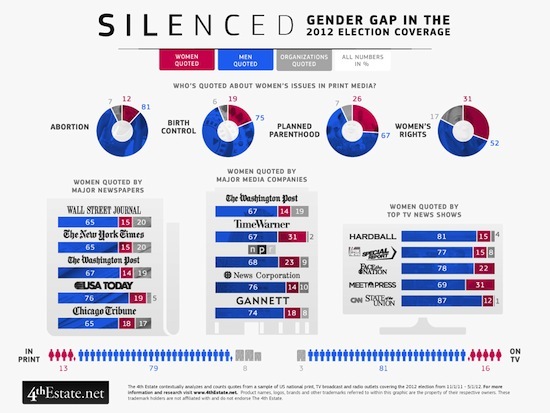
Who speaks for women?

In the Land of the Free and the Home of the Brave, it is men who speak for women, by an overwhelming majority.  At least in the mainstream media.  Via dailykos.com

Thursday, May 31, 2012

White Dawn

White Dawn by macgupta
White Dawn, a photo by macgupta on Flickr.

Lime Sublime

Lime Sublime by macgupta
Lime Sublime, a photo by macgupta on Flickr.

The lack of detail on the flower is simply the way the flower looks.

Thursday, May 24, 2012

The Name of the Rose

20120520-_MG_480520120520-_MG_480620120520-_MG_4807

Garden - May 20, 2012, a set on Flickr.

Damaged by pests, weather and deer, this is the first flower in two years. I don't remember its name. Perhaps Tahitian Sunrise - but it doesn't match pictures of that on the web. Anyway, the rose itself vanished the next day, likely eaten by a deer. The plant remains, but is sickly and weak.

Sunday, May 20, 2012

J.P. Morgan's losses tied to environmental degradation

Connecting the dots from the New York Times:

On the excess of deer in the Northeast :

"By 1900, deforestation and unregulated hunting had reduced deer populations in the Eastern United States to tiny remnant clusters surviving in remote sanctuaries. But subsequent protective laws and aggressive habitat management allowed deer to bounce back.

To this day, wildlife managers slice intact forests into sunny woodlots that maximize the number of deer and the frequency of encounters between deer and hunters. Private landowners are encouraged by wildlife agencies to crisscross their forest acreage with tasty plantings of clover and wheat in support of what is now a burgeoning population of perhaps 50 million white-tailed deer — in some places as many as 75 deer per square mile. 

....Less appreciated, though, is how these millions of deer are quietly eating every palatable leaf within their reach across the eastern forests of North America. That’s very bad news for migratory birds." 


----

Deer act as hosts for the ticks that carry Lyme disease.   The ticks get their Lyme disease bacteria from small mammals like mice and chipmunks.  While reducing deer would help, some argue that  reducing mice is likely to be more effective.
This is best accomplished by allowing natural predators like weasels, coyotes, foxes, and owls to do the job. And the best way to increase their numbers is to maximize the size of forest patches.
-----
Nevertheless, deer are the focus of this research:
A three-year experiment in tick control in two areas of Long Island — Shelter Island and western portions of Fire Island — has shown encouraging results.
Researchers from Cornell University installed and monitored dozens of “four-poster” feeding stations, which lure deer to a bin baited with corn and rigged with rollers soaked with a tick-killing pesticide, permethrin. When a deer rubs against the rollers, ticks die by the thousands. One station can treat all the deer in about 100 acres. 

New York had banned four-poster devices because feeding wild deer makes them congregate, which increases the risk of spreading chronic wasting disease. The Department of Environmental Conservation approved the experiment for these confined areas, where Lyme infections were severe and chronic wasting disease unknown.
How it all ties in to the losses at  J.P. Morgan:

Ever since JPMorgan Chase disclosed a multibillion-dollar trading loss this month, the central mystery has been how a bank known for its skill at risk management could err so badly.

As early as 2010, the senior banker who has been blamed for the debacle, Ina Drew, began to lose her grip on the bank’s chief investment office, according to current and former traders. She had guided the bank through some of the most rugged moments of the 2008 financial crisis, earning the trust of Jamie Dimon, JPMorgan’s chief executive, in the process. 

But after contracting Lyme disease in 2010, she was frequently out of the office for a critical period, when her unit was making riskier bets, and her absences allowed long-simmering internal divisions and clashing egos to come to the fore, the traders said. 

The morning conference calls Ms. Drew had presided over devolved into shouting matches between her deputies in New York and London, the traders said. That discord in 2010 and 2011 contributed to the chief investment office’s losing trades in 2012, the current and former bankers said.

Religious Freedom in the USA!

A letter in the NYTimes:

Cherokee Tribal membership is based upon direct Cherokee ancestors who 1. agreed to accept a tribal roll number and 2. dissolve the Cherokee Nation through the Dawes Commission, 3. accept a small allotment of land, 4. give up their religion under the adjunct American Indian Religious Crimes Codes of 1883. Cherokee Nation members who refused to accept the dissolution, take their small allotment and give up their religion did not have roll numbers. Their ancestors are not eligible for tribal membership and after the Bush I, "American Indian Arts and Crafts act," (limited to enrolled members), must call themselves of "Cherokee Descent" and cannot market their work as Cherokee, nor are they eligible for traditional religious approval conferred by a new Cherokee Nation that is largely converted.

Elizabeth Warren was 23 when the American Congress finally gave American Indians the right to practice their religion (1978) You have no idea what that meant to us. I was 37 at the time. But all over America, native children were harassed for returning to their faith and their culture. They were told that there were no longer traditional Indian religions and dress and that real Indians didn't dress or worship that way anymore.
This is a shameful record, and not very different from the all-devouring Christianity in Europe and Islam elsewhere.

Saturday, May 19, 2012

On the genetic roots of human disease

The New York Times carried this intriguing report by Nicholas Wade.

In brief: the theory used to be that some genetic mutations exert their bad effects only late in life, after people have had their children, and so were not eliminated by natural selection.  So some small set of common variants of genes were taken to underlie various diseases, and there was a hope that understanding the genes would lead to understanding the disease and from that to effective methods of treatment.

But improvements in genomics seems to show that very large numbers of rare genetic mutations are responsible for diseases.  So the situation is lots of genetic variants lead to common diseases, i.e., many different causes lead to similar effects.  The downside of this new understanding is that interpreting our genes is more difficult that we had hoped, that understanding and treating diseases influenced by genes is going to be hard.

At a meta level, it is interesting how such a simple and satisfying theory, and very respecting of Ockham's Razor,  is likely to be wrong.

Rahat Fateh Ali Khan: Disaster at Avery Fisher Hall

Ustad Rahat Fateh Ali Khan has a wonderful voice.  You wouldn't have known it if you attended the concert at the Lincoln Center in New York - the Avery Fisher Hall.   The Avery Fisher Hall is known to be somewhat mediocre, acoustically speaking, but that was not the problem.

Firstly, the artiste had a cold, as evidenced by the piles of tissues he periodically applied to his nose.  Maybe a sore throat too.    Also for some reason, he sang at a faster tempo than the compositions called for, like an express train. But even with that, when you could catch it, his voice was wonderful.  But you could get it only in bits and snatches, when the musical accompaniment was mostly silent and when his voice was low.

What was wrong?  Whomever the sound engineers were for this program were among the lousiest I have ever encountered (and that includes amateur nights at college).   They over-amplified the sound so that (and others said so independently) it sounded like baaraath music (the marriage procession in India, that blares out on cheap loudspeakers music so loud you may not know what song is being played.  The main purpose there is to simply have loud attention-gathering noise.)  On top of that, there was a heavy bass.  The railing in front of my seat, the seat armrests, even the seat cushion reverberated in that low frequency din.  In fact, all the instruments were overloud.  So you could hear the Ustad only in the quiet passages or if you held your hands tightly over your ears.

Since the organizers of these programs are interested in the money, not in the music, and because someone or the other is going to fill the seats for these scarce shows, I don't think this will be remedied unless the artist himself insists on it.  Or it has to be a matter of pride for the organizers. 

It so happens that just six days ago, I also attended a Kailash Kher concert (in Washington DC, the Lisner Auditorium at George Washington University) and that was a great event.  No such issues, the electronics was, in a sense, imperceptible, as it should be.   The sound was natural except if you paused to think how it could fill such a large hall.

I think unless it is a small private performance, it doesn't matter how good the musician is if the technical support is mediocre.

---

Neither concert began on time.  The Kailash Kher concert began about twenty minutes late, the Rahat Fateh Ali Khan a bit over half-an-hour.   The Lincoln Center made a valiant attempt to get people in by the starting time of 8:30 PM.  Nothing doing,   The doors remained open, and people walked down the aisle, and up the aisle and down the aisle.   From my vantage point in a box, it was the familiar sight, that this was a social occasion, people shaking hands, hugging and kissing, as they moved down from the entrance to their seats.    And while I think desis manage to stick to their seats during movies, here there was a constant flow of people throughout the concert.   I saw the usher showing somebody their seats an hour and twelve minutes after the concert began.   I guess those guys were smart, they didn't really miss much.

The organizers of the Kher concert did apologize for starting late, and mentioned that they are trying to do better.  With the customers they have, it is hard to do.  I don't know if any of the organizers of the Rahat Fateh Ali Khan said anything, a lot of what they said I couldn't parse, their sound was terrible too.

If you love Indian music, then apart from such acoustic disasters as described above, you should be able to identify the greatest enemy of enjoying the show - the Indian socialite who considers attending such an event to be a fashion statement.  There is no statement of disgust that is adequate.

---

PS: The Bhangra Blowout that I attended in D.C., organized by students of G.W.U., and where the music is supposed to have a heavy beat, had better sound quality and clarity than the atrocity perpetrated on Rahat Fateh Ali Khan at the Lincoln Center.

Thursday, May 17, 2012

Obama, the big spender?

As per this ThinkProgress article, when Obama took office, the federal annual spending was set to be 24.9% of GDP - and this was Bush's budget. For fiscal 2012, the federal annual spending is expected to be 23.4% of GDP.

In 2009, total federal tax revenue was projected to be 16.5% of GDP. In 2012, it is 15.8% of GDP.

Likewise, the 2009 deficit was projected to be 8.3% of GDP. For 2012, it is 7.6% of GDP.

Wednesday, May 16, 2012

The Bechdel Test for Women in Movies

Via Tazeen: Such a simple test, so many movies fail it!


If you can't view the youtube video, then here:

The Bechdel Test, sometimes called the Mo Movie Measure or Bechdel Rule is a simple test which names the following three criteria: (1) it has to have at least two women in it {who have names}, (2) who talk to each other, about (3) something besides a man.

Garden - May 16, 2012

20120516-_MG_424620120516-_MG_424720120516-_MG_424920120516-_MG_425020120516-_MG_425220120516-_MG_4253
20120516-_MG_425520120516-_MG_425620120516-_MG_425720120516-_MG_425820120516-_MG_425920120516-_MG_4260
20120516-_MG_426220120516-_MG_4263

Garden - May 16, 2012, a set on Flickr.

Some hurried shots to record the state of the garden.

Tuesday, May 15, 2012

Education in India

V. sent me this:
An intriguing recent book by Columbia's Stuart Firestein (a neurologist, but he has been teaching a broader course on this subject) titled Ignorance: How it Drives Science posits that it is not the acquisition of facts, but the ability to know what one does not know that drives the spirit of inquiry, and thus makes any progress possible. Naturally, by this measure there will be absolutely no innovation coming out of India. And that in fact is the case by and large.

 from an article by Rajeev Srinivasan on India’s educational system at rediff.com - http://www.rediff.com/news/column/rethinking-education-in-india/20120510.htm 

Thursday, May 10, 2012

Spring

20120506-_MG_4215

Sunday, May 06, 2012

QOTD

Paul Krugman: "The problem with digital books is that you can always find what you are looking for but you need to go to a bookstore to find what you weren’t looking for."

Focus stacking

iris_stacked

A first try at focus stacking, following Rajan Parrikar's suggestion. Used was the Canon 5d2 with the 100mm macro, the individual shots were obtained by varying the autofocus point among the 9 choices that Canon provides.  Each individual shot was at ISO 400, f/11, 1/30 seconds (which is what the available lighting dictated).  The slight breeze was a confounding factor.

This simple tutorial on youtube is what I followed.


However, I still have a lot to learn, because while the full sized stacked image was fine, when I tried to crop it or resize it, it developed annoying artifacts - little white lines running horizontally or vertically. I finally saved it as a full size jpeg, and then trimmed off the edges of the frame as a jpeg, resized, and here it is. In this size, the effect of focus stacking may not be clear, but in each of the individual shots only part of the beard of the iris was in focus, in the composite image, all of it is in focus.